



HIndex-FLSM_Fragmented_Log-Structured_Merge_Trees_Integrated_with_Heat_and_IndexHIndex-FLSM:分段日志结构合并.pdf
免费下载

HIndex-FLSM: Fragmented Log-Structured Merge
Trees Integrated with Heat and Index
1
st
Xiaopeng Wang
Shenzhen Graduate School
Peking University
Shenzhen, China
wangxp@stu.pku.edu.cn
4
th
Xiyu Wang
ZTE Corporation
Shenzhen, China
wang.xiyu@zte.com.cn
2
nd
Hui Li*
Shenzhen Graduate School
Peking University
Shenzhen, China
lih64@pkusz.edu.cn
5
th
Ping Lu
ZTE Corporation
Shenzhen, China
lu.ping@zte.com.cn
3
rd
Hong Tan
Shenzhen Graduate School
Peking University
Shenzhen, China
hongtan@stu.pku.edu.cn
6
th
Han Wang
Shenzhen Graduate School
Peking University
Shenzhen, China
wanghan2017@pku.edu.cn
Abstract—Log-Structured Merge Tree (LSM-tree) is
commonly used for building high-performance persistent key-
value stores. However, they are known to suffer from severe I/O
amplification. To mitigate this issue, structures like Fragmented
Log-Structured Merge Trees (FLSM-tree) have been developed,
which leverage tiering merge policies to reduce write
amplification. Nevertheless, FLSM-tree fails to consider data
access frequency, access times, and other heat-related
information. Additionally, the Sorted String Table(SSTable) in
each level may not necessarily be ordered, leading to diminished
read and range query performance. To address these issues, we
have proposed a high-performance key-value storage structure,
tailored specifically for read/write-intensive workloads, called
HIndex-FLSM. This structure employs a heat calculation
mechanism for cold and hot data segregation and enhances read
performance by indexing Guard. The compaction process has
also been optimized by combining heat and ordered indexing.
To evaluate the performance of HIndex-FLSM, we have
implemented the prototype system of HIndex-FLSM, called
HIndex-PebblesDB, based on the prototype system PebblesDB
of FLSM-tree. Through benchmark testing of HIndex-
PebblesDB, we observed an approximately 20% improvement
in hot spot read and 57% in range query compared to
PebblesDB.
Keywords—key-value database,log-structured merge tree,
index, tiering merge policy
I. INTRODUCTION
According to the International Data Corporation (IDC)
report, China's data volume is expected to reach a staggering
30.02ZB in 2023, and an estimated 76.6ZB by 2027, owing to
the rise of cloud computing and the artificial intelligence
industry. Due to the significant portion of unstructured data in
the current data landscape, traditional relational databases
exhibit inflexibility in handling such data. As a result, various
non-relational storage systems have emerged, with key-value
storage systems[3,4] simplifying the data processing model by
employing key-value pairs for data access. This simplistic data
processing model provides high system scalability, facilitating
the construction of distributed storage systems to meet the
demands of handling large data volumes.
Within data-intensive systems, LSM-tree[1] is frequently
used as the core indexing structure[5,6] for persistent key-
value databases and is utilized in popular storage engines such
as LevelDB[7], RocksDB[8], HBase[9], and Cassandra[10].
The LSM-tree leverages the deferred persistence of write
requests in memory, which are then batch-processed into
sequential writes on persistent storage. This takes advantage
of the random read-write speeds in memory and the high
sequential write bandwidth in persistent storage. Therefore,
the LSM-tree is an effective solution for persistent key-value
storage in data-intensive systems.
LSM-tree continues to bear persistent issues that arise
from the differences in characteristics and speed between
persistent storage and memory, as well as inherent design
trade-offs. The most prominent of these issues is write
amplification. Write amplification refers to the volume of data
written exceeding the data intended for application writing. It
results in reduced lifespan of Solid State Drive (SSD), a
popular storage medium, and subsequent increase in
application cost overhead.
It's fascinating to see the recent developments in
partitioned tiering merge policy[11] that aim to improve write
performance. The Lightweight Compaction Tree (LWC-tree)
[12] adopts a similar partitioned tiering design and vertical
grouping. It further introduces a method to achieve workload
balancing for SSTable groups. PebblesDB proposes a data
layout structure based on a log-structured merge tree, called
FLSM-tree[2]. The FLSM-tree avoids SSTable rewriting
during compaction, significantly reducing write amplification.
dCompaction [13] introduces the concepts of virtual SSTables
and virtual merges to reduce the frequency of merges.
However, the lack of order among SSTable files within
each Guard adversely affects the system's read performance.
Therefore, using FLSM-tree to build a system necessitates
additional read optimization measures to minimize its impact
on system read performance.To mitigate the impact of FLSM-
tree on system read performance, we propose a high-
performance key-value storage structure suitable for read-
write intensive workloads, called HIndex-FLSM. HIndex-
FLSM is built upon the FLSM-tree structure and employs a
heat calculation mechanism for data segregation. It enhances
read performance by establishing indexes for Guards and
further optimizes the overall system performance by
integrating ordered indexing into the FLSM-tree's compaction
process. We have implemented a prototype of HIndex-FLSM,
named HIndex-PebblesDB, on PebblesDB. Test results
indicate a significant improvement in read performance under
read-intensive workloads when compared to PebblesDB.
The main structure of our paper is as follows: In Section
II, we introduced LSM-tree and FLSM-tree. Following that,
in Section III, we described the design and implementation of
71
2024 3rd International Joint Conference on Information and Communication Engineering (JCICE)
979-8-3503-8872-5/24/$31.00 ©2024 IEEE
DOI 10.1109/JCICE61382.2024.00024
2024 3rd International Joint Conference on Information and Communication Engineering (JCICE) | 979-8-3503-8872-5/24/$31.00 ©2024 IEEE | DOI: 10.1109/JCICE61382.2024.00024
Authorized licensed use limited to: ZTE CORPORATION. Downloaded on November 26,2024 at 04:23:11 UTC from IEEE Xplore. Restrictions apply.
our proposed HIndex-FLSM structure. In Section IV, we
experimentally validated the performance of the prototype
implementation HIndex-PebblesDB for HIndex-FLSM.
II. RELATED WORK
As data accumulates, the query performance of the LSM-
tree can decline due to the growing number of components in
the disk. To address this issue, the components in the disk
gradually merge to reduce the overall count. Two primary
merging strategies are typically used in practice, namely the
horizontal merge policy and the tiering merge policy. Most
LSM-tree implementations use a well-known optimization
technique called Partitioning. Partitioning involves dividing
the disk components of the LSM-tree into multiple small
partitions, usually fixed in size. Both leveling merge and
tiering merge strategies can be employed to support
partitioning. However, the use of the horizontal partitioning
merge strategy in LSM-tree structures leads to severe write
amplification. This issue is illustrated using LevelDB as an
example of the horizontal merge strategy, while the FLSM-
tree demonstrates how the tiered partition merge strategy
reduces write amplification.
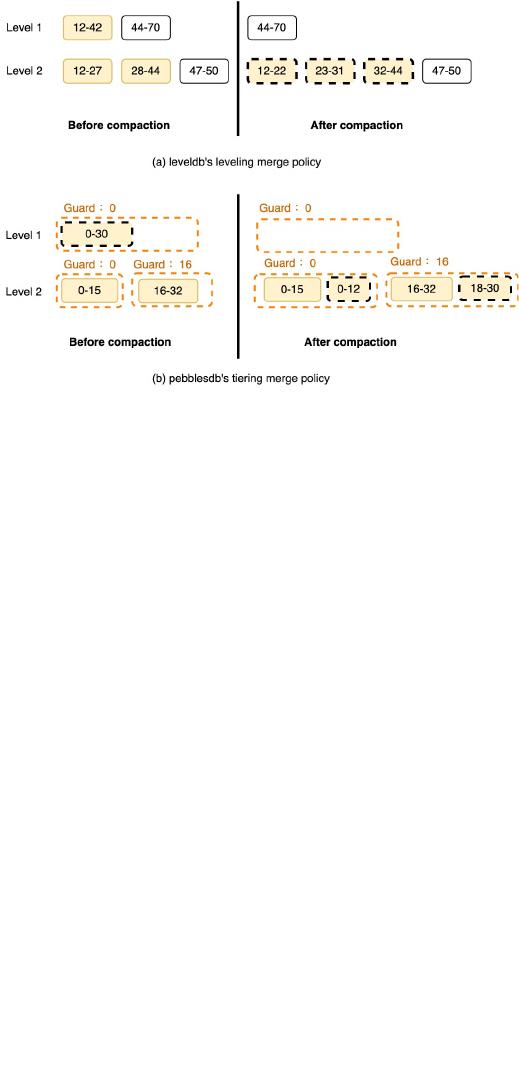
In the partitioning leveling merge policy pioneered by
LevelDB, each level's disk components are divided into
multiple fixed-sized SSTables, and each SSTable has key
range markings. To merge an SSTable from Level L into
Level L+1, all overlapping SSTables at Level L+1 are selected
and merged with the corresponding SSTable from Level L,
generating new SSTables that remain in Level L+1. As shown
in Figure 1a, the SSTable marked as 12-42 at Level 1 is
merged with the SSTables marked as 12-27 and 28-44 at Level
2, resulting in new SSTables marked as 12-22, 23-31, and 32-
44 at Level 2. In this horizontal partitioning merge strategy,
merging from lower to upper levels may impact multiple
SSTables in the upper level, necessitating read and write
operations for all these SSTables, leading to significant write
amplification.
The FLSM-tree is an improvement over LSM-tree and
effectively reduces the write amplification effect. It exhibits
low write amplification, high write throughput, and excellent
read performance under write-intensive workloads compared
to the original LSM-tree structure.
Fig. 1. The compaction process of LevelDB and PebblesDB.
The FLSM-tree is a combination of LSM-tree and skip-list
structures[14], with each level being divided into multiple
Guards. SSTables are enclosed within Guards at different
levels, and Guards within the same level are ordered by
attribute values in an ascending sequence, with no intersection
of key values between different Guards. Interestingly, queries
in an FLSM-tree are directed to a Guard through binary search,
unlike LSM-tree, which locates an SSTable within each level.
The compression process of SSTables in the FLSM-tree
is different from LSM-tree, as SSTables are compressed on a
per-Guard basis. As shown in Figure 1b, when the number of
SSTables within a Guard reaches a certain threshold, the
system triggers data compression on that Guard. All SSTables
within the Guard are merged, and the new SSTable created
directly enters the corresponding Guard in the next level. This
optimization ensures that data in the lower-level table files are
no longer rewritten, and data within the same level is rewritten
only once during the merge, avoiding multiple rewrites caused
by higher-level table file compression. This optimization
significantly reduces write amplification in FLSM-tree under
typical workloads compared to LSM-tree.
Upon studying the FLSM-tree structure, it was noted that
although it effectively reduces write amplification and
exhibits high write throughput, it suffers from relatively poor
read performance. Additionally, considerations related to data
access frequency and access time were overlooked during read
and write processes and the compaction process. Based on this,
t this paper proposes a series of optimization strategies:
• Introduce a heat calculation method[15] based on the
FLSM-tree structure. By incorporating heat values,
partitioning Guards in the FLSM-tree based on heat
levels can enhance read performance without
compromising the high write throughput and low write
amplification of the FLSM-tree.
• Add ordered indexes[16,17] to Guards with higher
heat levels. This mechanism offers benefits such as
significantly improving single-point query
72
Authorized licensed use limited to: ZTE CORPORATION. Downloaded on November 26,2024 at 04:23:11 UTC from IEEE Xplore. Restrictions apply.
of 6
免费下载
【版权声明】本文为墨天轮用户原创内容,转载时必须标注文档的来源(墨天轮),文档链接,文档作者等基本信息,否则作者和墨天轮有权追究责任。如果您发现墨天轮中有涉嫌抄袭或者侵权的内容,欢迎发送邮件至:contact@modb.pro进行举报,并提供相关证据,一经查实,墨天轮将立刻删除相关内容。
下载排行榜

文档被以下合辑收录
评论