



【李国良论文】Vector Database Management Techniques and Systems.pdf
免费下载
Vector Database Management Techniques and Systems
James Jie Pan
jamesjpan@tsinghua.edu.cn
Tsinghua University
Beijing, China
Jianguo Wang
csjgwang@purdue.edu
Purdue University
West Lafayette, Indiana, USA
Guoliang Li
liguoliang@tsinghua.edu.cn
Tsinghua University
Beijing, China
ABSTRACT
Feature vectors are now mission-critical for many applications, in-
cluding retrieval-based large language models (LLMs). Traditional
database management systems are not equipped to deal with the
unique characteristics of feature vectors, such as the vague notion
of semantic similarity, large size of vectors, expensive similarity
comparisons, lack of indexable structure, and diculty of answering
“hybrid” queries that combine structured attributes with feature vec-
tors. A number of vector database management systems (VDBMSs)
have been developed to address these challenges, combining novel
techniques for query processing, storage and indexing, and query
optimization and execution and culminating in a spectrum of perfor-
mance and accuracy characteristics and capabilities. In this tutorial,
we review the existing vector database management techniques and
systems. For query processing, we review similarity score design
and selection, vector query types, and vector query interfaces. For
storage and indexing, we review various indexes and discuss com-
pression as well as disk-resident indexes. For query optimization
and execution, we review hybrid query processing, hardware ac-
celeration, and distibuted search. We then review existing systems,
search engines and libraries, and benchmarks. Finally, we present
research challenges and open problems.
CCS CONCEPTS
• Information systems → Data management systems.
KEYWORDS
Vector Database, Vector Similarity Search, Dense Retrieval, 𝑘-NN
ACM Reference Format:
James Jie Pan, Jianguo Wang, and Guoliang Li. 2024. Vector Database
Management Techniques and Systems. In Companion of the 2024 Inter-
national Conference on Management of Data (SIGMOD-Companion ’24),
June 9–15, 2024, Santiago, AA, Chile. ACM, New York, NY, USA, 8 pages.
https://doi.org/10.1145/3626246.3654691
1 INTRODUCTION
High-dimensional feature vectors are now used in a variety of
dense retrieval search applications, including retrieval-based large
language models (LLMs) [
28
,
31
,
51
], e-commerce [
54
], recommen-
dation [
82
], document retrieval [
76
], and so on [
45
,
51
,
79
,
84
]. These
applications may involve billions of vectors and require millisecond
This work is licensed under a Creative Commons Attribution
International 4.0 License.
SIGMOD-Companion ’24, June 9–15, 2024, Santiago, AA, Chile
© 2024 Copyright held by the owner/author(s).
ACM ISBN 979-8-4007-0422-2/24/06.
https://doi.org/10.1145/3626246.3654691
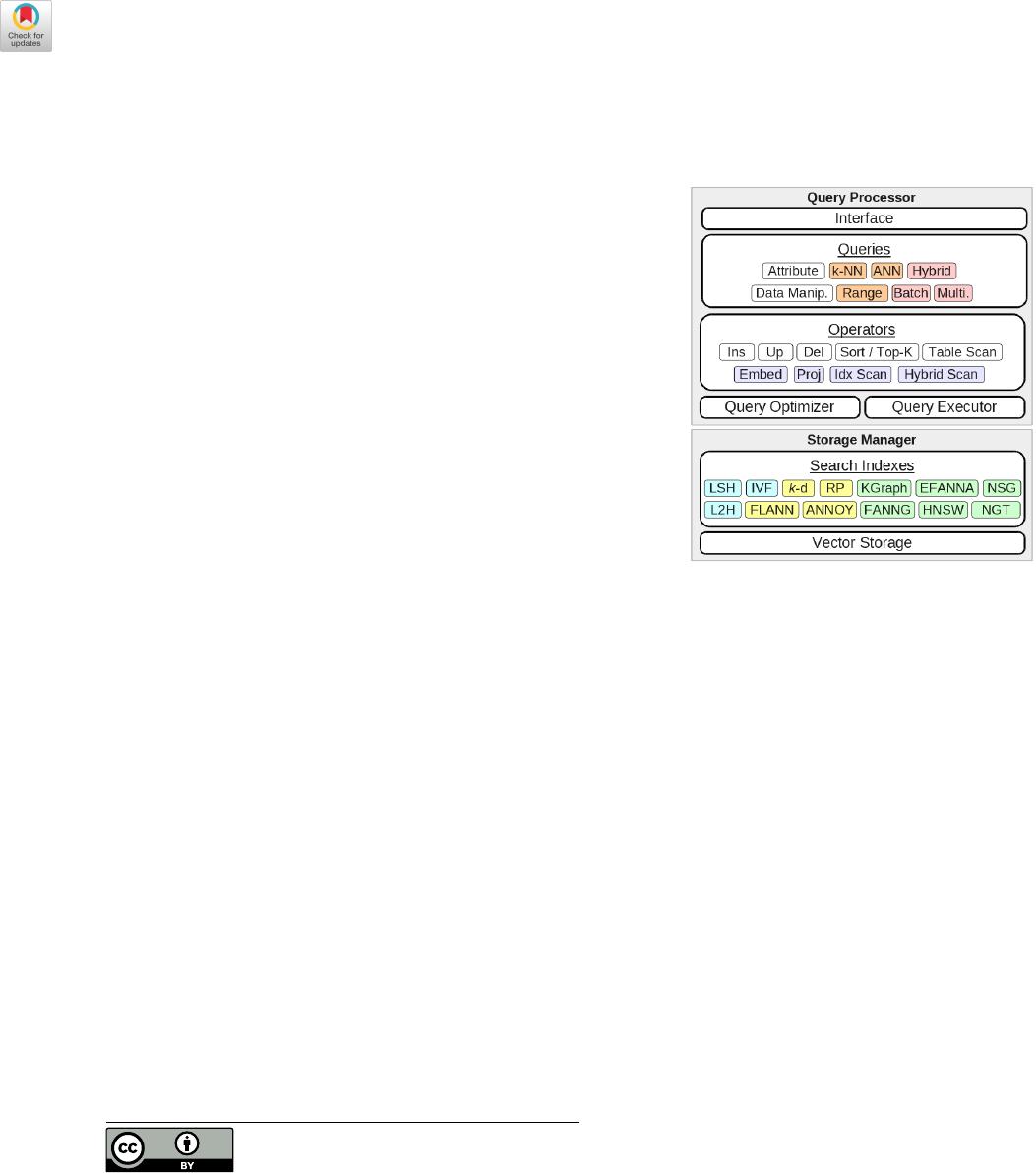
Figure 1: Overview of a VDBMS (Vector Database Manage-
ment System).
query latencies, all while needing to scale to increasing workloads
without sacricing performance or response quality.
But existing traditional database management systems, includ-
ing NoSQL and relational databases, are not designed for these
datasets and workloads. First, vector queries rely on the concept of
similarity which can be vague for dierent applications, requiring
a dierent query specication. Second, similarity computation is
more expensive than other types of comparisons seen in relational
predicates, requiring ecient techniques. Third, processing a vector
query often requires retrieving full vectors from the collection. But
each vector may be large, possibly spanning multiple disk pages,
and the cost of retrieval is more expensive compared to simple
attributes while also straining memory. Fourth, vector collections
lack obvious properties that can be used for indexing, such as being
sortable or ordinal, preventing the use of traditional techniques. Fi-
nally, “hybrid” queries require accessing both attributes and vectors
together, but it remains unclear how to do this eciently.
These challenges have led to the rise of vector database man-
agement systems (VDBMSs) specially adapted for these applica-
tions, and there are now over 20 commercial VDBMSs developed
within the past ve years. A typical VDBMS is composed of a query
processor and a storage manager (Figure 1). For the query proces-
sor, VDBMSs introduce new approaches to query interfaces, query
types such as
𝑘
-nearest-neighbor search, hybrid, and multi-vector
queries, and data operators such as similarity projection and hybrid
index scan. New techniques have also been proposed for query
597
SIGMOD-Companion ’24, June 9–15, 2024, Santiago, AA, Chile James Jie Pan, Jianguo Wang, and Guoliang Li
optimization and execution, including plan enumeration and se-
lection for hybrid query plans and hardware accelerated search.
For the storage manager, several techniques for large-scale vector
indexing and vector storage are now available, including hashing
and quantization-based approaches like
PQ
[
1
] and IVFADC [
49
]
that tend to be easy to update; tree-based indexes like FLANN [
62
]
and ANNOY [
2
] that tend to support logarithmic search complex-
ity; and graph-based indexes like HNSW [
58
] and others that are
ecient in practice but with less theoretical understanding. To-
gether, these techniques culminate into a variety of native systems,
extended systems, and search engines and libraries over a spectrum
of performance and accuracy characteristics and capabilities.
In this tutorial, we review techniques and systems for vector
data management along with benchmarks, followed by remaining
challenges and open problems.
Tutorial Overview. This tutorial contains three parts and the
intended length is 1.5 hours. The rst part discusses specic tech-
niques and will last 50 minutes.
(1) Query Processing (10 min.). Query processing begins with a search
specication that denes the search parameters. These include
considerations for similarity score design, score selection and the
curse of dimensionality [
22
,
30
,
61
], the query type such as basic,
multi-vector, and hybrid queries [79, 84], and the query interface.
(2) Storage and Indexing (30 min.). Vector indexes tend to rely on
novel partitioning techniques such as randomization, learned par-
titioning, and navigable partitioning. The performance, accuracy,
and storage characteristics of an index depend on the techniques
used and the index structure. We classify indexes into table, tree, or
graph-based, and then describe the techniques for each index type.
To deal with large size, we also discuss vector compression using
quantization [49, 59] and disk-resident indexes [32, 74].
(3) Optimization and Execution (10 min.). For processing hybrid
queries, several plan enumeration and plan selection techniques
have been proposed, including rule-based [
3
,
4
] and cost-based
selection [
79
,
84
], and which also introduce new hybrid operators
including block-rst scan [
43
,
79
,
84
,
87
] and visit-rst scan [
43
,
87
]. Several techniques also speed up vector search via hardware
acceleration using SIMD [
26
,
27
], GPUs [
50
], and distributed search.
To address slow index updates, some VDBMSs also rely on out-of-
place updates.
The second part discusses vector database management systems
and will last 30 minutes.
(1) Native Systems (10 min). Native systems such as Pinecone [
5
],
Miluvs [
6
,
79
], and Manu [
45
] aim at high performance vector
search applications by oering a narrower range of capabilities.
(2) Extended Systems (10 min). For applications that require more so-
phisticated capabilities, several extended systems such as AnalyticDB-
V [
84
], PASE [
90
],
pgvector
[
7
], and Vespa [
4
] have been developed
based on NoSQL or relational systems.
(3) Search Engines and Libraries (5 min). Several search engines such
as Apache Lucene [
8
] and Elasticsearch [
9
] now also incorporate
vector search capability via integrated vector indexes. Several li-
braries are also available such as Meta Faiss [
1
] that provide vector
search functionality.
(4) Benchmarks (5 min). We describe two notable benchmarks that
evaluate a wide variety of search algorithms and systems over a
range of workloads [29, 91].
The nal part discusses challenges and open problems (10 min.).
We describe several fundamental challenges, including how to per-
form similarity score selection, design more ecient hybrid oper-
ators and indexes, and estimate the cost of hybrid plans. We also
describe future applications, including index-supported incremental
search, multi-vector search, and enhancing security and privacy.
Target Audience. This tutorial is intended for database researchers
interested in understanding and advancing the state-of-art tech-
niques for large-scale vector database management and modern
applications beyond similarity search. This tutorial may also ben-
et industry practitioners interested in learning about the latest
commercial systems. There are no prerequisites beyond a basic
understanding of database concepts.
Related Tutorials. A recent tutorial [
28
] discusses how vector
search can be used for retrieval-based LLMs. There are also separate
tutorials on similarity search techniques [37, 67, 68].
Our tutorial aims to complement these tutorials by focusing
on vector database management systems as a whole, and most of
this tutorial has not been covered elsewhere. Specically, most of
the overlap is conned to Section 2.2, and the extent is not large.
In [
37
], a broad taxonomy of search techniques is given, along
with representative examples. Similarly in [
67
,
68
], an overview of
various exact and approximate search techniques is given. Some
of the material in Section 2.2, mainly locality-sensitive hashing,
learning-to-hash, ANNOY, and HNSW, overlaps with these past
tutorials. But Section 2.2 also discusses key indexing trends in
VDBMSs that have not been discussed in past tutorials, including
disk-based indexes, quantization-based compression approaches for
handling large vector collections, and the diversity of graph-based
indexes. Aside from this section, all other sections in this tutorial
have not been covered elsewhere as they pertain to the VDBMS
as a whole, including query processing, hybrid operators, plan
enumeration, and plan selection, and a survey of existing VDBMSs.
2 TUTORIAL
2.1 Query Processing
Similarity Scores. Dense retrieval works based on similarity. A
similarity score can be used to quantify the degree of similarity be-
tween two feature vectors. While many scores have been proposed,
dierent scores may lead to dierent query results, and so how to
perform score selection is an important problem for VDBMSs, in
addition to score design.
(1) Score Design. A similarity score is designed to accurately capture
similarity relationships between feature vectors. Existing similarity
scores can be classied as basic scores, aggregate scores, and learned
scores. Basic scores are derived directly from the vector space and
include Hamming distance, inner product, cosine angle, Minkowski
distance, and Mahalanobis distance. For certain workloads involv-
ing multiple query or feature vectors per entity, aggregate scores
such as mean, weighted sum, and others [
79
] combine multiple
scores into a single scalar score that can be more easily compared.
598
of 8
免费下载
【版权声明】本文为墨天轮用户原创内容,转载时必须标注文档的来源(墨天轮),文档链接,文档作者等基本信息,否则作者和墨天轮有权追究责任。如果您发现墨天轮中有涉嫌抄袭或者侵权的内容,欢迎发送邮件至:contact@modb.pro进行举报,并提供相关证据,一经查实,墨天轮将立刻删除相关内容。
下载排行榜

评论