



IDCE2024-qos Personalized PageRanks over Dynamic Graphs– The Case for Optimizing Quality of Service.pdf
免费下载
Personalized PageRanks over Dynamic Graphs
– The Case for Optimizing Quality of Service
Zulun Zhu
Nanyang Technological University
ZULUN001@e.ntu.edu.sg
Sibo Wang
The Chinese University of Hong Kong
swang@se.cuhk.edu.hk
Siqiang Luo
Nanyang Technological University
siqiang.luo@ntu.edu.sg
Dingheng Mo
Nanyang Technological University
dingheng001@e.ntu.edu.sg
Wenqing Lin
Tencent
edwlin@tencent.com
Chunbo Li
Nanyang Technological University
chunbo001@e.ntu.edu.sg
Abstract—We study the problem of Quality-of-Service (QoS)-
Aware Personalized PageRank (PPR) computation. Existing stud-
ies mostly focus on improving the PPR query processing time.
However, the query processing time alone may not reflect the ser-
vice quality in real-world PPR-based systems. The query response
time can be a more service-relevant measure in many applications
such as the online game service of Tencent and the related-
pin recommendation module of Pinterest. We make the first
attempt at studying QoS-Aware PPR computation and present
Quota, a system that adapts the state-of-the-art PPR algorithms
to a given environment for minimizing query response time.
Equipped with mathematical tools including queuing theory,
algorithmic complexity analysis, and constrained optimization,
Quota is designed to adapt itself to a wide spectrum of workloads.
We conduct extensive experiments on real datasets and show that
Quota can reduce the query response time compared with state-
of-the-art PPR algorithms, often by a significant margin.
I. INTRODUCTION
Given a source node s and a target node t in a graph, the
Personalized PageRank (PPR) π(s, t) reflects the probability
that a random walk starting from node s terminates at node t.
PPR is a fundamental proximity measure between two nodes in
graphs, and it has been widely adopted in various applications
such as the Whom-to-Follow service of Twitter [1], the game
service of Tencent [2], and the related-pin recommendation of
Pinterest [3]. As real-world graphs (e.g., in the aforementioned
applications) are dynamically evolving with edge inserts or
deletes, it becomes increasingly important to study efficient
PPR queries on dynamic graphs [4].
When performing PPR queries in dynamically evolving
graphs, it is an intrinsic requirement to simultaneously process
PPR queries and data updates. The data update is not only
about updating the graph but may also involve updating the
index built to facilitate queries. For example, Pinterest uses
PPR queries on its underlying user-item preference graph to
support related-pin recommendations for users, and each page
visit will trigger a PPR query. According to the reports [5],
Pinterest has thousands of page visits per second, demon-
strating a high query workload. Meanwhile, the extensive
user base in Pinterest can lead to frequent updates in the
preference graph, which happens in the same duration as
queries, and ultimately forms a mixture workload of queries
Queries
Updates
Queue
time
time
time
Total time
Fig. 1. Timeline of query and update arrivals, as well as the status of the
queue.
and updates. As another example, the online gaming service
of Tencent [6] uses PPR values to measure the proximity
between two game players, where the PPR query is computed
on a game player network formed by players (nodes) and
player interactions (edges). To avoid customer attrition, an
incentive strategy based on PPR has been proven effective in
Tencent [6]. Frequently, a PPR query is issued at the node of
an active player (who regularly uses the service) to sort their
proximity to other inactive players. Those highly-approximate
but inactive players will receive an invite-back message from
the active player. Meanwhile, while applying the incentive
strategy, the player network evolves fast and leads to a mix-
load of PPR queries and data updates. In summary, in real-
world applications based on PPR measures, the workload often
consists of a series of PPR queries and data updates, which
may arrive in a stochastic manner.
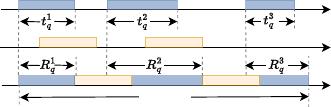
In these applications, when the queries and updates arrive
at the system faster than their processing speed, they line up
and form a queue, as shown in Figure 1. The function of the
queue is to ensure that the queries and updates are processed
in a first-come-first-served (FCFS) manner, which is crucial to
guarantee the query accuracy [4], scheduling fairness [7], and
user fairness [8], [9]. In this queuing context, one important
measure to be optimized is the query response time, which
refers to the amount of time taken between the query’s arrival
at the system and the time at which the query’s answer is
computed, also illustrated as R
q
in Figure 1. Query response
time is not only determined by the exact query processing
time t
q
and the processing total time but is also influenced by
the query/update queuing status. To explain, before a query
can be executed, its previous updates on the graph or indexes
have to be enforced, which can incur a significant cost. Hence,
there exists the contention of CPU time between query and
update processing, which often leads to an imbalance of
computing resource allocation between queries and updates.
As the contention intensifies, the user waiting time for queries
can be extended, resulting in lengthy query response time
for the users. In a high-load situation, the queue builds up
quickly, and the response time of a query can be significantly
exaggerated, impacting user satisfaction. Therefore, the query
response time closely reflects the Quality-of-Service (QoS) to
the user in a PPR-based application.
The problem: QoS-Aware PPR Computations. Despite the
importance of queue-based PPR query response time opti-
mization in practical applications, most of the existing PPR
algorithms [10], [11], [12], [13], [14], [15], [16] focus on a
stand-alone PPR query or update, as reviewed in Section III.
However, the query response time does not solely depend
on query or update processing time, but is more related to
the behavior combination of PPR queries and data updates
in a waiting queue, as we discussed earlier. In this paper,
we make the first attempt at PPR computation with a focus
on optimizing the query response time for single-source PPR
(SSPPR) queries or top-k PPR queries over dynamic graphs,
and we name the problem as QoS-Aware PPR Computation.
In particular, given any PPR query and update arrival rates, we
aim to design an algorithmic framework that can adapt itself
to suit the workload in producing a reasonable average query
response time.
QoS-Aware PPR computation is a non-trivial problem. First,
directly applying the state-of-the-art PPR query algorithms
(e.g., Agenda [4], FORA [13]) does not ensure a reasonable
query response time, because they mainly optimize for a
shorter query time at the expense of update time (e.g., updating
index structures). As we have argued, faster query processing
is not necessarily translated into a shorter query response time.
Second, the workload of PPR queries and graph updates may
change over time in recommendation systems. However, the
mainstream PPR algorithms often entail many hyperparam-
eters, making it difficult to set justifiable parameters under
different workloads.
These challenges motivate us to design Quota,
1
a system
that aims to optimize PPR query response time for a wide
spectrum of query and update workload configurations. We
emphasize several main design philosophies of Quota. First,
our purpose is not to design a faster PPR query algorithm
than existing ones which are already close to the optimum
in many aspects due to the promising development in recent
decades. Instead, given the maturity of the PPR algorithms, it
can be more important to design an algorithmic framework to
accommodate some state-of-the-art PPR algorithms as base
algorithms and allow them to be transparently adapted for
optimizing query response time. In this paper, we discuss three
base algorithms: Agenda [4], FORA [13], and SpeedPPR [16],
because Agenda [4] is the state-of-the-art dynamic PPR al-
gorithm, FORA [13] is a representative PPR algorithm that
motivates many later algorithms, and SpeedPPR is one of the
1
Quality of Service Optimization for Personalized PageRank over Evolving
Graphs
most query-efficient PPR algorithms in static graphs. Second,
the design of Quota integrates several different branches
of mathematical tools including queuing theory, constrained
optimization, and complexity analysis. Particularly, Quota ab-
stracts the tuning parameters of a typical PPR query framework
and builds a mathematical relationship between the parameters
and the real cost. It then incorporates an in-depth queuing
model to facilitate the transformation of the problem into a
constrained optimization problem. We also design algorithms
to solve the optimization problem to precisely determine the
most suitable parameters for the given workload.
We summarize our main contributions as follows:
• Problem Formulation. We define the problem of QoS-
Aware PPR optimization, which reflects the issues when
applying PPR measures in practical recommendation systems.
The problem is significantly different from the existing PPR
optimization problems which optimize a stand-alone PPR
query or update.
• Auto-Configuration System. We present Quota, a con-
figuration system that can be deployed with some state-of-
the-art PPR algorithms to optimize the query response time.
Quota is an auto-configuration system to enhance the state-of-
the-art approach in adaptability to various query and update
workloads. Quota can be applied to four recent state-of-the-art
algorithms, namely, Agenda [4], FORA [13], SpeedPPR [16],
and TopPPR [17]. To the best of our knowledge, Quota is the
first configuration system that aims to optimize the PPR query
response time for PPR-based systems.
• Reordering Algorithm. In order to further optimize the
query response time, Quota further allows violation of the
FCFS queuing policy with controllable shuffling of the queries
and updates, without affecting the accuracy guarantees. This
forms the reordering algorithm named Seed.
• Extensive Experiments. We have conducted extensive
experiments in various real datasets and settings. Our results
demonstrate that Quota can achieve up to 86%, 40%, 34%,
50% and 33% shorter response time than the state-of-the-
art PPR algorithms Agenda, FORA, SpeedPPR, FORA-TopK
and TopPPR respectively, if deployed with the corresponding
algorithm.
II. PROBLEM DEFINITION
A. PPR Queries
Let G = (V, E) be a directed graph. Given a source node
s ∈ V and a probability α ∈ (0, 1), a random walk from s
is a traversal in G where at each walk step it will move to a
neighbor chosen uniformly at random with probability 1 −α,
and otherwise terminate at the current node. The Personalized
PageRank (PPR) value from s to t, denoted by π(G, s, t),
equals the probability that a random walk starting from s
terminates at t. An important task of PPR computation is the
single-source PPR query, defined as follows.
Definition 1. (SSPPR queries) Given a source node s, a
threshold δ ∈ (0, 1), an error bound ϵ, and a failure prob-
ability p
f
, a Single-Source PPR (SSPPR) query returns an
estimated PPR value ˆπ(G, s, t) for each vertex t ∈ V , such
that for any π(G, s, t) > δ, we have:
of 19
免费下载
【版权声明】本文为墨天轮用户原创内容,转载时必须标注文档的来源(墨天轮),文档链接,文档作者等基本信息,否则作者和墨天轮有权追究责任。如果您发现墨天轮中有涉嫌抄袭或者侵权的内容,欢迎发送邮件至:contact@modb.pro进行举报,并提供相关证据,一经查实,墨天轮将立刻删除相关内容。
下载排行榜

评论