



VLDB2024_SALI: A scalable adaptive learned index framework based on probability models_腾讯云.pdf
免费下载

SALI: A Scalable Adaptive Learned Index Framework based on
Probability Models
Jiake Ge
♠♥
, Huanchen Zhang
♦§
, Boyu Shi
♣♥
, Yuanhui Luo
♠♥
, Yunda Guo
♠♥
, Yunpeng Chai
♣♥∗
,
Yuxing Chen
+
, Anqun Pan
+
♠
Key Laboratory of Data Engineering and Knowledge Engineering, MOE, China
♣
Engineering Research Center of Database and Business Intelligence, MOE, China
♥
School of Information, Renmin University of China
§
China and Shanghai Qi Zhi Institute
♦
Tsinghua University
+
Tencent Inc.
gejiake@ruc.edu.cn, huanchen@tsinghua.edu.cn, shiboyu5687@ruc.edu.cn, losk@ruc.edu.cn,
guoyunda@ruc.edu.cn, ypchai@ruc.edu.cn, axingguchen@tencent.com, aaronpan@tencent.com
ABSTRACT
The growth in data storage capacity and the increasing demands for
high performance have created several challenges for concurrent
indexing structures. One promising solution is learned indexes,
which use a learning-based approach to t the distribution of stored
data and predictively locate target keys, signicantly improving
lookup performance. Despite their advantages, prevailing learned
indexes exhibit constraints and encounter issues of scalability on
multi-core data storage.
This paper introduces SALI, the Scalable Adaptive Learned Index
framework, which incorporates two strategies aimed at achieving
high scalability, improving eciency, and enhancing the robust-
ness of the learned index. Firstly, a set of node-evolving strategies
is dened to enable the learned index to adapt to various work-
load skews and enhance its concurrency performance in such sce-
narios. Secondly, a lightweight strategy is proposed to maintain
statistical information within the learned index, with the goal of
further improving the scalability of the index. Furthermore, to vali-
date their eectiveness, SALI applied the two strategies mentioned
above to the learned index structure that utilizes ne-grained write
locks, known as LIPP. The experimental results have demonstrated
that SALI signicantly enhances the insertion throughput with 64
threads by an average of 2
.
04
×
compared to the second-best learned
index. Furthermore, SALI accomplishes a lookup throughput similar
to that of LIPP+.
CCS CONCEPTS
• Information systems → Data access methods.
∗
Yunpeng Chai is the corresponding author.
Permission to make digital or hard copies of all or part of this work for personal or
classroom use is granted without fee provided that copies are not made or distributed
for prot or commercial advantage and that copies bear this notice and the full citation
on the rst page. Copyrights for components of this work owned by others than ACM
must be honored. Abstracting with credit is permitted. To copy otherwise, or republish,
to post on servers or to redistribute to lists, requires prior specic permission and/or a
fee. Request permissions from permissions@acm.org.
Conference SIGMOD ’24, June 09–15, 2024, Santiago, Chile
© 2024 Association for Computing Machinery.
ACM ISBN 978-1-4503-XXXX-X/18/06. .. $15.00
https://doi.org/XXXXXXX.XXXXXXX
KEYWORDS
Learned Index; Probability Models; Adaptive Index
ACM Reference Format:
Jiake Ge
♠♥
, Huanchen Zhang
♦§
, Boyu Shi
♣♥
, Yuanhui Luo
♠♥
, Yunda Guo
♠♥
,
Yunpeng Chai
♣♥∗
, Yuxing Chen
+
, Anqun Pan
+
. 2024. SALI: A Scalable Adap-
tive Learned Index Framework based on Probability Models. In Proceedings
of In Proceedings of the 2024 International Conference on Management of Data
(Conference SIGMOD ’24). ACM, Santiago, Chile, 17 pages.
1 INTRODUCTION
With the exponential growth of the data volume today, ecient
indexing data structures are crucial for a big data system to sup-
port timely information retrieval. To improve the performance and
memory eciency of traditional tree-based indexes, Kraska et al.
introduced a learned index, called the Recursive Model Indexes
(RMI) that uses machine learning models to replace the internal
nodes of a B+tree [
15
,
20
]. An outstanding problem of the original
RMI is that it is static: inserting or updating a key in the index
requires a signicant portion of the data structure to rebuild, thus
limiting the use cases of the learned index.
Previous work has proposed two strategies to address the up-
datability issue of learned indexes. The rst (i.e., the buer-based
strategy) is to accommodate new entries in separate insert buers
rst to amortize the index reconstruction cost. XIndex [
36
] and
FINEdex [
21
] fall into this category. The other strategy (i.e., the
model-based strategy) adopted by ALEX [
3
] and LIPP [
39
] is to re-
serve slot gaps within nodes to handle new entries with an in-place
insertion. Upon an insert collision (i.e., the mapped slot is already
occupied), ALEX reorganizes the node by shifting the existing en-
tries, while LIPP utilizes a chaining scheme, creating a new node for
the corresponding slot to transform the last-mile search problem
into a sub-tree traversal problem.
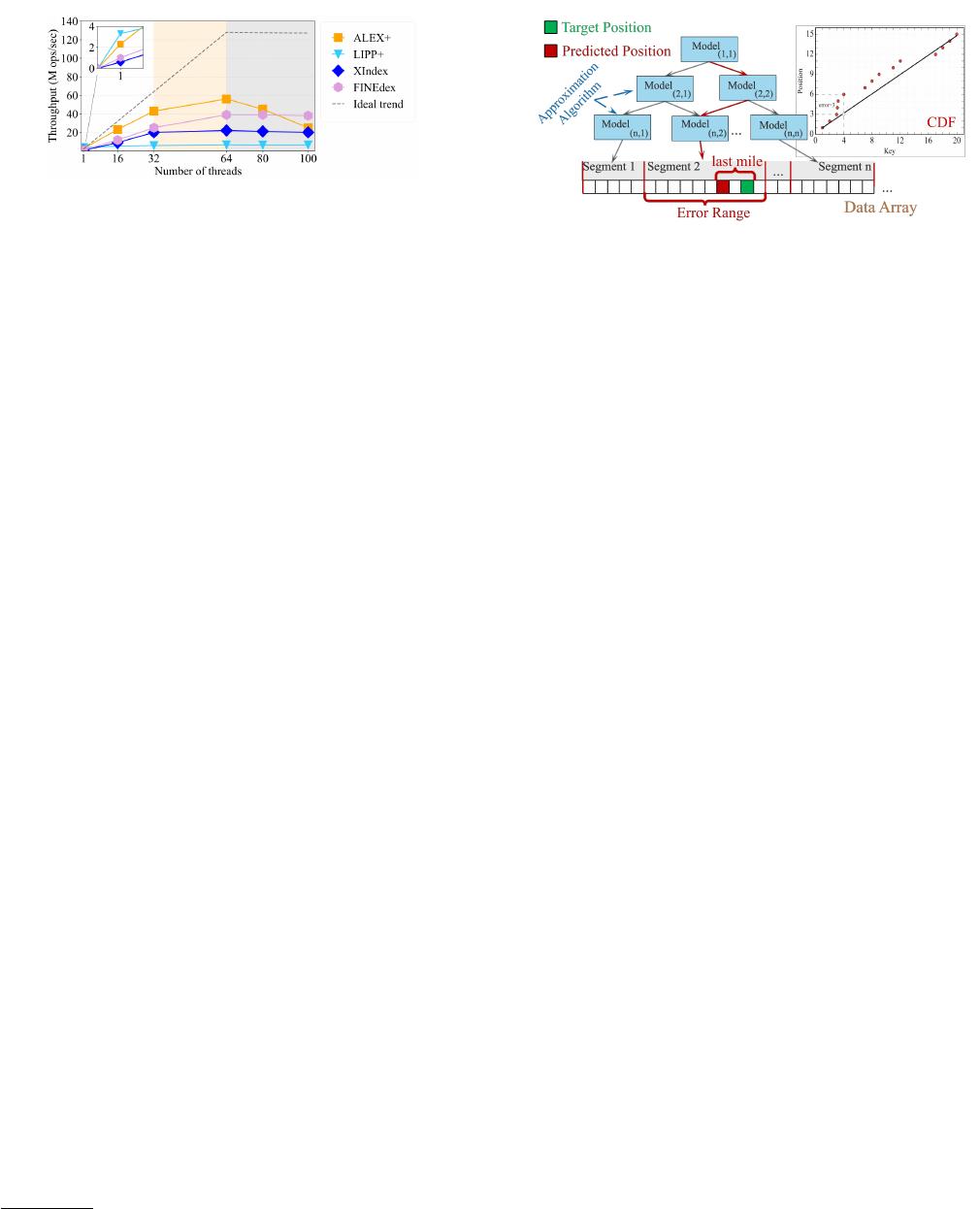
We found, however, that none of the above index designs scale at
a high concurrency. We performed an experiment where we insert
200 million random integer keys into a learned index, with a varying
number of threads each time. Figure 1 shows the results. Note that
the number of threads in the grey area of the gure is larger than
the number of hardware threads of the machine. This is common
in practice as a database/key-value server typically handles a large
number of user connections simultaneously.
1
arXiv:2308.15012v2 [cs.DB] 5 Sep 2023
Conference SIGMOD ’24, June 09–15, 2024, Santiago, Chile Jiake Ge and Huanchen Zhang, et al.
Figure 1: Write-only performance of state-of-the-art learned
indexes on the FACE dataset [
11
]. The evaluation is con-
ducted on a two-socket machine with two 16-core CPUs.
As shown in Figure 1, indexes with a buer-based strategy (i.e.,
XIndex and FINEdex) exhibit inferior base performance and worse
scalability compared to those with a model-based strategy (i.e.,
ALEX+ and LIPP+
1
). This shows that a larger margin of predic-
tion errors prevents scaling because the concurrent “last mile”
searches saturate the memory bandwidth quickly which becomes
the system’s bottleneck [38].
The problem is solved in LIPP+ where each position prediction
is accurate (i.e., no “last mile” search). However, LIPP+ requires
maintaining statistics, such as access counts and collision counts,
in each node to trigger node retraining to prevent performance
degradation. These per-node counters create high contention
among threads and cause severe cacheline ping-pong [
38
]. The
model-based strategy in ALEX+ requires shifting existing entries
upon an insert collision. Therefore, ALEX+ must acquire coarse-
grained write locks for this operation. As the number of threads
increases, more and more threads are blocked, waiting for those
exclusive locks.
In this paper, we propose SALI, the Scalable Adaptive Learned
Index framework based on probability models to solve the scalabil-
ity issues in existing solutions. To solve the scalability bottleneck
of maintaining per-node statistics, we developed lightweight prob-
ability models that can trigger node retraining and other structural
evolving operations in SALI with accurate timing (as if the timing
were determined by accurate statistics). In addition, we developed
a set of node-evolving strategies, including expanding an insert-
heavy node to contain more gaps, attening the tree structure
for frequently-accessed nodes, and compacting the rarely-touched
nodes to save memory. SALI applies these node-evolving strate-
gies adaptively according to the probability models so that it can
self-adjust to changing workloads while maintaining excellent scal-
ability. Finally, SALI adopts the learned index structure that utilizes
ne-grained write locks, i.e., LIPP+, to validate the eectiveness of
the aforementioned two strategies. Note that the lightweight proba-
bility models and node-evolving strategies are highly versatile and
can be applied to various index scenarios, as detailed in Section 5.
Our microbenchmark with real-world data sets shows that SALI
improves the insertion throughput with 64 threads by 2
.
04
×
on
average compared to the second-best learned index, i.e., ALEX+,
while achieving a lookup throughput comparable to LIPP+.
We make three primary contributions in this paper. Firstly, we
proposed SALI, a high-concurrency learned index framework de-
signed to improve the scalability of learned indexes. Secondly, we
1
ALEX+ and LIPP+ are concurrent implementations of ALEX and LIPP, respec-
tively [38].
Figure 2: The scheme of the learned index.
dened a set of node-evolving strategies in addition to model re-
training to allow the learned index to self-adapt to dierent work-
load skews. Thirdly, we replaced the per-node statistics in existing
learned indexes with lightweight probability models to remove the
scalability bottleneck of statistics maintenance while keeping the
timing accuracy of node retraining/evolving. Finally, we proved
the eectiveness of the proposed approaches by showing that SALI
outperforms the SOTA learned indexes under high concurrency.
The rest of this paper is organized as follows. Section 2 sum-
marizes the basics of learned indexes and further motivates the
scalability problem. Section 3 introduces the structure of SALI with
an emphasis on the node-evolving strategies and the probability
models. Section 4 presents our experimental results. Section 5 dis-
cusses the generalizability of the node-evolving strategies and the
probability models, as well as the limitations of SALI, followed
by a related work discussion in Section 6 Section 7 concludes the
paper. The source code of this paper has been made available at
https://github.com/YunWorkshop/SALI.
2 BACKGROUND AND MOTIVATION
2.1 The principle of learned indexes
The core concept of the learned index is to employ a set of learning
models to estimate the cumulative distribution function (CDF) of
the stored data [
29
], allowing for the prediction of the data’s storage
location, as depicted in the CDF diagram on Figure 2.
Figure 2 shows the scheme for the learned index structure. Each
node, or only the lowest leaf nodes, stores the slope and intercept
of the linear function [
3
,
5
,
8
,
15
,
21
,
36
,
39
]. Each segment corre-
sponds to a linear model, which is responsible for the approximate
position of the target key. The index segments correspond to linear
models that estimate the target key’s position, eliminating the need
for multiple indirect search operations in traditional tree-based in-
dexes. This approach has the potential to improve indexed lookup
performance signicantly.
2.2 Scalable Evaluation of Learned Index
Structures
Currently, learned indexes demonstrate good performance in
single-threaded environments. However, their scalability remains
limited [
38
]. In this part, our objective is to conduct a thorough
investigation into the factors that contribute to the concurrent
performance bottlenecks in existing learned indexes. To achieve
this, we begin by introducing the insertion strategies employed in
learned indexes, along with their corresponding index structures,
as these design choices signicantly inuence the concurrent per-
formance of the indexes. Additionally, we conduct a comprehensive
2
of 17
免费下载
【版权声明】本文为墨天轮用户原创内容,转载时必须标注文档的来源(墨天轮),文档链接,文档作者等基本信息,否则作者和墨天轮有权追究责任。如果您发现墨天轮中有涉嫌抄袭或者侵权的内容,欢迎发送邮件至:contact@modb.pro进行举报,并提供相关证据,一经查实,墨天轮将立刻删除相关内容。
下载排行榜

评论