



ICDE 2025_Artemis A Customizable Workload Generation Toolkit for Benchmarking Cardinality Estimation_OceanBase.pdf
免费下载

Artemis: A Customizable Workload Generation
Toolkit for Benchmarking Cardinality Estimation
Zirui Hu
1,2
, Rong Zhang
1,2
*, Chengcheng Yang
1,2
, Xuan Zhou
1,2
, Quanqing Xu
3
, Chuanhui Yang
3
1
School of Data Science and Engineering, East China Normal University,
2
Engineering Research Center of Blockchain Data Management, Ministry of Education,
3
OceanBase, Ant Group
zrhu@stu.ecnu.edu.cn, {rzhang, ccyang, xzhou}@dase.ecnu.edu.cn, {xuquanqing.xqq, rizhao.ych}@oceanbase.com
Abstract—Cardinality Estimation (CardEst) is crucial for
query optimization. Despite the remarkable achievement in
DBMS, there is a pressing need to test or tune the work of
CardEst. To satisfy the need, we introduce ARTEMIS, a customiz-
able workload generator, which can be used to generate various
scenarios with the sensitive features for CardEst, including
various data dependencies, complex SQL structures, and diverse
cardinalities. It designs a PK-oriented deterministic data gener-
ation mechanism to plot various data characteristics; a search-
based workload generation is proposed for composing queries
with various complexities; it takes a constraint optimization-
guided way to achieve a cost-effective cardinality calculation.
In this demonstration, users can explore the core features of
ARTEMIS in generating workloads.
Index Terms—cardinality estimation, benchmarking.
I. INTRODUCTION
Cardinality estimation (CardEst), renowned for the Achilles
Heel of query optimization, is one of the critical tasks in
query optimizer for estimating the intermediate result size of
each operator, and deciding an optimal query plan. However,
the intricate data dependencies and complicated selection/join
operators still make CardEst an unsolved hard issue [1].
Traditionally, DBMSs use histograms to collect data statistics
with low construction and maintenance costs. Due to high
statistics storage cost, the histogram-based method is gen-
erally adopted based on some assumptions, e.g., uniformity
within a histogram bucket and independence of attributes.
To move beyond these assumptions, learning-based methods
are leveraged to sketch the underlying data distribution and
attribute correlations. Learning-based methods are mainly cat-
egorized into data-driven and query-driven. The data-driven
method employs generative models for unsupervised learning
of the proportion of rows in the joint domain represented as
P (D
M
) = P (D
1
, D
2
, ..., D
n
) [2], where D
M
is the joint
domain from the full outer join of all tables, and D
i
is the
sub-domain of the i
th
attribute column. Supposing the size of
table T as |T |, the new query as Q, the joint domain covered
by Q as D
Q
, the cardinality of query Q is P (D
Q
) ∗ |T |.
The query-driven method uses discriminative models trained
on annotated query-cardinality pairs (Q, Card(Q)) to predict
the Card(
¯
Q) for new query
¯
Q. Though learning-based meth-
ods have demonstrated supreme capability on some classical
benchmarks, e.g., TPC-H, JOB-light [3], and STATS-CEB [4],
they can not be easily generalized to obtain high accuracy
across diversified scenarios, which makes it impossible for the
*Rong Zhang is the corresponding author.
practical industry use. However, providing diverse workloads
for CardEst has always been a tough work. The core challenges
come from the requirements of:
C1: Insufficient Data Dependency and Distribution. Both
data-driven and traditional methods fundamentally try to iden-
tify joint domain with strong correlations and plot their joint
distribution, which requires enormous datasets with various
data dependencies and distributions. Traditional OLAP bench-
marks, e.g., TPC-H, are meticulously designed for evaluating
execution engines with uniform distribution and independence
between attributes, which is too simple for the CardEst task.
The other CardEst benchmarks [4] typically rely on a fixed
schema using publicly available datasets, which have the
defect of representativeness and generalizability; additionally,
maintaining the established dependency relationships and data
distributions when scaling data is still a great challenge.
C2: Demanding Training Label Generation. For query-
driven methods, their effectiveness is fundamentally decided
by the size of diverse annotated queries and cardinality label
pairs for training, which can be generally obtained in two
ways. One is to extract training data from real-life industry
logs, but it is barely possible to collect such kinds of training
data due to the concerns of privacy [5]. The other one is to
construct self-defined training data. However, it may consume
a significant amount of CPU and memory resources, along
with tedious and time-consuming manual effort to construct
and run queries in a full-fledged system to gather labels. For
example, collecting cardinality labels for 500 queries with
1TB of input data could take nearly 10 days [6]. Therefore,
the exhaustive resource consumption and burdensome manual
effort for label generation challenge the model training.
C3: Limited Complexity of Workloads. The diversity of
training workloads greatly influences the model robustness
of learning-based methods, while the diversity of testing
workloads verifies the effectiveness of methods across various
scenarios. Workload diversity can be represented by three
dimensions [4], i.e., 1) query templates composed of operators,
2) access distribution of the predicates, and 3) query cardinal-
ities. On the one hand, existing benchmarks have fundamental
shortcomings in their template design. For instance, the state-
of-the-art CardEst benchmark STATS-CEB [4] loses sup-
port to some join types, including cycle/cyclic-joins, non-key
joins, and outer/semi/anti-joins, and selection predicates like
disjunctive logical predicates (∨) and arithmetic predicates.
On the other hand, existing benchmarks do not guarantee
4628
2025 IEEE 41st International Conference on Data Engineering (ICDE)
2375-026X/25/$31.00 ©2025 IEEE
DOI 10.1109/ICDE65448.2025.00369
BBAAD9C20180234D78A0072836F0B930E2B9B2091C41FBA0A4D98436B1942B0C6B4CB93861533B082259240898463FEBCAE921BA61D05B811BBFC2157ABE32D6241290ADFF21A9A794B72A276F474945CAF7ED3875D043744886019CE8BDACD8D7C6299B9E3
the generation diversity in predicate parameters or operator
cardinalities, since they only take a randomization and manual
inspection way to guarantee valid queries (cardinality > 0).
Therefore, generating diverse query templates and instantiating
parameters to fulfill arbitrary cardinality requirements remains
a challenging and time-consuming task.
To tame these challenges, we propose a benchmark toolkit
called ARTEMIS for CardEst with the following features.
First, we design a PK-oriented deterministic data generation
method by using a set of distribution functions to map from
PKs to common attribute columns, with PKs playing as
the seeds. Second, we employ a lightweight automatic label
generation method by modeling the cardinality calculation of
predicates as a Constraint Optimization Problem (COP) with
the predicates and the predefined data generation functions
as constraints, which can be solved precisely by COP solver.
Third, to accommodate diverse query generation, we first
utilize a dynamic weighted random walk over a well-defined
finite-state machine (FSM) to generate SQLs with various
predicates; we then vectorize the generated query template,
and compare it with the historical query template vectors to
adapt the weight on FSM; finally, for each generated query
template, we mutate or crossover each parameter with the dual
objectives of minimizing both the distance from the specified
cardinality requirement and the overlap in the accessed data
ranges between the new query and historical queries.
In summary, this paper makes the following contributions:
• We propose a computation-driven method for generating
realistic data dependencies and distributions.
• We introduce a constraint optimization-guided calculation
approach for efficient cardinality label generation.
• We design a guided search-based strategy to generate
diverse workloads.
• We provide a vivid demonstration to showcase the effec-
tiveness of ARTEMIS.
In this demonstration, we first provide an overview of
ARTEMIS in § II, including its workflow and key techniques.
The demonstration details are finally presented in § III.
II. DESIGN OVERVIEW
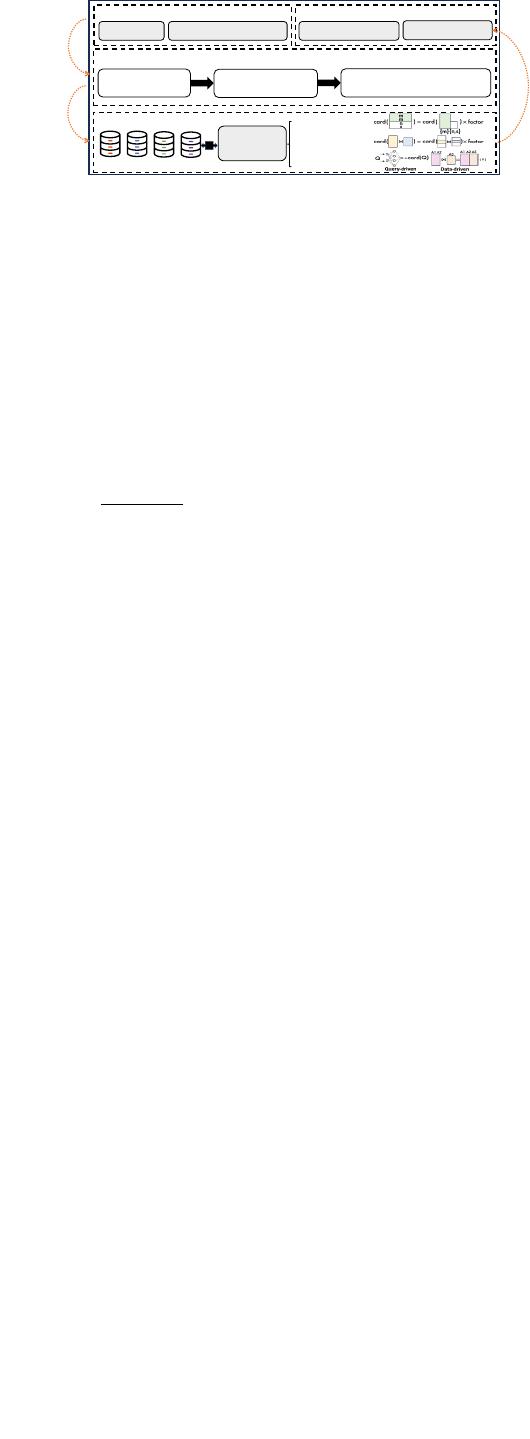
The architecture of ARTEMIS is shown in Fig. 1. Specifi-
cally, users configure their requirements about benchmarking
scenarios, including schema (e.g., table number and table
reference relationship); data characteristics (e.g., intra-column
distribution and inter-column dependency); query type dis-
tribution (e.g., chain/cycle joins, the joined table numbers),
and query cardinality. The generation has three phases: 1) it
generates schema and data following the requirements of the
data dependencies and distributions; 2) it constructs query tem-
plates that have various query types and diverse predicates; 3)
it instantiates predicate parameters for generating valid queries
with different cardinalities across various access ranges.
A. Data Characteristic Sketch
To scalably generate data with various distributions and
dependencies, we employ a PK-oriented deterministic gener-
ation strategy, where each non-key value is deduced from its
Application
Database Systems
User Interface
Schema Data/Workload Settings
Visualization
Cardinality Result
Generation Process
Step1: Generate
Schema and Data
Workflow of Artemis
Step2: Generate
Workload Templates
Step3: Instantiate Parameters
& Cardinality Calculation
Input
Test/Tune
Return Result
Cardinality
Estimation
Component
Histogram-based
Sampling-based
Learned-based
…
Fig. 1. ARTEMIS Architecture
corresponding PK under any intra-column distributions and
inter-column dependencies. Each table T has an automatic
incremental PK column, and each non-key column, e.g., col
i
,
follows an intra-column distribution ϕ
col
i
and has d
col
i
distinct
values from a specified domain (d
col
i
≤ |T |). We map PKs se-
quentially into d
col
i
groups with auto-incremented group IDs,
each corresponding to a distinct value x in col
i
. Let g
k
[P K]
(abbr. g
k
) represent the group ID for an individual PK w.r.t
x
k
in col
i
, where group sizes follow the frequency of x
k
from
ϕ
col
i
. Since for a single column, a linear function effectively
guarantees the intra-column distribution by controlling distinct
value frequency, we define the generation function from PK to
a non-key column col
i
as F unc
col
i
(g
k
) = α ∗ g
k
+ β, where
α =
x
max
−x
min
d
col
i
−1
and β = x
min
− α, with x
max/min
as the
column bounds. Given a value x
k
w.r.t g
k
, we can derive
its covered PK range. Specifically, from ϕ
col
i
, we obtain its
cumulative distribution function (CDF) F
col
i
. The PK range
for group g
k
is represented by start PK (P K
s
k
) and end
PK (P K
e
k
), calculated as P K
s
k
= ⌊|T | × F
col
i
(x
k−1
)⌋ + 1
and P K
e
k
= ⌊|T | × F
col
i
(x
k
)⌋, where x
k−1
and x
k
are
derived from the generation function of col
i
for g
k−1
and
g
k
, respectively. We efficiently map g
k
(i.e., x
k
) back to its
continuous PK range. Note that a column can be of any type,
achieved via a type transformer, and data is shuffled during
database population. Based on these generation functions,
we introduce the generation of four typical inter-column
dependencies for CardEst [7]: unique column combination
(UCC), order dependency (OD), functional dependency (FD),
and inclusion dependency (ID). We take ID as an example,
and the generation method of others can be found in our
GitHub repository [8]. ID indicates that any value in column
col
i
will also be found in col
j
(i ̸= j). Thus, ID dependency
exists between included column col
i
with d
col
i
and inclusive
column col
j
with d
col
j
. Since d
col
i
≤ d
col
j
, applying the same
generation function to both ensures values in col
i
exist in col
j
.
B. Workload Template Generation
To create a query template
b
Q, we have two generation steps:
1) we determine its query type and the number of involved
tables, then select a subset of table T
Q
to construct the query
template; 2) we compose the join predicates J and selection
predicates S in the query. The basic form is like SELECT
COUNT(*) FROM T
Q
WHERE J AND S. If there is a join,
we first initialize an empty join graph and then iteratively
update the graph by randomly selecting tables (nodes) to the
graph. The nodes selected are decided by the join type and join
number. For instance, to generate a cycle query, by searching
cycles within the schema that satisfy the required number of
4629
BBAAD9C20180234D78A0072836F0B930E2B9B2091C41FBA0A4D98436B1942B0C6B4CB93861533B082259240898463FEBCAE921BA61D05B811BBFC2157ABE32D6241290ADFF21A9A794B72A276F474945CAF7ED3875D043744886019CE8BDACD8D7C6299B9E3
of 4
免费下载
【版权声明】本文为墨天轮用户原创内容,转载时必须标注文档的来源(墨天轮),文档链接,文档作者等基本信息,否则作者和墨天轮有权追究责任。如果您发现墨天轮中有涉嫌抄袭或者侵权的内容,欢迎发送邮件至:contact@modb.pro进行举报,并提供相关证据,一经查实,墨天轮将立刻删除相关内容。
下载排行榜

文档被以下合辑收录
评论