



DuckDB an Embeddable Analytical Database.pdf
免费下载
DuckDB: an Embeddable Analytical Database
Mark Raasveldt
m.raasveldt@cwi.nl
CWI, Amsterdam
Hannes Mühleisen
hannes@cwi.nl
CWI, Amsterdam
ABSTRACT
The immense popularity of SQLite shows that there is a need
for unobtrusive in-process data management solutions. How-
ever, there is no such system yet geared towards analytical
workloads. We demonstrate DuckDB, a novel data manage-
ment system designed to execute analytical SQL queries
while embedded in another process. In our demonstration,
we pit DuckDB against other data management solutions
to showcase its performance in the embedded analytics sce-
nario. DuckDB is available as Open Source software under a
permissive license.
ACM Reference Format:
Mark Raasveldt and Hannes Mühleisen. 2019. DuckDB: an Em-
beddable Analytical Database. In 2019 International Conference on
Management of Data (SIGMOD ’19), June 30-July 5, 2019, Ams-
terdam, Netherlands. ACM, New York, NY, USA, 4 pages. https:
//doi.org/10.1145/3299869.3320212
1 INTRODUCTION
Data management systems have evolved into large mono-
lithic database servers running as stand-alone processes. This
is partly a result of the need to serve requests from many
clients simultaneously and partly due to data integrity re-
quirements. While powerful, stand-alone systems require
considerable eort to set up properly and data access is con-
stricted by their client protocols [
12
]. There exists a com-
pletely separate use case for data management systems, those
that are embedded into other processes where the database
system is a linked library that runs completely within a “host”
process. The most well-known representative of this group
is SQLite, the most widely deployed SQL database engine
with more than a trillion databases in active use [
4
]. SQLite
strongly focuses on transactional (OLTP) workloads, and con-
tains a row-major execution engine operating on a B-Tree
storage format [
3
]. As a consequence, SQLite’s performance
on analytical (OLAP) workloads is very poor.
Permission to make digital or hard copies of part or all of this work for
personal or classroom use is granted without fee provided that copies are
not made or distributed for prot or commercial advantage and that copies
bear this notice and the full citation on the rst page. Copyrights for third-
party components of this work must be honored. For all other uses, contact
the owner/author(s).
SIGMOD ’19, June 30-July 5, 2019, Amsterdam, Netherlands
© 2019 Copyright held by the owner/author(s).
ACM ISBN 978-1-4503-5643-5/19/06.
https://doi.org/10.1145/3299869.3320212
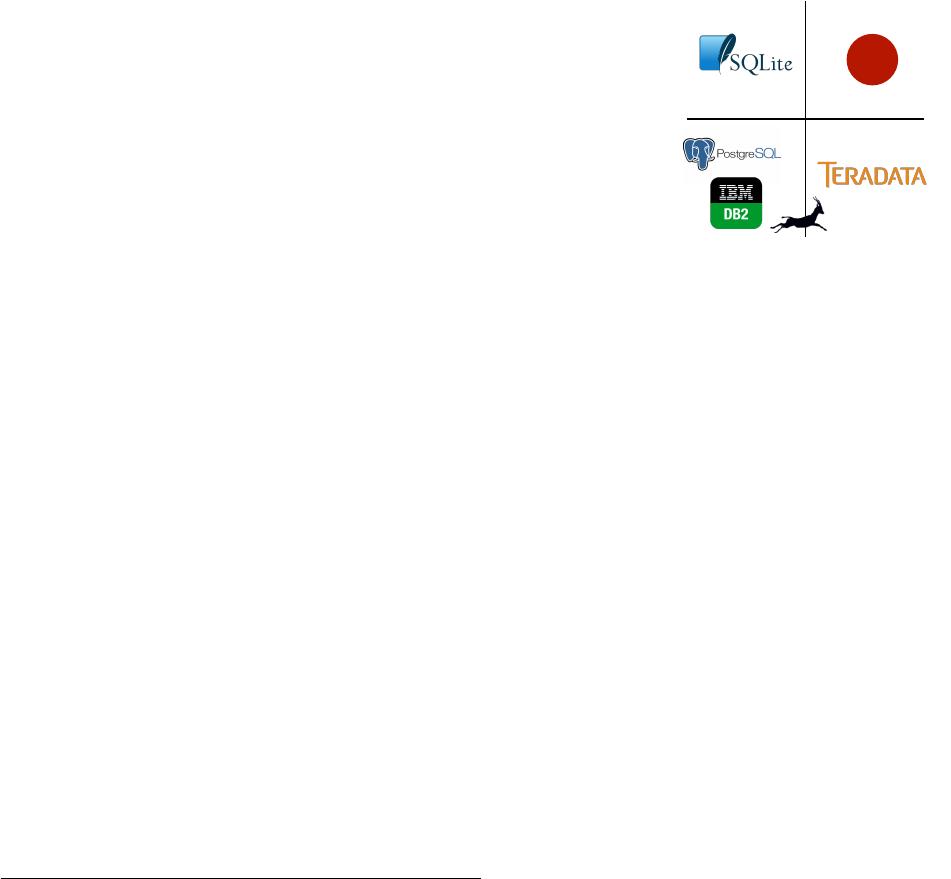
OLTP
OLAP
Embedded
Stand-Alone
?
Figure 1: Systems Landscape
There is a clear need for embeddable analytical data man-
agement. This needs stems from two main sources: Inter-
active data analysis and “edge” computing. Interactive data
analysis is performed using tools such as R or Python. The
basic data management operators available in these envi-
ronments through extensions (dplyr [
14
], Pandas [
6
], etc.)
closely resemble stacked relational operators, much like in
SQL queries, but lack full-query optimization and transac-
tional storage. Embedded analytical data management is also
desirable for edge computing scenarios. For example, con-
nected power meters currently forward data to a central
location for analysis. This is problematic due to bandwidth
limitations especially on radio interfaces, and also raises pri-
vacy concerns. An embeddable analytical database is very
well-equipped to support this use case, with data analyzed
on the edge node. The two use cases of interactive analysis
and edge computing appear orthogonal. But surprisingly, the
dierent use cases yield similar requirements. For example,
in both use cases portability and resource requirements are
critical, and systems that are careful with both will do well
in both usage scenarios.
In our previous research, we have developed MonetDBLite,
an embedded analytical system that was derived from the
MonetDB system [
13
]. MonetDBLite proved successfully
that there is a real interest in embedded analytics, it enjoys
thousands of downloads per month and is used all around
the world from the Dutch central bank to the New Zealand
police. However, its success also uncovered several issues
that proved very complex to address in a non-purpose-built

SIGMOD ’19, June 30-July 5, 2019, Amsterdam, Netherlands Mark Raasveldt and Hannes Mühleisen
system. The following requirements for embedded analytical
databases were identied:
•
High eciency for OLAP workloads, but without com-
pletely sacricing OLTP performance. For example,
concurrent data modication is a common use case in
dashboard-scenarios where multiple threads update
the data using OLTP queries and other threads run the
OLAP queries that drive visualizations simultaneously.
•
Ecient transfer of tables to and from the database
is essential. Since both database and application run
in the same process and thus address space, there is
a unique opportunity for ecient data sharing which
needs to be exploited.
•
High degree of stability, if the embedded database
crashes, for example due to an out-of-memory situ-
ation, it takes the host down with it. This can never
happen. Queries need to be able to be aborted cleanly
if they run out of resources, and the system needs to
gracefully adapt to resource contention.
•
Practical “embeddability” and portability, the database
needs to run in whatever environment the host does.
Dependencies on external libraries (e.g.
openssh
)
for either compile- or runtime have been found to
be problematic. Signal handling, calls to
exit()
and
modication of singular process state (locale, working
directory etc.) are forbidden.
In this demonstration, we present the capabilities of our
new system, DuckDB. DuckDB is a new purpose-built em-
beddable relational database management system. DuckDB
is available as Open-Source software under the permissive
MIT license
1
. To the best of our knowledge, there currently
exists no purpose-built embeddable analytical database de-
spite the clear need outlined above. DuckDB is no research
prototype but built to be widely used, with millions of test
queries run on each commit to ensure correct operation and
completeness of the SQL interface. Our rst-ever demonstra-
tion of DuckDB will pit it against other systems on a small
device. We will allow viewers to increase the size of the
dataset processed, and observe various metrics such as CPU
load and memory pressure as the dataset size changes. This
will demonstrate the performance of DuckDB for analytical
embedded data analysis.
2 DESIGN AND IMPLEMENTATION
DuckDB’s design decisions are informed by its intended use
case: embedded analytics. Overall, we follow the “textbook”
separation of components: Parser, logical planner, optimizer,
physical planner, execution engine. Orthogonal components
are the transaction and storage managers. While DuckDB
is rst in a new class of data management systems, none of
1
https://github.com/cwida/duckdb
API C/C++/SQLite
SQL Parser libpg_query [2]
Optimizer Cost-Based [7, 9]
Execution Engine Vectorized [1]
Concurrency Control Serializable MVCC [10]
Storage DataBlocks [5]
Table 1: DuckDB: Component Overview
DuckDB’s components is revolutionary in its own regard.
Instead, we combined methods and algorithms from the state
of the art that were best suited for our use cases.
Being an embedded database, DuckDB does not have a
client protocol interface or a server process, but instead is
accessed using a C/C++ API. In addition, DuckDB provides
a SQLite compatibility layer, allowing applications that pre-
viously used SQLite to use DuckDB through re-linking or
library overloading. As with MonetDBLite, we have also im-
plemented the database APIs for R (DBI) and Python (PEP
249).
The SQL parser is derived from Postgres’ SQL parser that
has been stripped down as much as possible [
2
]. This has
the advantage of providing DuckDB with a full-featured and
stable parser to handle one of the most volatile form of its
input, SQL queries. The parser takes a SQL query string as
input and returns a parse tree of C structures. This parse tree
is then immediately transformed into our own parse tree of
C++ classes to limit the reach of Postgres’ data structures.
This parse tree consists of statements (e.g.
SELECT
,
INSERT
etc.) and expressions (e.g. SUM(a)+1).
The logical planner consists of two parts, the binder and
the plan generator. The binder resolves all expressions re-
ferring to schema objects such as tables or views with their
column names and types. The logical plan generator then
transforms the parse tree into a tree of basic logical query
operators such as scan, lter, project, etc. After the plan-
ning phase, we have a fully type-resolved logical query plan.
DuckDB keeps statistics on the stored data, and these are
propagated through the dierent expression trees as part of
the planning process. These statistics are used in the opti-
mizer itself, and are also used for integer overow prevention
by upgrading types when required.
DuckDB’s optimizer performs join order optimization us-
ing dynamic programming [
7
] with a greedy fallback for
complex join graphs [
11
]. It performs attening of arbitrary
subqueries as described in Neumann et al. [
9
]. In addition,
there are a set of rewrite rules that simplify the expression
tree, by performing e.g. common subexpression elimination
of 4
免费下载
【版权声明】本文为墨天轮用户原创内容,转载时必须标注文档的来源(墨天轮),文档链接,文档作者等基本信息,否则作者和墨天轮有权追究责任。如果您发现墨天轮中有涉嫌抄袭或者侵权的内容,欢迎发送邮件至:contact@modb.pro进行举报,并提供相关证据,一经查实,墨天轮将立刻删除相关内容。
下载排行榜

文档被以下合辑收录
评论