



2025 ICDE_-HC-SpMM_Accelerating_Sparse_Matrix-Matrix_Multiplication_for_Graphs_with_Hybrid_GPU_Cores.pdf
免费下载
HC-SpMM: Accelerating Sparse Matrix-Matrix
Multiplication for Graphs with Hybrid GPU Cores
Zhonggen Li
∗
, Xiangyu Ke
∗†
, Yifan Zhu
∗†
, Yunjun Gao
∗†
, Yaofeng Tu
‡
∗
Zhejiang University,
†
Zhejiang Key Laboratory of Big Data Intelligent Computing,
‡
ZTE Corporation
{zgli, xiangyu.ke, xtf z, gaoyj}@zju.edu.cn, tu.yaofeng@zte.com.cn
Abstract—Sparse Matrix-Matrix Multiplication (SpMM) is
a fundamental operation in graph computing and analytics.
However, the irregularity of real-world graphs poses significant
challenges to achieving efficient SpMM for graph data on GPUs.
Recently, the introduction of new efficient computing cores within
GPUs offers new opportunities for acceleration.
In this paper, we present HC-SpMM, a pioneering algorithm
that leverages Hybrid GPU Cores (Tensor cores and CUDA cores)
to accelerate SpMM for graphs. To adapt to the computing
characteristics of different GPU cores, we investigate the impact
of sparse graph features on the performance of different cores,
develop a data partitioning technique for the graph adjacency
matrix, and devise a novel strategy for intelligently selecting the
most efficient cores for processing each submatrix. Additionally,
we optimize it by considering memory access and thread uti-
lization. To support complex graph computing workloads, we
integrate HC-SpMM into the GNN training pipeline. Further-
more, we propose a kernel fusion strategy to enhance data
reuse, as well as a cost-effective graph layout reorganization
method to mitigate the irregularity of real-world graphs, better
fitting the computational models of hybrid GPU cores. Extensive
experiments on 14 real-world datasets demonstrate that HC-
SpMM achieves an average speedup of 1.33× and 1.23× over
state-of-the-art SpMM kernels and GNN frameworks.
Index Terms—GPU cores, SpMM, Graph Computing
I. INTRODUCTION
Sparse Matrix-Matrix Multiplication (SpMM) is a funda-
mental operation that multiplies a sparse matrix and a dense
matrix, which has been widely used in various graph comput-
ing tasks such as Graph Neural Networks (GNNs) training &
inference [9], [28], [62], PageRank [21], [29], [37] and graph
clustering [4], [14], [53], [59]. Recent studies employ matrix
multiplication operations on GPUs to accelerate commonly
used graph algorithms such as triangle counting and shortest
path computing, with SpMM emerging as one of the core
operations and becoming the efficiency bottleneck [40], [57].
SpMM is also a fundamental operation in GNNs, accounting
for more than 80% of the GNN training time [47]. However,
characterized by irregular memory access patterns and low
computational intensity, the real-world graphs pose significant
challenges for achieving efficient SpMM on GPU [47]. Es-
pecially for GNNs, as the scale of graph data proceeds to
grow and the complexity of GNN architectures escalates with
an increasing number of layers, the efficiency issue becomes
more serious, constraining the large-scale applicability
1
, even
1
Training a GNN-based recommendation system over a dataset comprising
7.5 billion items consumes approximately 3 days on a 16-GPU cluster [10].
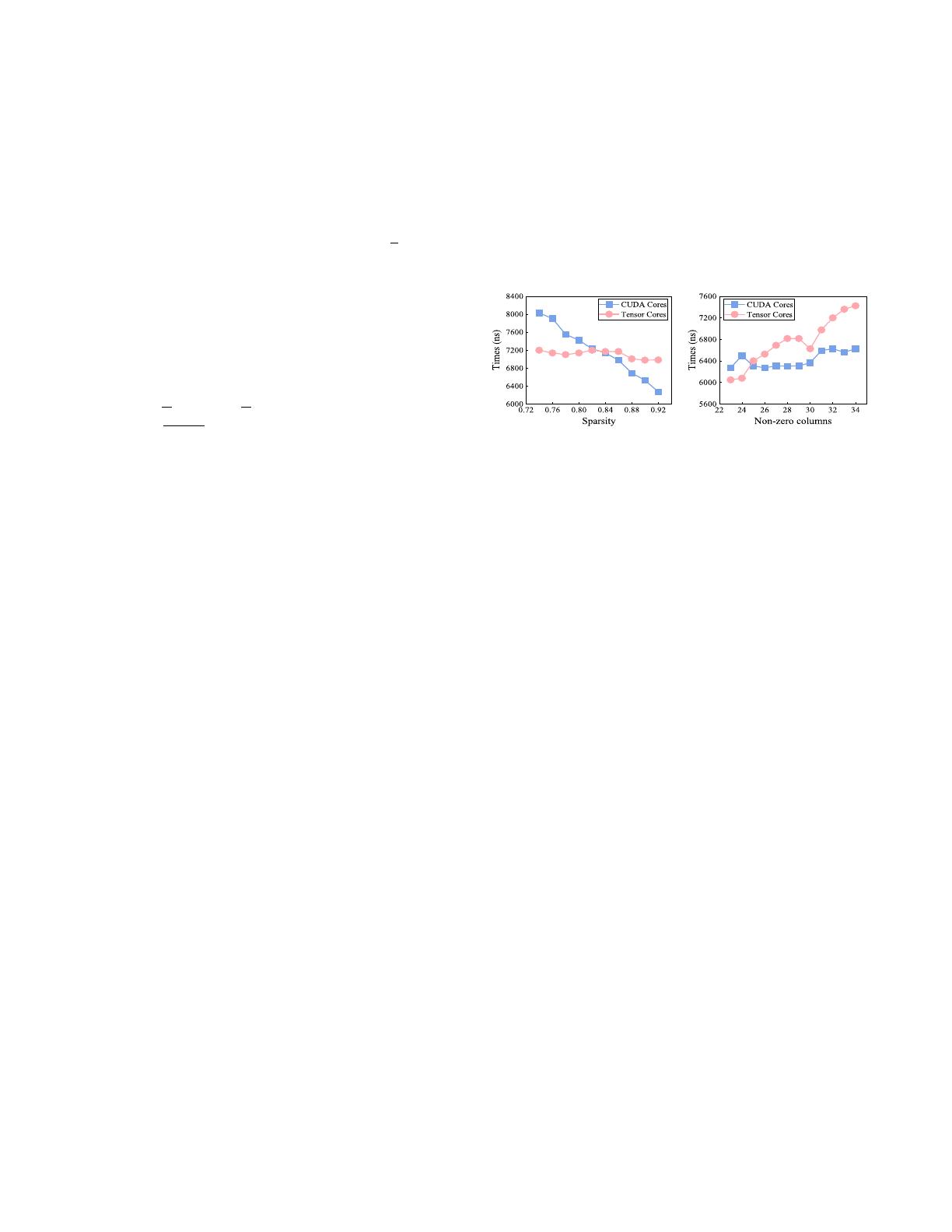
(a) Varying sparsity. (b) Varying non-zero columns.
Fig. 1. SpMM execution time with varying sparsity and non-zero columns.
though it achieves state-of-the-art performance on a myriad
of problems such as node classification [38], [48], [61], link
prediction [18], [35], [64], [68], recommendation [49], [51],
[60] and beyond [5], [13], [26], [39].
To enhance the efficiency of SpMM, some efforts have been
made to employ CUDA cores in GPU for acceleration [16],
[20], [23], [32]. As the performance ceil is constrained by
the hardware structure of CUDA cores, recent attempts have
turned to explore harnessing the Tensor cores, which are
specialized for efficient matrix multiplication, to accelerate
SpMM [6], [27], [58]. However, despite significantly improv-
ing the efficiency of dense matrix multiplication [30], the
irregularity and sparsity of real-world graphs impeding Tensor
cores from achieving satisfactory performance [12], [47], [58].
Various preprocessing techniques have been investigated to
enhance the density of sparse matrices, yet significant sparse
portions persist, hindering performance improvement
2
.
Figure 1 illustrates the time overhead incurred by CUDA
cores and Tensor cores across matrices with varying sparsity
and the number of non-zero columns, which highlights their
distinct applicabilities
3
. CUDA cores demonstrate superior
performance when handling sparser matrices with a higher
number of non-zero columns, whereas Tensor cores exhibit
greater efficacy in denser matrices characterized by fewer
non-zero columns. Thereafter, relying solely on CUDA cores
or Tensor cores for SpMM acceleration fails to fully exploit
their respective computational strengths, primarily due to the
irregularity of real-world graphs, which typically comprise a
mixture of dense and sparse regions [55].
In this paper, we aim to devise a graph-friendly SpMM
kernel using hybrid CUDA cores and Tensor cores, tailored
2
For instance, the average sparsity of the matrices output by the preprocess-
ing method proposed in TC-GNN [47] is still 90.9% on 10 tested datasets.
3
An in-depth analysis is provided in § IV-C.
501
2025 IEEE 41st International Conference on Data Engineering (ICDE)
2375-026X/25/$31.00 ©2025 IEEE
DOI 10.1109/ICDE65448.2025.00044
2025 IEEE 41st International Conference on Data Engineering (ICDE) | 979-8-3315-3603-9/25/$31.00 ©2025 IEEE | DOI: 10.1109/ICDE65448.2025.00044
Authorized licensed use limited to: ZTE Corporation (One Dept). Downloaded on October 28,2025 at 06:54:20 UTC from IEEE Xplore. Restrictions apply.

to the varying computational demands of different graph
regions, to support high-performance graph computing work-
loads. Furthermore, as a DB technique for AI acceleration,
we integrate the hybrid SpMM kernel into the GNN training
pipeline to enhance the training efficiency and demonstrate its
effectiveness in complex graph computing scenarios.
However, crafting a hybrid SpMM kernel using CUDA
cores and Tensor cores based on the characteristics of graph
data and systematically integrating it into the GNN training
pipeline encounters non-trivial challenges.
Challenges of designing hybrid SpMM kernel. (1) Ef-
fectively partitioning the adjacency matrix into sub-regions
with distinct sparsity characteristics to leverage the different
cores for collaborative computation presents a considerable
challenge. (2) The computational characteristics of CUDA and
Tensor cores vary significantly, which is also influenced by the
graph features, making the selection of the optimal core for
matrices with different sparsity levels crucial for enhancing
efficiency. (3) Accurately modeling the computational perfor-
mance of CUDA and Tensor cores for SpMM to facilitate
precise core selection is another major difficulty. (4) Last but
not least, inefficiencies inherent in the SpMM kernel, such as
suboptimal memory access patterns and underutilized threads,
limit the overall performance. To address these issues, we
firstly propose a fine-grained partition strategy, which divides
the adjacency matrix into equal-sized submatrices along the
horizontal axis, allocating each submatrix to the appropriate
GPU cores for efficient computation (§ IV-A). This allows
CUDA and Tensor cores to perform calculations indepen-
dently, eliminating the need to merge results between cores.
Secondly, comprehensive quantitative experiments reveal that
CUDA cores are memory-efficient while Tensor cores are
computing-efficient (§ IV-B). These experiments identify two
pivotal factors for submatrix characterization: sparsity and
the number of non-zero columns, which dominate the most
expensive parts for CUDA and Tensor cores, computation and
memory access, respectively. Thirdly, leveraging these factors,
we develop an algorithm tailored for the selection of appro-
priate GPU cores for submatrices, optimizing computational
capability (§ IV-B). Finally, we conduct in-depth optimiza-
tions of the SpMM kernel, considering thread collaboration
mode (§ IV-D1) and memory access patterns (§ IV-D2).
Challenges of integrating the SpMM kernel into GNN.
When integrating our proposed hybrid SpMM kernel into the
GNN training pipeline, there arise new challenges. (1) The
isolation among GPU kernels within a GNN layer in prevalent
GNN training frameworks [43], [47] impedes data reuse,
leads to additional memory access overhead, and introduces
significant kernel launch overhead. (2) Tensor cores incur
significantly higher throughput than CUDA cores, potentially
offering substantial efficiency gain. However, real-world graph
layouts inherently exhibit irregularity and sparsity, resulting in
a majority of segments partitioned from the adjacency matrix
being sparse and less amenable to processing via Tensor cores.
Consequently, the performance gains achievable with Tensor
cores are often negligible [47]. To tackle the first problem,
we discover opportunities to reuse data in the shared memory
of GPU and present a kernel fusion strategy to mitigate
kernel launch costs and global memory access (§ V-A). To
address the second problem, we first introduce a metric termed
computating intensity to estimate the calculation workload of
the submatrices multiplication (§ V-B), which is calculated
by the quotient of the number of non-zero elements and the
number of non-zero columns. Higher computational intensity
is achieved with more non-zero elements and fewer non-
zero columns. Subsequently, we propose an efficient algorithm
to reconstruct submatrices, adjusting the graph layouts to
obtain more dense segments suitable for processing by Tensor
cores, gaining significant efficiency with Tensor cores (§ V-B).
This adjustment has a relatively small cost compared with
GNN training but renders the graph data more compatible
with hybrid GPU cores, unlocking the full computational
potential of Tensor cores and thereby significantly enhancing
the efficiency of GNN training (§ VI-C3).
Contributions. In this work, we propose HC-SpMM, a novel
approach for accelerating SpMM using hybrid GPU cores. Our
key contributions are summarized as follows:
• We quantify the difference between CUDA and Tensor
cores in SpMM, and propose a hybrid SpMM kernel,
which partitions the graph adjacency matrix and intelli-
gently selects appropriate GPU cores for the computation
of each submatrix based on its characteristics. We further
optimize the SpMM kernel considering thread collabora-
tion mode and memory access patterns (§ IV).
• We propose a kernel fusion strategy for integrating HC-
SpMM into the GNN training pipeline, eliminating kernel
launch time and enabling efficient data reuse, and present
a lightweight graph layout optimization algorithm to
enhance irregular graph layouts and better align with the
characteristics of both GPU cores (§ V).
• We conduct comprehensive evaluations demonstrating
that HC-SpMM outperforms existing methods, achieving
1.33× speedup in SpMM and 1.23× speedup in GNN
training on average (§ VI).
The rest of this paper is organized as follows. Section II
reviews the related work. Section III gives the preliminaries.
Section IV presents the design of the hybrid SpMM kernel.
Section V describes the optimization of integrating the SpMM
kernel into GNNs. Section VI exhibits the experimental results.
We conclude the paper in Section VII.
II. RELATED WORK
SpMM Using CUDA Cores. Optimization of SpMM has
been a subject of extensive study [3], [20], [50], [56], [65].
In recent years, Yang et al. [56] leveraged merge-based load
balancing and row-major coalesced memory access strategies
to accelerate SpMM. Hong et al. [20] designed an adap-
tive tiling strategy to enhance the performance of SpMM.
cuSPARSE [32] offers high-performance SpMM kernels and
has been integrated into numerous GNN training frameworks
such as DGL [43]. Gale et al. point out that cuSPARSE
is efficient only for matrices with sparsity exceeding 98%.
502
Authorized licensed use limited to: ZTE Corporation (One Dept). Downloaded on October 28,2025 at 06:54:20 UTC from IEEE Xplore. Restrictions apply.
of 14
免费下载
【版权声明】本文为墨天轮用户原创内容,转载时必须标注文档的来源(墨天轮),文档链接,文档作者等基本信息,否则作者和墨天轮有权追究责任。如果您发现墨天轮中有涉嫌抄袭或者侵权的内容,欢迎发送邮件至:contact@modb.pro进行举报,并提供相关证据,一经查实,墨天轮将立刻删除相关内容。
下载排行榜

评论