



20190830摩根大通全球数据.pdf
50墨值下载
Economic Research
August 30, 2019
Global Data Watch
Central banks need to engage government to address their constraints
US growth holds up but global drag is washing onto its shores
2020 fiscal easing remains an EM Asia story so far
Next week: Tariffs up; Powell talks; August PMIs and US payrolls
You dance with the one that brung ya
Rapid-fire geopolitical news and elevated global recession risks naturally take
focus away from underlying challenges facing the global economy. Arresting two
decades of weakening demographic and productivity trends (“the global supply
slide”) is a central one (Figure 1). With the reverberations of the financial crisis
magnifying this slide, persistent weak wage gains, rising income inequality, and
public sector debt are altering the political landscape. These alterations are not,
however, generating policy responses that address underlying problems. Instead, a
rising tide of populism and nationalism in geopolitical conflicts—trade and Brexit
among others—is further damaging global growth prospects. The biggest medi-
um-term risk is that this rising tide establishes a sustained adverse feedback loop
whereby economic pressures produce counter-productive political responses.
Against this backdrop, central banks have been pressured to engage in the
political process. Former New York Fed president William Dudley opined
this week that “if the goal of monetary policy is to achieve the best long-term
economic outcome, then Fed officials should consider how their decisions
will affect the political outcome in 2020.” Similar advice has been offered
elsewhere. During the Euro area sovereign crisis the ECB was often advised
to set policy to pressure governments to address EMU’s institutional flaws. In
pre-Abenomics Japan, it was regularly suggested that the BoJ refrain from
easing to pressure its government to tackle Japan’s pressing structural needs.
This advice is misguided, in our view, notwithstanding the limited leverage
central banks have in influencing politics. Modern monetary policy is built on
the idea that the business cycle is managed best when central bankers are insu-
lated from political pressure. By attempting to influence politics, central
bankers undermine the case for their operational independence. In addition,
effective monetary policy transmission depends on markets having a clear
understanding of their objectives and reaction function. Intermittent breaks in
this framework to influence political outcomes would undermine the credibil-
ity and effectiveness of monetary policy.
-2.0
0.0
2.0
4.0
1.2
1.7
2.2
2.7
3.2
01 04 07 10 13 16 19
%oya; both scales
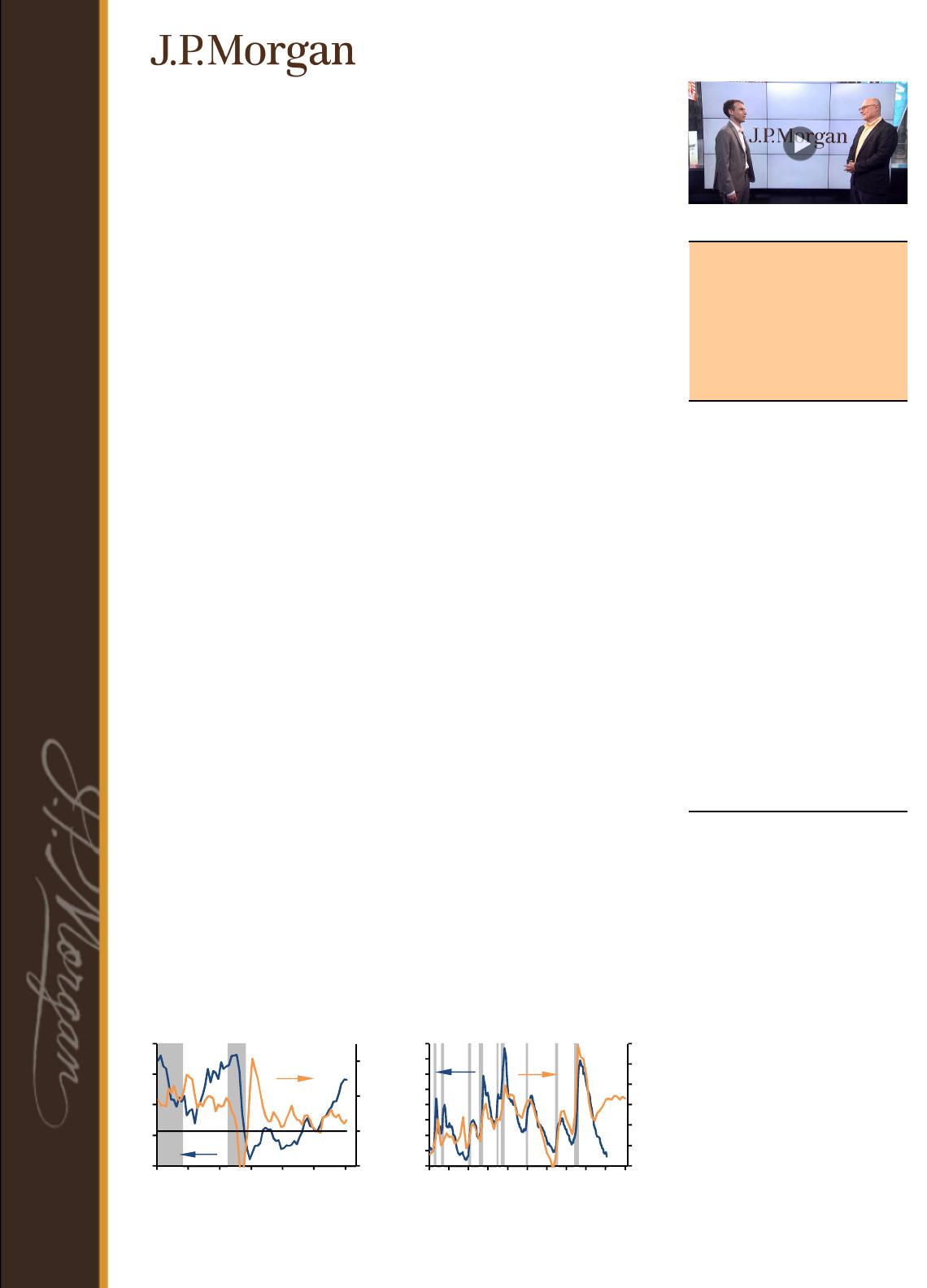
Figure 1: DM wages and productivity
Source: J.P. Morgan
Wages
Productivity
-10
-8
-6
-4
-2
0
23
4
5
6
7
8
9
10
11
56 63 70 77 84 91 98 05 12 19 26
%
Figure 2: US u-rate and federal deficit
% of GDP
Source: CBO, J.P. Morgan
Deficit (with
CBO fcst)
U-rate
Contents
US-China will weigh more on Japan's
growth than US-Japan 10
ECB will likely view further easing as
effective 14
Debt crises in Asia and their lessons for
China 17
Brexit: Preparing for an early general
election 21
India: An implicit fiscal stimulus 23
Australian labor supply: Demographic lags
and NAIRU drags
26
Global Economic Outlook Summary 4
Global Central Bank Watch 6
Nowcast of global growth 7
Selected recent research from J.P. Morgan
Economics 9
Data Watches
United States 28
Euro area 36
Japan 42
Canada 46
Mexico 48
Brazil 50
Argentina 52
Peru 54
United Kingdom 56
Emerging Europe 58
South Africa & SSA 62
Australia and New Zealand 64
China, Hong Kong, and Taiwan 66
Korea 69
ASEAN 71
India 75
Asia focus 77
Regional Data Calendars 80
Bruce Kasman
(1-212) 834-5515
bruce.c.kasman@jpmorgan.com
JPMorgan Chase Bank NA
Joseph Lupton
(1-212) 834-5735
joseph.p.lupton@jpmorgan.com
JPMorgan Chase Bank NA
Michael S Hanson
(1-212) 622-8603
michael.s.hanson@jpmchase.com
J.P. Morgan Securities LLC
www.jpmorganmarkets.com
2
Economic Research
Global Data Watch
August 30, 2019
JPMorgan Chase Bank NA
Bruce Kasman (1-212) 834-5515
bruce.c.kasman@jpmorgan.com
Joseph Lupton (1-212) 834-5735
joseph.p.lupton@jpmorgan.com
Michael S Hanson (1-212) 622-8603
michael.s.hanson@jpmchase.com
But even independent central bankers need to respond to poli-
cy actions that affect the macroeconomic outlook. Whether it
is Brexit or the US-China trade conflict, judgments about pol-
icies need to be made that will differ from the judgments of
those making policy. That this sparks public debate and criti-
cism of central banks is appropriate, as long as their opera-
tional independence is respected and central bankers act in
good faith and are held accountable for their actions.
It is troubling to think that central bankers would take a con-
frontational political stance at a time that their constraints
require closer coordination with elected officials. In particu-
lar, the next recession is likely to see each G-4 central bank
facing an effective lower bound constraint. Their unconven-
tional tools—QE and enhanced forward guidance—will likely
prove less effective as a result of the past decade’s r* drop
and yield curve flattening. This points to the need to prepare
for the next recession now by putting in place facilities by
which monetary, fiscal, and regulatory authorities can move
in a rapid and coordinated counter-cyclical fashion.
US consumers and labor markets are okay
Experience shows global recessions emanating from the US.
However, this time is different. The business sentiment shock
has been largest in Western Europe and Asia with other coun-
try-specific shocks holding back EM, notably Argentina and
Turkey. The risk is that global weakness washes onto US
shores kicking the more traditional dynamic into gear.
Recent US reports point in this direction as exports and capex
contract and business confidence slides (Figure 3). But the
economy continues to deliver 2% growth around midyear.
This resilience reflects continued solid labor market perfor-
mance—we forecast a 150,000 August job gain next week—
and strong consumer spending. Households have been on a
tear, delivering 4.6% ar in real spending gains in the first sev-
en months of the year. A decline in consumer confidence sug-
gests a cooling ahead. But this week’s July report points to a
faster than 3% ar gain this quarter, providing an important
cushion at a time that global drags look set to be intensifying.
German sentiment and jobs are a concern
With the Euro area experiencing a more troubling 1H19 loss
of growth momentum, it is comforting to see the composite
flash PMI and EC economic sentiment index both move high-
er this month. However, Germany remains a weak regional
link and labor demand is cooling. Employment gains slowed
to a 0.4% ar in the three months through July, half its 1H19
pace (Figure 4). Take-up of the government’s short-time work
subsidy scheme remains very low as companies continued to
report elevated labor shortages. But with the IFO expectations
component falling further this month, this cooling suggests
downside risk is rising for Europe’s largest economy.
With growth risks high and core inflation stuck around 1%,
the case for broad-based ECB easing is strong. However, the
ECB’s hawkish camp aggressively pushed back on this view
this week. They grudgingly accept a rate cut, but remain op-
posed to tiering and to QE in particular. We remain comforta-
ble that the ECB will deliver a rate cut and more QE, along-
side guidance to beef up the impact of its actions. But this
week’s ECB talk suggests a healthy debate is coming and that
there are two-sided risk around the outcome.
Italy shows Mother of Parliaments the way
PM Johnson’s decision to suspend Parliament constrains the
time available for the Commons to restrict his push toward a
no-deal Brexit at end-October. But it also exposes the lengths
to which his administration will go to deliver his objective,
galvanizing the opposition. The stage is hence set for a show-
down starting next week. MPs will challenge the prorogation,
and attempt to pass a law forcing Johnson to request an Arti-
cle 50 extension, with a no-confidence motion and replace-
ment of the Johnson administration possible if necessary. Our
best guess remains that MPs will succeed in blocking the no-
deal path, and Johnson will be forced toward calling a general
-5
0
5
10
15
0
1
2
3
4
5
15 16 17 18 19
%chg over 2q, saar; both scales
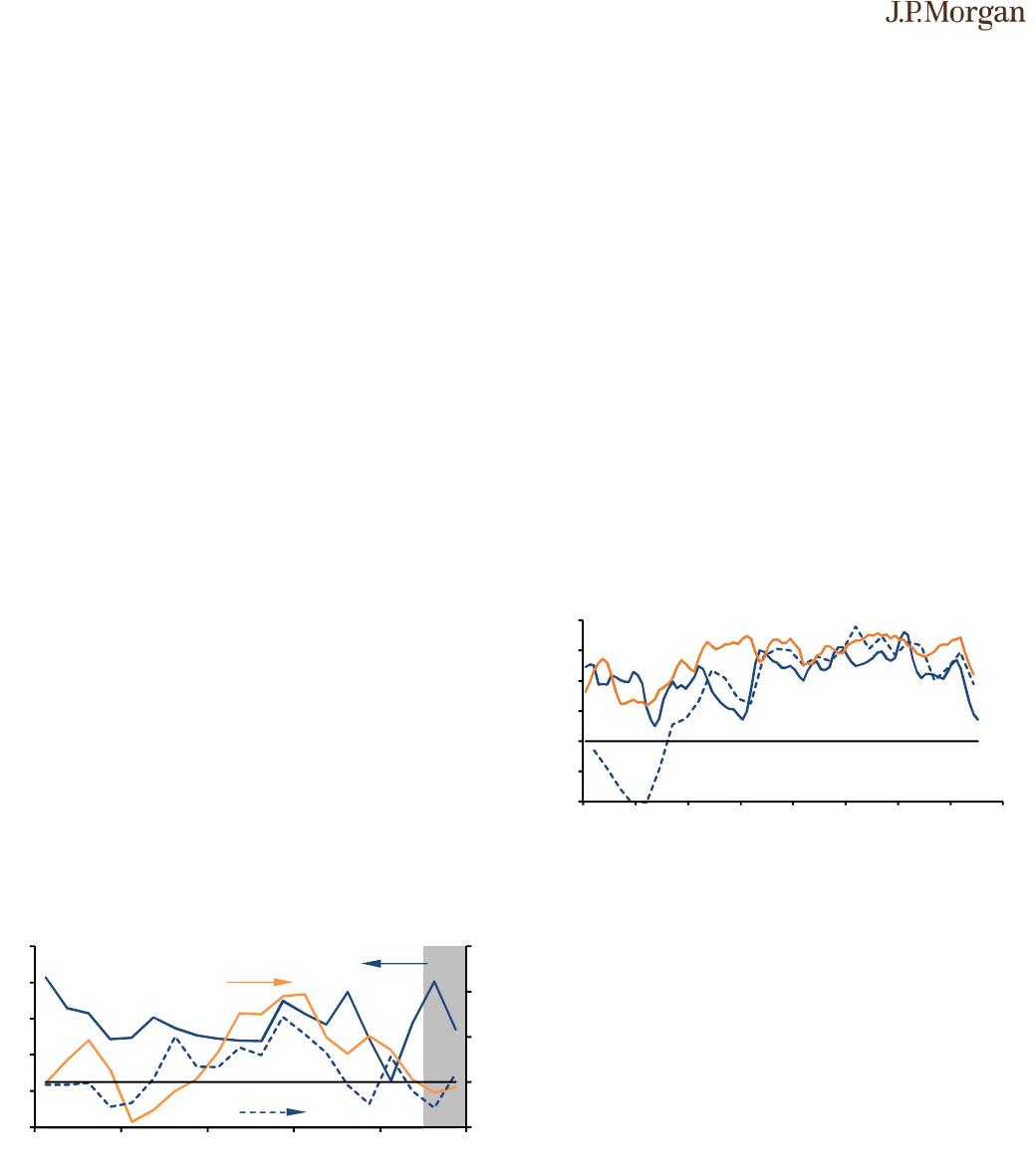
Figure 3: US real GDP components
Source: J.P. Morgan
Private consumption
Exports
Equipment
-1.0
-0.5
0.0
0.5
1.0
1.5
2.0
12 13 14 15 16 17 18 19 20
%3m3m, saar
Figure 4: Global employment
Source: J.P. Morgan
Global
(thru Jun)
Germany
(thru Jul)
Euro area
(thru Jun)
of 88
50墨值下载
【版权声明】本文为墨天轮用户原创内容,转载时必须标注文档的来源(墨天轮),文档链接,文档作者等基本信息,否则作者和墨天轮有权追究责任。如果您发现墨天轮中有涉嫌抄袭或者侵权的内容,欢迎发送邮件至:contact@modb.pro进行举报,并提供相关证据,一经查实,墨天轮将立刻删除相关内容。
下载排行榜

评论