



Courtesy Behavior for Highly Automated Vehicles on Highway Interchanges.pdf
50墨值下载
Courtesy Behavior for Highly Automated Vehicles
on Highway Interchanges
Cristina Men
´
endez-Romero
1
, Mustafa Sezer
1
, Franz Winkler
1
, Christian Dornhege
2
and Wolfram Burgard
2
Abstract— On the highway, human drivers continuously
make decisions adapting their driving behavior. In some of
these, for example near highway ramp-entrances, they adjust
intuitively their own behavior in order to facilitate the merging
of the incoming vehicles. On highly automated vehicles, this
decision should be taken by the system. In such situations, not
only the own goal should be optimized but also the comfort of
the surrounding traffic. The ability to plan adequate courtesy
behaviors improves public acceptance of autonomous systems
and the comfort of the surrounding vehicles without consider-
ably decreasing the own comfort. We present a novel method
that automatically adapts the driving behavior, integrating the
merging intention of other vehicles. In contrast to other systems,
robustness is achieved by considering not only the most likely
evolution, but also the expected value of the possible outcomes
in real time. The flexibility of this method allows us to integrate
it within different planning systems. We are therefore able to
offer courtesy behaviors to other vehicles, thereby improving
the collective comfort and also safety of the situation. We
evaluate the method in simulation and in real world experiments
with our test vehicle. Results show an improvement of the
aggregate traffic comfort and in addition a reduction of critical
situations, as a result of applying our courtesy behavior to
different planning strategies.
I. INTRODUCTION
Vehicles of different automated levels are already ope-
rating on the streets and interacting with purely manually
human-driven vehicles. One challenge lies in situations that
a human driver solves in an intuitive way and that are still
non-trivial for the machine.
Particularly interesting are those situations that arise from
the politeness of the traffic participants. For many merging
situation as presented in Figure 1, human drivers antici-
pate the merging intention of other vehicles driving on the
neighbor lane and select a cooperative behavior. Drivers also
expect such cooperative behavior from automated vehicles.
In dense traffic situations, the vehicle should be able to adapt
its strategy in such situations where a light decrease of the
own comfort considerably improves the collective one. For
example if a merging vehicle is reaching the end of lane or
approaching a slower vehicle, the ego vehicle could decide
to open a gap by decelerating or changing the lane.
This paper focuses on such cooperative behaviors. After
the identification of a conflicting situation for a potential
merging vehicle, our vehicle assesses the options between
behaving cooperatively or following its own interest. The
1
C.Men
´
endez-Romero, M.Sezer and F.Winkler are with BMW Group,
Munich, Germany cristina.menendez@bmw.de
2
C.Dornhege and W.Burgard are with Autonomous Intelligent Systems,
University of Freiburg, D-79110 Freiburg, Germany
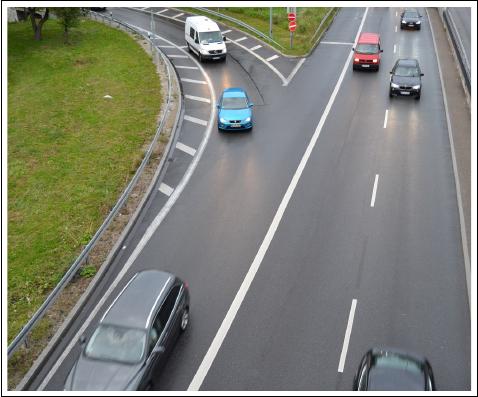
Fig. 1: On a merging scenario, incoming vehicles should
select the appropriate gap to merge and vehicles in the main
flow can cooperate to facilitate the maneuver.
challenge is to optimize safety and comfort over the evo-
lution of several possible scenes without the explosion of
computational costs.
Many works address the prediction of other traffic partici-
pants behavior. However, this behavior is only partially pre-
dictable and only accurate for a short time horizon. Classical
planning systems consider only the most likely evolution of
the situation, neglecting less likely actions that could result
in more dangerous situations. On the other extreme, some
approaches include all possible scene evolutions resulting in
too conservative systems or too high computational load to
be used for real-world applications.
The decision-making should deal with the uncertainties
derived from the behavior of other traffic participants in
an efficient way. This means that the trade-off between
computational load, comfort and safety should be optimized.
The focus of this work concerns the integration of the
intention of the merging vehicles within the decision-making
process.
In this paper we present a courtesy behavior method that
enhances several existing planning approaches. This method
allows to assess the adequacy for the ego vehicle to adapt
its own strategy in order to facilitate the merging maneuver
of a potential merging vehicle. As the main contribution the
improvement of two already existing planning approaches
using our method is presented. The limits between a good
2018 IEEE Intelligent Vehicles Symposium (IV)
Changshu, Suzhou, China, June 26-30, 2018
978-1-5386-4451-5/18/$31.00 ©2018 IEEE 943
intention and planning algorithm and the re-planning ability
of the system are also analyzed.
II. RELATED WORK
Human drivers analyze and anticipate the traffic situation.
In a similar manner, autonomous vehicles should integrate
a prediction of the behavior of other participants into their
driving task.
The problem of robots interacting on populated human
environments is not only focus of autonomous driving but
also point of interest of other robotic fields. Bennewitz et
al. [1] presented a method to predict the trajectories of per-
sons and improve the navigation behavior of a mobile robot.
Kuderer [2] and Kretzschmar [3] present a cooperative navi-
gation model for mobile robots interacting with pedestrians.
Nevertheless, when navigating on freeways and highways,
the topology is more structured and the velocities of the
traffic participants are higher, which requires consideration
of specific solutions.
In a near future, as presented by Hobert [4], the intercom-
munication between vehicles and infrastructure (V2X) will
allow to acquire a precise information about the intentions of
the traffic participants and the evolution of the situations. The
authors of [5] proposed an on-ramp merging system which
assessed the road traffic conditions and transmit the instruc-
tions to the vehicles on the surrounding area. The system
performs well but relies on an advanced infrastructure. V2X
technology presents encouraging results but the technology
is still not mature enough.
Thourought the last years several prediction methods for
traffic participants have been intensively studied in the lit-
erature. Different motion models like physic-based models,
maneuver-based models or interaction-aware based models
can be used for the prediction [6]. The integration of pre-
diction and intention information within the decision-making
process plays a crucial role in the system performance.
In [7] the authors compute the complete set of the
collision-free start and end points of trajectories for each
vehicle. This kind of intensive computations provide accurate
results in detriment of the online capability of the system.
Other strategies take the current most likely prediction and
rely on a continuous update of the available information and
fast re-planning system, as the multilevel planning system
presented by Men
´
endez-Romero et al. [8]. Carvalho et al. [9]
integrate the most likely cut-in prediction information to
improve the autonomous cruise control. The combination of
the most likely prediction with a fast re-planing works for
most of the situations quite well, but still does not consider
other possible interactions between the agents involved.
Iterative planning strategies combine the planning and pre-
diction tasks. Wei et al. [10] propose an intention prediction
based strategy generation. In [11] the authors suggest a game
theoretic approach which can model the re-planning capa-
bilities of the drivers. In [12] the decision-making is based
on Partially Observable Markov Decision Process (POMDP).
The multi-policy decision-making presented by Cunningham
et al. [13] also simulates the scene evolution using the most
likely evolution of the other agents involved in order to
reason about the policies. The problem with such iterative
planning approaches is that they only consider the most
likely evolution of the other traffic participants. Especially in
longer prediction horizons the model predictions can become
inaccurate and overlook some critical situations.
One step further, our proposed system not only anticipates
the behavior of other traffic participants to improve their own
safety but also plans a cooperative behavior to improve the
aggregate traffic comfort.
III. APPROACH
The objective of this work is to provide our system with
a courtesy behavior, which identifies the intention of other
traffic participants and assesses the cost of adapting the own
ego strategy. We achieve this by integrating an intention
prediction algorithm into the decision-making. Thereby we
gain a better foresight of the scene evolution by including
all possible outcomes to provide our system with robustness
over false predictions. Decisions are made based on maxi-
mizing the expected utility of the involved traffic participants.
A. Problem and Task Description
We semantically determine the possible actions for the
ego and the conflicting vehicle as shown in Tables I and II.
All possible ego actions are clustered as No Cooperative
(NC) and Cooperative (CO). Thus, the action space of
the ego vehicle is defined as A
eg o
:= {NC, CO}. For the
conflicting vehicle normal, courtesy and forced merge actions
are combined into the No Yield actions (N Y ), corresponding
to merging in front of the ego vehicle, and the Yield actions
(Y ). Thus, the action space of the conflicting vehicle is
defined as A
cv
:= {Y, NY }. The Cartesian product A =
A
eg o
× A
cv
defines the joint action space.
Our goal is to choose an action for the ego vehicle so that
the combined expected utility (U(a)) is maximized, i.e.,
a
∗
eg o
= argmax
a∈A
ego
E(U(a))
= argmax
a∈A
ego
X
a
cv
∈A
cv
p(a
cv
| a
eg o
) · U(a
eg o
, a
cv
).
(1)
This makes necessary to predict the intention of the merging
vehicle p(a
cv
| a
ego
), which is presented in the next sec-
tion. The description of the expected utilities is given in
Section III-C.
B. Prediction Module
In the state-of-the-art methods, the costs of actions are
computed for the most likely actions of other traffic partici-
pants. But these approaches lack the robustness against false
predictions. Our aim, on the other hand, is to predict the
probability of unlikely behavior of other traffic participants,
specifically the misprediction probability for the conflicting
vehicle. Using this probability we can compute the expected
utility of an ego action considering two possible decisions
of the conflicting vehicle.
In order to predict the probability of unlikely outcomes, we
use an ensemble learning based Gentle Boost classifier [14].
944
of 6
50墨值下载
【版权声明】本文为墨天轮用户原创内容,转载时必须标注文档的来源(墨天轮),文档链接,文档作者等基本信息,否则作者和墨天轮有权追究责任。如果您发现墨天轮中有涉嫌抄袭或者侵权的内容,欢迎发送邮件至:contact@modb.pro进行举报,并提供相关证据,一经查实,墨天轮将立刻删除相关内容。
下载排行榜

评论