



16.Edge Boxes_ Locating Object Proposals from Edges.pdf
50墨值下载
Edge Boxes: Locating
Object Proposals from Edges
C. Lawrence Zitnick and Piotr Doll´ar
Microsoft Research
Abstract. The use of object proposals is an effective recent approach
for increasing the computational efficiency of object detection. We pro-
pose a novel method for generating object bounding box proposals us-
ing edges. Edges provide a sparse yet informative representation of an
image. Our main observation is that the number of contours that are
wholly contained in a bounding box is indicative of the likelihood of the
box containing an object. We propose a simple box objectness score that
measures the number of edges that exist in the box minus those that
are members of contours that overlap the box’s boundary. Using efficient
data structures, millions of candidate boxes can be evaluated in a fraction
of a second, returning a ranked set of a few thousand top-scoring propos-
als. Using standard metrics, we show results that are significantly more
accurate than the current state-of-the-art while being faster to compute.
In particular, given just 1000 proposals we achieve over 96% object recall
at overlap threshold of 0.5 and over 75% recall at the more challenging
overlap of 0.7. Our approach runs in 0.25 seconds and we additionally
demonstrate a near real-time variant with only minor loss in accuracy.
Keywords: object proposals, object detection, edge detection
1 Introduction
The goal of object detection is to determine whether an object exists in an
image, and if so where in the image it occurs. The dominant approach to this
problem over the past decade has been the sliding windows paradigm in which
object classification is performed at every location and scale in an image [1–
3]. Recently, an alternative framework for object detection has been proposed.
Instead of searching for an object at every image location and scale, a set of
object bounding box proposals is first generated with the goal of reducing the
set of positions that need to be further analyzed. The remarkable discovery
made by these approaches [4–11] is that object proposals may be accurately
generated in a manner that is agnostic to the type of object being detected.
Object proposal generators are currently used by several state-of-the-art object
detection algorithms [5, 12, 13], which include the winners of the 2013 ImageNet
detection challenge [14] and top methods on the PASCAL VOC dataset [15].
High recall and efficiency are critical properties of an object proposal gen-
erator. If a proposal is not generated in the vicinity of an object that object
2 C. Lawrence Zitnick and Piotr Doll´ar
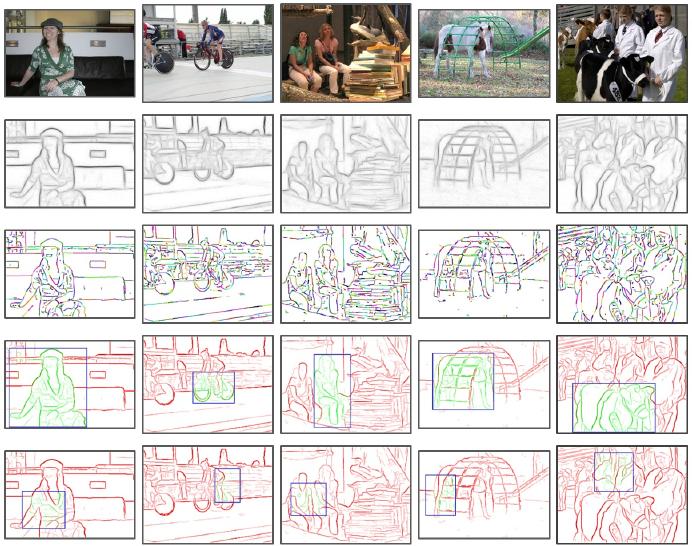
Fig. 1. Illustrative examples showing from top to bottom (first row) original image,
(second row) Structured Edges [16], (third row) edge groups, (fourth row) example
correct bounding box and edge labeling, and (fifth row) example incorrect boxes and
edge labeling. Green edges are predicted to be part of the object in the box (w
b
(s
i
) = 1),
while red edges are not (w
b
(s
i
) = 0). Scoring a candidate box based solely on the
number of contours it wholly encloses creates a surprisingly effective object proposal
measure. The edges in rows 3-5 are thresholded and widened to increase visibility.
cannot be detected. An effective generator is able to obtain high recall using a
relatively modest number of candidate bounding boxes, typically ranging in the
hundreds to low thousands per image. The precision of a proposal generator is
less critical since the number of generated proposals is a small percentage of the
total candidates typically considered by sliding window approaches (which may
evaluate tens to hundreds of thousands of locations per object category). Since
object proposal generators are primarily used to reduce the computational cost
of the detector, they should be significantly faster than the detector itself. There
is some speculation that the use of a small number of object proposals may even
improve detection accuracy due to reduction of spurious false positives [4].
In this paper we propose Edge Boxes, a novel approach to generating object
bounding box proposals directly from edges. Similar to segments, edges provide
a simplified but informative representation of an image. In fact, line drawings of
of 15
50墨值下载
【版权声明】本文为墨天轮用户原创内容,转载时必须标注文档的来源(墨天轮),文档链接,文档作者等基本信息,否则作者和墨天轮有权追究责任。如果您发现墨天轮中有涉嫌抄袭或者侵权的内容,欢迎发送邮件至:contact@modb.pro进行举报,并提供相关证据,一经查实,墨天轮将立刻删除相关内容。
下载排行榜

评论