



29.Image Completion with Structure Propagation.pdf
50墨值下载
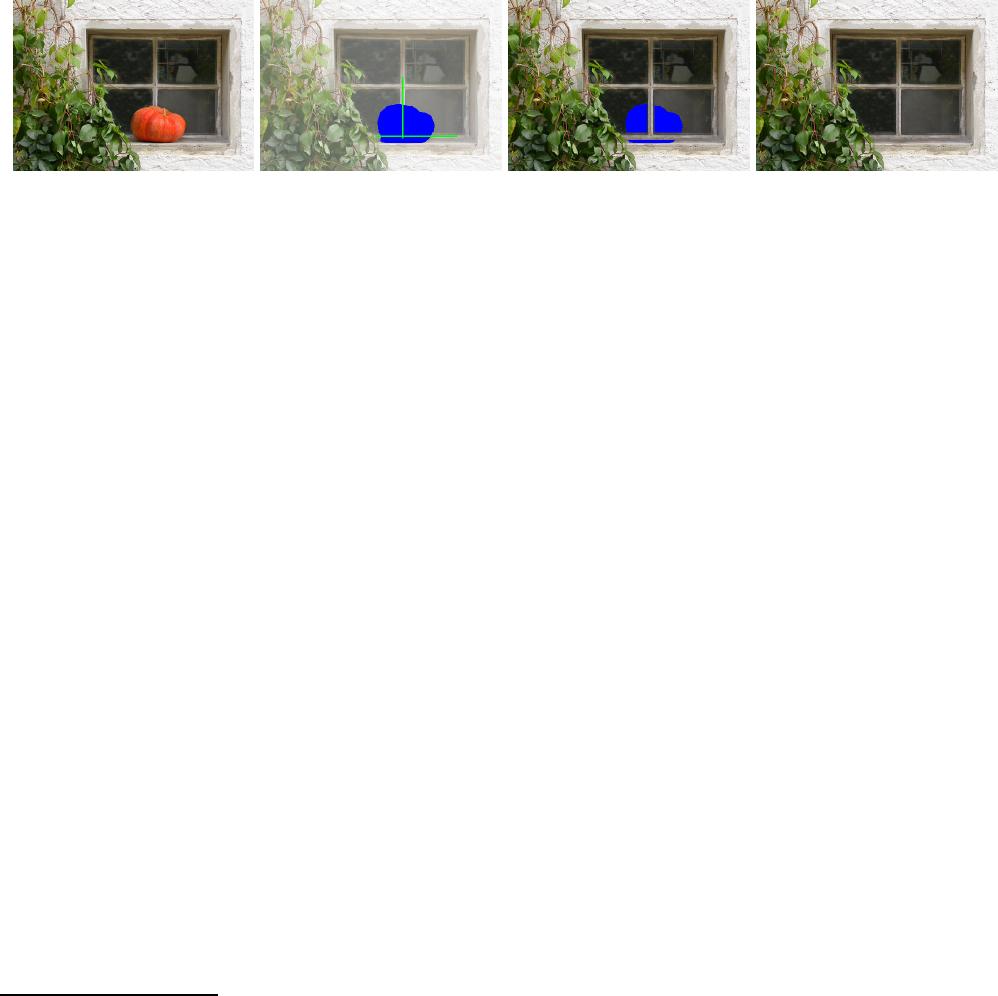
Image Completion with Structure Propagation
Jian Sun
1
Lu Yuan
2∗
Jiaya Jia
3†
Heung-Yeung Shum
1
1
Microsoft Research Asia
2
Tsinghua University
3
Chinese University of Hong Kong
(a) (b) (c) (d)
Figure 1: Image completion with structure propagation. (a) Input image, (b) unknown region (blue) after removing the pumpkin, with
two intersecting lines (green) specified by the user, (c) intermediate result after propagating structure and texture information along the
user-specified lines, and (d) final result after filling in the remaining unknown regions by texture propagation.
Abstract
In this paper, we introduce a novel approach to image com-
pletion, which we call structure propagation. In our system,
the user manually specifies important missing structure in-
formation by extending a few curves or line segments from
the known to the unknown regions. Our approach synthe-
sizes image patches along these user-specified cu rves in the
unknown region using patches selected around the curves in
the known region. Structure propagation is formulated as
a global optimization problem by enforcing structure and
consistency constraints. If only a single curve is specified,
structure propagation is solved using Dynamic Program-
ming. When multiple intersecting curves are specified, we
adopt the Belief Propagation algorithm to find the optimal
patches. After completing structure p ropagation, we fill in
the remaining unknown regions using patch-based texture
synthesis. We show that our approach works well on a num-
ber of examples that are challenging to state-of-the-art tech-
niques.
Keywords: Image Completion, Image Inp ainting, Dy-
namic Programming, Belief Propagation, User Interaction
1 Introduction
Image completion, also known as image inpainting, is a chal-
lenging problem in computer graphics and computer vision.
Image completion aims at fi lling in missing pixels in a large
unknown region of an image in a visually plausible way.
Given an input image I with an unknown or missing region
Ω, the goal of image completion is to propagate structure
∗
This work was done when Lu was an intern at MSR Asia.
†
This work was done while visiting MSR Asia.
and texture information from the known or existing regions
I − Ω to Ω, where I is the image region of I. Image com-
pletion is inherently an under-constrained problem.
1.1 Related work
Image inpainting, introduced by Bertalmio et al. [2000], fills
in holes in an image by propagating image Laplacians in
the isophote direction continuously from the exterior. Their
method is PDE-based and has its root in the Navier-Stokes
equation in fluid dynamics [Bertalmio et al. 2001]. The in-
painting problem has also been formulated in a variational
framework [Ballester et al. 2001]. Chan and Shen [2001]
incorporate Euler’s elastica as a prior to handle curve struc-
tures. Levin et al. [2003] perform image inpainting in the
gradient domain using an image-specified prior. Im age in-
painting techniques work at the pixel level, and have worked
well for small gaps, thin structures, and text overlays. How-
ever, for larger missing regions or textured regions, they may
generate blurring artifacts.
Example-based approaches [Igehy and Pereira 1997; Harri-
son 2001; Bornard et al. 2002; Barret and Cheney 2002]
have also been proposed for image completion by synthesiz-
ing pix els using texture synthesis techniques [Efros and Le-
ung 1999; Wei and Levoy 2000; Liang et al. 2001; Ashikhmin
2001; Efros and Freeman 2001; Hertzmann et al. 2001].
Recent example-based methods work at the image p atch
level [Drori et al. 2003; Criminisi et al. 2003; Bertalmio et al.
2003; Jia and Tang 2003]. They fill in unknown regions more
effectively by augmenting texture synthesis with some au-
tomatic guidance. This guidance determines the synthesis
ordering, which significantly improves the quality of com-
pletion by preserving some salient structures.
For example, a fast smoothing approximation is constructed
in a coarse-to-fine manner to guide an iterative completion
process by adaptive example fragments [Drori et al. 2003].
A confidence map is computed to determine the synthesis
ordering. A priority order is proposed to perform the com-
pletion [Criminisi et al. 2003]. The priority of each patch
is determined from both the confidence map and the image
edges in the patch to encourage propagation of linear struc-
tures. Bertalmio et al. [2003] decompose the input image
into texture and structure components that are completed
using texture synthesis and image inpainting, respectively.
The final result is the sum of the two completed components.
Based on texture segmentation, a tensor-voting algorithm is
introduced to smoothly link structures across holes to repair
images [Jia and Tang 2003].
Interactive guidance has also been p roposed. Previous sys-
tems have utilized source region selection, depth informa-
tion [P´erez et al. 2004], and “point of interest” [Drori et al.
2003] to further improve their completion results.
While previous approaches have produced some amazing re-
sults, they have difficulties completing images where com-
plex salient structures exist in the missing regions. Such
salient structures may include curves, T-junctions, and X-
junctions. A challenging example to previous techniques is
shown in Figure 1, where the region left by the removed
pumpkin needs to be filled in. Although the human vi-
sual system has the ability to perceptu ally complete missing
structures [Noe et al. 1998] (e.g., completing the window
frames occluded by the pumpkin in Figure 1), the underly-
ing mechanisms (e.g., visual Gestalt principles [Koffka 1935,
1967]) remain unclear. Moreover, previous patch-by-patch
completion algorithms operate in a greedy manner that may
also cause discontinuities in salient stru ctures. Due to the
inherent ambiguity of image completion from a single image,
we must leverage high-level knowledge.
1.2 Our Approach
Our approach is based on the following observations.
• For natu ral images, the most salient missing structures
can often be approximated by a few well-defined curves.
• There exists a synthesis ordering for image completion:
the regions with salient structures should be completed
before filling in other regions.
Therefore, our approach proceeds in three steps: user inter-
action to specify the curves, structure propagation to syn-
thesize regions with salient structures, and texture propaga-
tion to fill in the remaining unknown regions. Note that we
completely separate structure propagation and texture prop-
agation and perform structure propagation first. Compared
with previous methods, this completion process largely re-
duce the breaking of salient structures which human eyes are
sensitive to.
In our system, we allow t he user to draw a few curves that
extend from the known region to the unknown region to in-
dicate how the global structures should be completed. As
shown in Figure 1(b), two nearly perpendicular lines com-
plete the window frames. These two simple lines can sig-
nificantly reduce inherent ambiguity in the unknown regions
because they provide information on what structure should
be propagated and where texture can be obt ained. By draw-
ing a few curves or lines, the user can generate desirable
completed images by propagating the salient structures ac-
cordingly.
Given the user-sp ecified curves, our approach first synthe-
sizes t he missing structure and texture information along
the curves inside the unknown region. Unlike previous tech-
niques that synthesize image patches in a greedy patch-
by-patch manner, we formulate structure propagation as a
global optimization problem. For all the patches synthesized
on th e specified curves, the color difference in the overlap-
ping area between neighboring patches is globally minimized.
I
Ω
p
i
C
P
P (x
i
)
(a) (b)
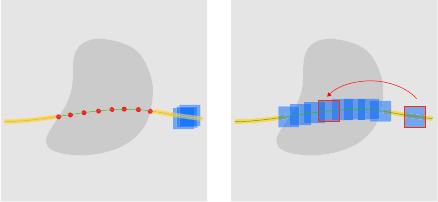
Figure 2: Structure propagation - 1D chain. (a) I is the
input image region, Ω is the unknown region and C is a user-
specified curve. St ructure propagation synthesizes missing
image patches on a set of anchor points {p
i
}
L
i=1
using the
sample set P. (b) P (x
i
) is a candidate patch in P which is
chosen for the anchor point p
i
.
If a single curve is specified by the user, we connect the
synthesized patches as a chain, and solve the optimization
problem effectively using dynamic programming. For multi-
ple intersecting curves, we connect the patches as a graph,
and adopt the efficient belief propagation algorithm for op-
timization. Figure 1(c) shows the intermediate result after
structure propagation using belief p ropagation.
The user-specified curves also partition the input image I
into several regions. Using patch-based texture synthesis,
texture propagation synthesizes the remaining missing re-
gions using samples from respective segmented regions. A
photometric correction method in the gradient domain fur-
ther improves the synthesis results. Figure 1(d) shows the
final result after filling in all unknown regions.
2 Structure Propagation
In this section, we introduce the concept of structure prop-
agation using a single curve C specified by the user. The
problem we address is how to synthesize missing structure
and texture along curve C in th e unknown region by using
samples around the curve in the known region. Applying
structure propagation for multiple non-intersecting curves is
straightforward. We will discuss the case of multiple inter-
secting curves in Section 3.
We first sparsely sample curve C in the unknown region
Ω to generate a set of L anchor points {p
i
}
L
i=1
. A s illus-
trated in Figure 2(a), the centers of the synthesized patches
are located at these anchor points, which form a single
chain, or a one-dimensional graph G = {V, E}. V is the
set of L nodes corresponding t o the anchor points, and
E is the set of all edges connecting adjacent no des on C.
The sampling interval is typically half of the patch size to
guarantee sufficient overlaps. Outside Ω, the sample set
P = {P (1), P (2), ..., P (N)} contains all patches whose cen-
ters are within a narrow band (typically 1-5 pixels wide)
along curve C, as shown in Figure 2(a). Typically the sam-
ple size N is in the order of hundreds or thousands.
We thus consider structure propagation as a graph labeling
problem. For each anchor position p
i
, we find a label x
i
∈
{1, 2, ..., N} corresponding t o one of the sample patches. We
select the sample p atch P (x
i
) from P, and paste it at point
p
i
as shown in Figure 2(b).
of 8
50墨值下载
【版权声明】本文为墨天轮用户原创内容,转载时必须标注文档的来源(墨天轮),文档链接,文档作者等基本信息,否则作者和墨天轮有权追究责任。如果您发现墨天轮中有涉嫌抄袭或者侵权的内容,欢迎发送邮件至:contact@modb.pro进行举报,并提供相关证据,一经查实,墨天轮将立刻删除相关内容。
下载排行榜

评论