



Time, Clocks, and the Ordering of Events in a Distributed System.pdf
100墨值下载
Operating R. Stockton Gaines
Systems Editor
Time, Clocks, and the
Ordering of Events in
a Distributed System
Leslie Lamport
Massachusetts Computer Associates, Inc.
The concept of one event happening before another
in a distributed system is examined, and is shown to
define a partial ordering of the events. A distributed
algorithm is given for synchronizing a system of logical
clocks which can be used to totally order the events.
The use of the total ordering is illustrated with a
method for solving synchronization problems. The
algorithm is then specialized for synchronizing physical
clocks, and a bound is derived on how far out of
synchrony the clocks can become.
Key Words and Phrases: distributed systems,
computer networks, clock synchronization, multiprocess
systems
CR Categories: 4.32, 5.29
Introduction
The concept of time is fundamental to our way of
thinking. It is derived from the more basic concept of
the order in which events occur. We say that something
happened at 3:15 if it occurred
after
our clock read 3:15
and
before
it read 3:16. The concept of the temporal
ordering of events pervades our thinking about systems.
For example, in an airline reservation system we specify
that a request for a reservation should be granted if it is
made
before
the flight is filled. However, we will see that
this concept must be carefully reexamined when consid-
ering events in a distributed system.
General permission to make fair use in teaching or research of all
or part of this material is granted to individual readers and to nonprofit
libraries
acting for them provided that ACM's copyright notice is given
and that reference is made to the publication, to its date of issue, and
to the fact that reprinting privileges were granted by permission of the
Association for Computing Machinery. To otherwise reprint a figure,
table, other substantial excerpt, or the entire work requires specific
permission as does republication, or systematic or multiple reproduc-
tion.
This work was supported by the Advanced Research Projects
Agency of the Department of Defense and Rome Air Development
Center. It was monitored by Rome Air Development Center under
contract number F 30602-76-C-0094.
Author's address: Computer Science Laboratory, SRI Interna-
tional, 333 Ravenswood Ave., Menlo Park CA 94025.
© 1978 ACM 0001-0782/78/0700-0558 $00.75
558
A distributed system consists of a collection of distinct
processes which are spatially separated, and which com-
municate with one another by exchanging messages. A
network of interconnected computers, such as the ARPA
net, is a distributed system. A single computer can also
be viewed as a distributed system in which the central
control unit, the memory units, and the input-output
channels are separate processes. A system is distributed
if the message transmission delay is not negligible com-
pared to the time between events in a single process.
We will concern ourselves primarily with systems of
spatially separated computers. However, many of our
remarks will apply more generally. In particular, a mul-
tiprocessing system on a single computer involves prob-
lems similar to those of a distributed system because of
the unpredictable order in which certain events can
occur.
In a distributed system, it is sometimes impossible to
say that one of two events occurred first. The relation
"happened before" is therefore only a partial ordering
of the events in the system. We have found that problems
often arise because people are not fully aware of this fact
and its implications.
In this paper, we discuss the partial ordering defined
by the "happened before" relation, and give a distributed
algorithm for extending it to a consistent total ordering
of all the events. This algorithm can provide a useful
mechanism for implementing a distributed system. We
illustrate its use with a simple method for solving syn-
chronization problems. Unexpected, anomalous behav-
ior can occur if the ordering obtained by this algorithm
differs from that perceived by the user. This can be
avoided by introducing real, physical clocks. We describe
a simple method for synchronizing these clocks, and
derive an upper bound on how far out of synchrony they
can drift.
The Partial Ordering
Most people would probably say that an event a
happened before an event b if a happened at an earlier
time than b. They might justify this definition in terms
of physical theories of time. However, if a system is to
meet a specification correctly, then that specification
must be given in terms of events observable within the
system. If the specification is in terms of physical time,
then the system must contain real clocks. Even if it does
contain real clocks, there is still the problem that such
clocks are not perfectly accurate and do not keep precise
physical time. We will therefore define the "happened
before" relation without using physical clocks.
We begin by defining our system more precisely. We
assume that the system is composed of a collection of
processes. Each process consists of a sequence of events.
Depending upon the application, the execution of a
subprogram on a computer could be one event, or the
execution of a single machine instruction could be one
Communications July 1978
of Volume 21
the ACM Number 7
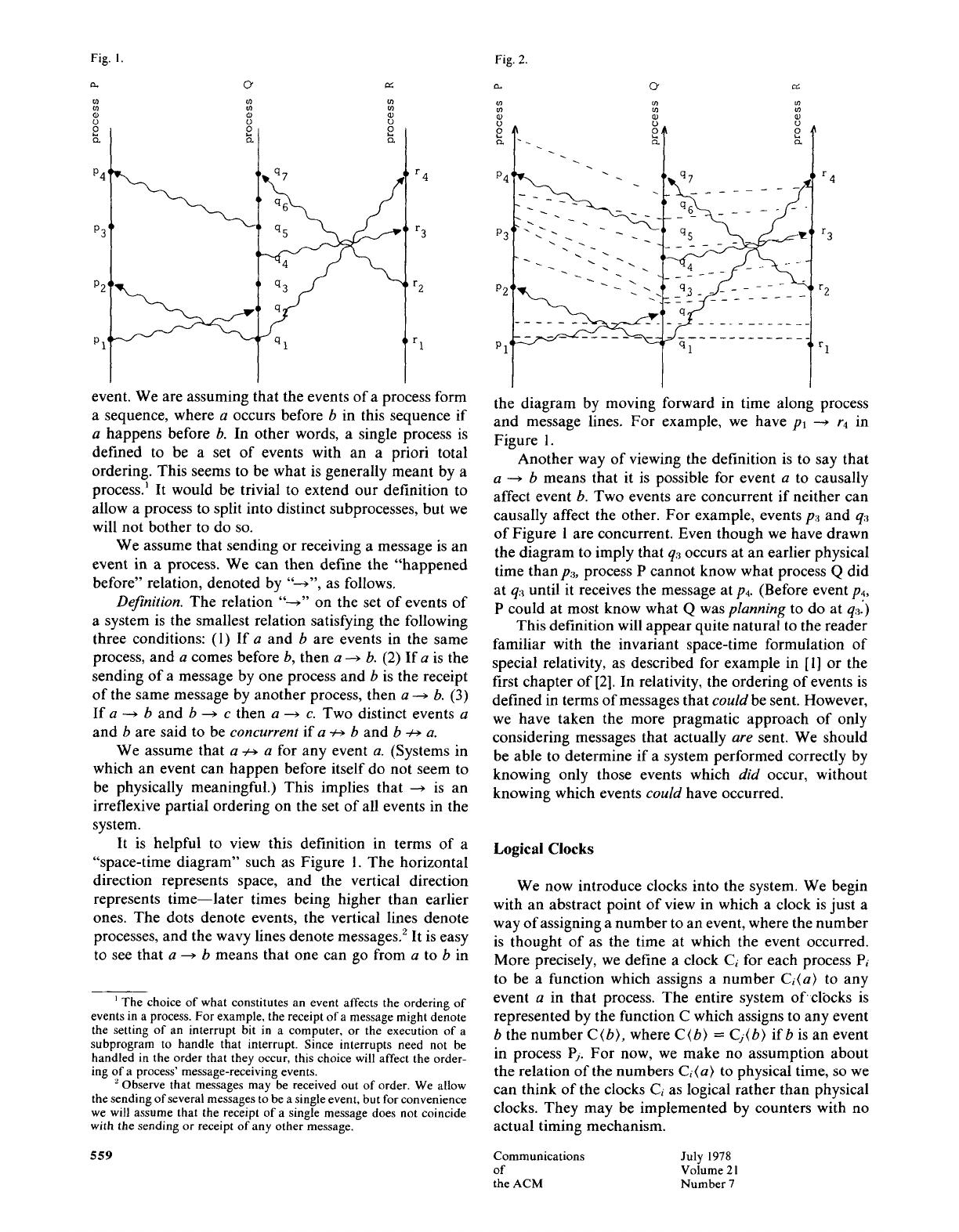
Fig. 1.
a, CY ,Y
(9 (9 ~o
~ o
P4'
P3
P2'
Pl ~
q7
q6
q5
ql
r 4
r 3
r 2
r 1
event. We are assuming that the events of a process form
a sequence, where a occurs before b in this sequence if
a happens before b. In other words, a single process is
defined to be a set of events with an a priori total
ordering. This seems to be what is generally meant by a
process.~ It would be trivial to extend our definition to
allow a process to split into distinct subprocesses, but we
will not bother to do so.
We assume that sending or receiving a message is an
event in a process. We can then define the "happened
before" relation, denoted by "---~", as follows.
Definition.
The relation "---->" on the set of events of
a system is the smallest relation satisfying the following
three conditions: (1) If a and b are events in the same
process, and a comes before b, then a ~ b. (2) If a is the
sending of a message by one process and b is the receipt
of the same message by another process, then a ~ b. (3)
If a ~ b and b ~ c then a ---* c. Two distinct events a
and b are said to be
concurrent
if a ~ b and b -/-* a.
We assume that a ~ a for any event a. (Systems in
which an event can happen before itself do not seem to
be physically meaningful.) This implies that ~ is an
irreflexive partial ordering on the set of all events in the
system.
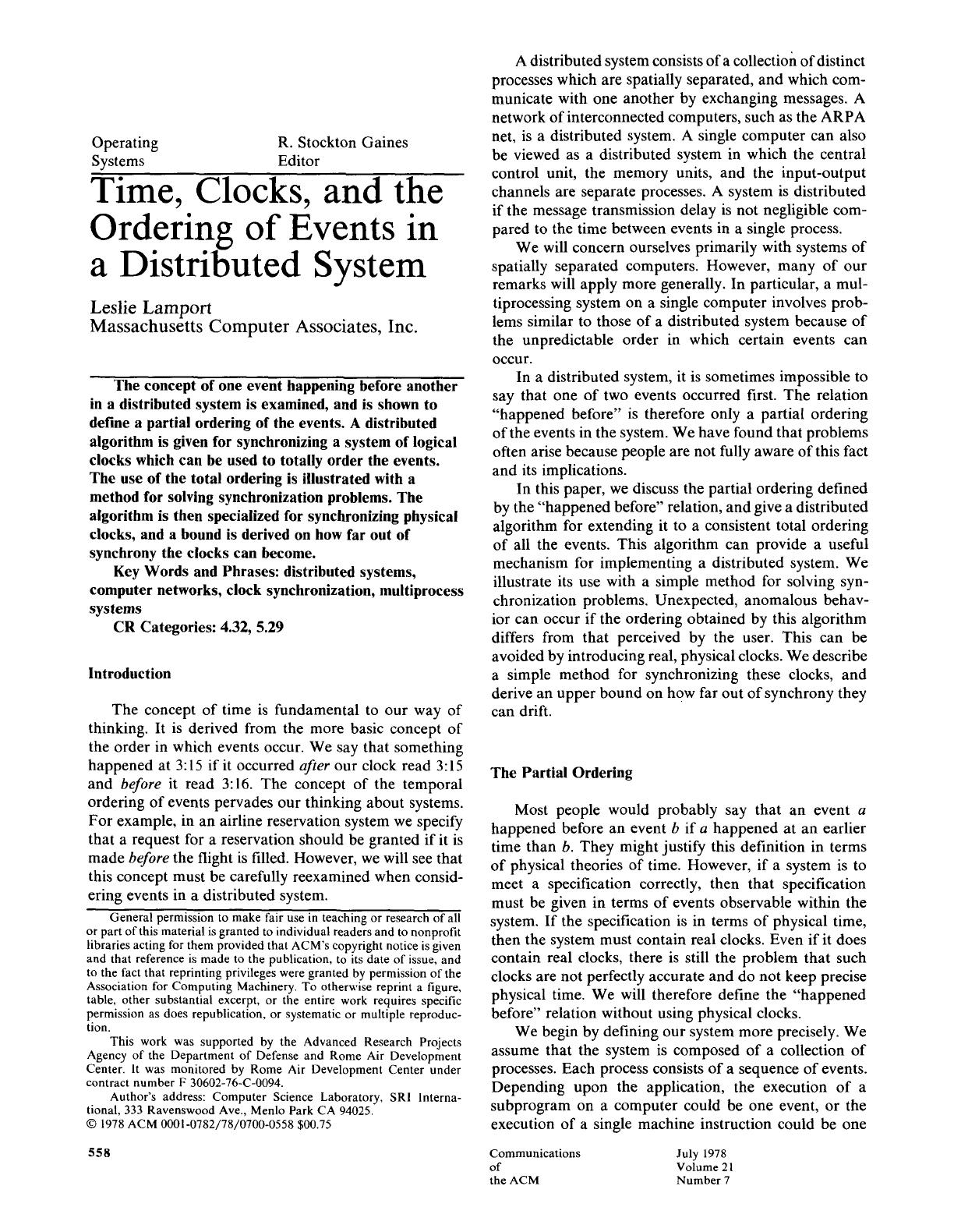
It is helpful to view this definition in terms of a
"space-time diagram" such as Figure 1. The horizontal
direction represents space, and the vertical direction
represents time--later times being higher than earlier
ones. The dots denote events, the vertical lines denote
processes, and the wavy lines denote messagesfl It is easy
to see that a ~ b means that one can go from a to b in
' The choice of what constitutes an event affects the ordering of
events in a process. For example, the receipt of a message might denote
the setting of an interrupt bit in a computer, or the execution of a
subprogram to handle that interrupt. Since interrupts need not be
handled in the order that they occur, this choice will affect the order-
ing of a process' message-receiving events.
2 Observe that messages may be received out of order. We allow
the sending of several messages to be a single event, but for convenience
we will assume that the receipt of a single message does not coincide
with the sending or receipt of any other message.
559
Fig. 2.
cy c~
(9 (9 ~)
O O U
-2 - - -
q6 -- ;#.i
Y _
P3' ~ ~ ~ ~ ~ _~~-~ r3
the diagram by moving forward in time along process
and message lines. For example, we have p, --~ r4 in
Figure 1.
Another way of viewing the definition is to say that
a --) b means that it is possible for event a to causally
affect event b. Two events are concurrent if neither can
causally affect the other. For example, events pa and q:~
of Figure 1 are concurrent. Even though we have drawn
the diagram to imply that q3 occurs at an earlier physical
time than
1)3,
process P cannot know what process Q did
at qa until it receives the message at p, (Before event p4,
P could at most know what Q was
planning
to do at
q:~.)
This definition will appear quite natural to the reader
familiar with the invariant space-time formulation of
special relativity, as described for example in [1] or the
first chapter of [2]. In relativity, the ordering of events is
defined in terms of messages that
could
be sent. However,
we have taken the more pragmatic approach of only
considering messages that actually
are
sent. We should
be able to determine if a system performed correctly by
knowing only those events which
did
occur, without
knowing which events
could
have occurred.
Logical Clocks
We now introduce clocks into the system. We begin
with an abstract point of view in which a clock is just a
way of assigning a number to an event, where the number
is thought of as the time at which the event occurred.
More precisely, we define a clock Ci for each process Pi
to be a function which assigns a number
Ci(a)
to any
event a in that process. The entire system ofclbcks is
represented by the function C which assigns to any event
b the number C(b), where C(b) = C/(b) ifb is an event
in process Pj. For now, we make no assumption about
the relation of the numbers Ci(a) to physical time, so we
can think of the clocks Ci as logical rather than physical
clocks. They may be implemented by counters with no
actual timing mechanism.
Communications July 1978
of Volume 21
the ACM Number 7
of 8
100墨值下载
【版权声明】本文为墨天轮用户原创内容,转载时必须标注文档的来源(墨天轮),文档链接,文档作者等基本信息,否则作者和墨天轮有权追究责任。如果您发现墨天轮中有涉嫌抄袭或者侵权的内容,欢迎发送邮件至:contact@modb.pro进行举报,并提供相关证据,一经查实,墨天轮将立刻删除相关内容。
下载排行榜

评论