



2017CVPR最佳论文-密集连接的卷积网络.pdf
50墨值下载
Densely Connected Convolutional Networks
Gao Huang
∗
Cornell University
gh349@cornell.edu
Zhuang Liu
∗
Tsinghua University
liuzhuang13@mails.tsinghua.edu.cn
Laurens van der Maaten
Facebook AI Research
lvdmaaten@fb.com
Kilian Q. Weinberger
Cornell University
kqw4@cornell.edu
Abstract
Recent work has shown that convolutional networks can
be substantially deeper, more accurate, and efficient to train
if they contain shorter connections between layers close to
the input and those close to the output. In this paper, we
embrace this observation and introduce the Dense Convo-
lutional Network (DenseNet), which connects each layer
to every other layer in a feed-forward fashion. Whereas
traditional convolutional networks with L layers have L
connections—one between each layer and its subsequent
layer—our network has
L(L+1)
2
direct connections. For
each layer, the feature-maps of all preceding layers are
used as inputs, and its own feature-maps are used as inputs
into all subsequent layers. DenseNets have several com-
pelling advantages: they alleviate the vanishing-gradient
problem, strengthen feature propagation, encourage fea-
ture reuse, and substantially reduce the number of parame-
ters. We evaluate our proposed architecture on four highly
competitive object recognition benchmark tasks (CIFAR-10,
CIFAR-100, SVHN, and ImageNet). DenseNets obtain sig-
nificant improvements over the state-of-the-art on most of
them, whilst requiring less computation to achieve high per-
formance. Code and pre-trained models are available at
https://github.com/liuzhuang13/DenseNet.
1. Introduction
Convolutional neural networks (CNNs) have become
the dominant machine learning approach for visual object
recognition. Although they were originally introduced over
20 years ago [
18], improvements in computer hardware and
network structure have enabled the training of truly deep
CNNs only recently. The original LeNet5 [
19] consisted of
5 layers, VGG featured 19 [
28], and only last year Highway
∗
Authors contributed equally
x
0
x
1
H
1
x
2
H
2
H
3
H
4
x
3
x
4
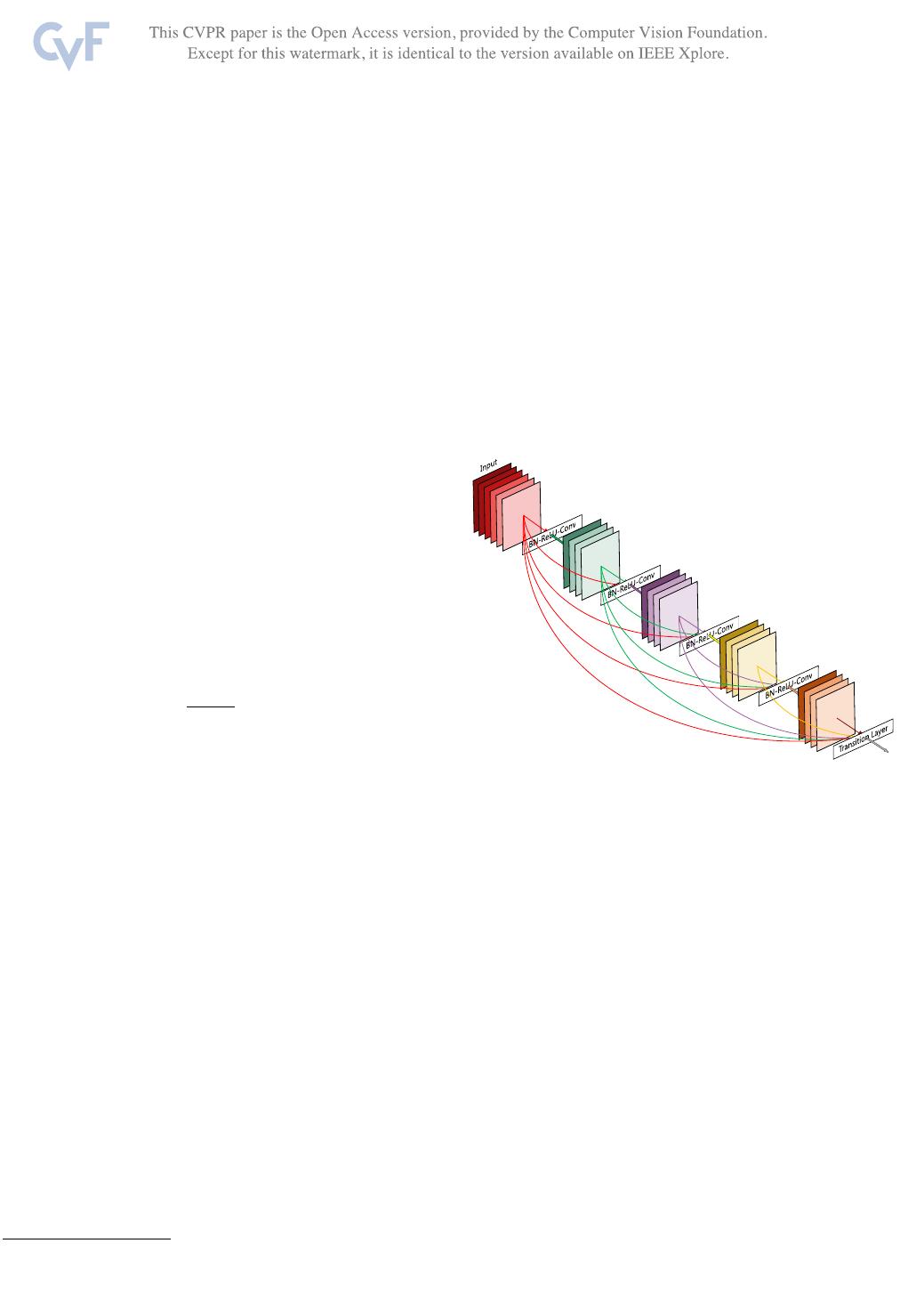
Figure 1: A 5-layer dense block with a growth rate of k = 4.
Each layer takes all preceding feature-maps as input.
Networks [33] and Residual Networks (ResNets) [11] have
surpassed the 100-layer barrier.
As CNNs become increasingly deep, a new research
problem emerges: as information about the input or gra-
dient passes through many layers, it can vanish and “wash
out” by the time it reaches the end (or beginning) of the
network. Many recent publications address this or related
problems. ResNets [
11] and Highway Networks [33] by-
pass signal from one layer to the next via identity connec-
tions. Stochastic depth [13] shortens ResNets by randomly
dropping layers during training to allow better information
and gradient flow. FractalNets [
17] repeatedly combine sev-
eral parallel layer sequences with different number of con-
volutional blocks to obtain a large nominal depth, while
maintaining many short paths in the network. Although
these different approaches vary in network topology and
training procedure, they all share a key characteristic: they
create short paths from early layers to later layers.
1
4700

In this paper, we propose an architecture that distills this
insight into a simple connectivity pattern: to ensure maxi-
mum information flow between layers in the network, we
connect all layers (with matching feature-map sizes) di-
rectly with each other. To preserve the feed-forward nature,
each layer obtains additional inputs from all preceding lay-
ers and passes on its own feature-maps to all subsequent
layers. Figure
1 illustrates this layout schematically. Cru-
cially, in contrast to ResNets, we never combine features
through summation before they are passed into a layer; in-
stead, we combine features by concatenating them. Hence,
the ℓ
th
layer has ℓ inputs, consisting of the feature-maps
of all preceding convolutional blocks. Its own feature-maps
are passed on to all L−ℓ subsequent layers. This introduces
L(L+1)
2
connections in an L-layer network, instead of just
L, as in traditional architectures. Because of its dense con-
nectivity pattern, we refer to our approach as Dense Convo-
lutional Network (DenseNet).
A possibly counter-intuitive effect of this dense connec-
tivity pattern is that it requires fewer parameters than tra-
ditional convolutional networks, as there is no need to re-
learn redundant feature-maps. Traditional feed-forward ar-
chitectures can be viewed as algorithms with a state, which
is passed on from layer to layer. Each layer reads the state
from its preceding layer and writes to the subsequent layer.
It changes the state but also passes on information that needs
to be preserved. ResNets [
11] make this information preser-
vation explicit through additive identity transformations.
Recent variations of ResNets [13] show that many layers
contribute very little and can in fact be randomly dropped
during training. This makes the state of ResNets similar
to (unrolled) recurrent neural networks [
21], but the num-
ber of parameters of ResNets is substantially larger because
each layer has its own weights. Our proposed DenseNet ar-
chitecture explicitly differentiates between information that
is added to the network and information that is preserved.
DenseNet layers are very narrow (e.g., 12 filters per layer),
adding only a small set of feature-maps to the “collective
knowledge” of the network and keep the remaining feature-
maps unchanged—and the final classifier makes a decision
based on all feature-maps in the network.
Besides better parameter efficiency, one big advantage of
DenseNets is their improved flow of information and gra-
dients throughout the network, which makes them easy to
train. Each layer has direct access to the gradients from the
loss function and the original input signal, leading to an im-
plicit deep supervision [20]. This helps training of deeper
network architectures. Further, we also observe that dense
connections have a regularizing effect, which reduces over-
fitting on tasks with smaller training set sizes.
We evaluate DenseNets on four highly competitive
benchmark datasets (CIFAR-10, CIFAR-100, SVHN, and
ImageNet). Our models tend to require much fewer param-
eters than existing algorithms with comparable accuracy.
Further, we significantly outperform the current state-of-
the-art results on most of the benchmark tasks.
2. Related Work
The exploration of network architectures has been a part
of neural network research since their initial discovery. The
recent resurgence in popularity of neural networks has also
revived this research domain. The increasing number of lay-
ers in modern networks amplifies the differences between
architectures and motivates the exploration of different con-
nectivity patterns and the revisiting of old research ideas.
A cascade structure similar to our proposed dense net-
work layout has already been studied in the neural networks
literature in the 1980s [
3]. Their pioneering work focuses on
fully connected multi-layer perceptrons trained in a layer-
by-layer fashion. More recently, fully connected cascade
networks to be trained with batch gradient descent were
proposed [
39]. Although effective on small datasets, this
approach only scales to networks with a few hundred pa-
rameters. In [
9, 23, 30, 40], utilizing multi-level features
in CNNs through skip-connnections has been found to be
effective for various vision tasks. Parallel to our work, [
1]
derived a purely theoretical framework for networks with
cross-layer connections similar to ours.
Highway Networks [
33] were amongst the first architec-
tures that provided a means to effectively train end-to-end
networks with more than 100 layers. Using bypassing paths
along with gating units, Highway Networks with hundreds
of layers can be optimized without difficulty. The bypass-
ing paths are presumed to be the key factor that eases the
training of these very deep networks. This point is further
supported by ResNets [
11], in which pure identity mappings
are used as bypassing paths. ResNets have achieved im-
pressive, record-breaking performance on many challeng-
ing image recognition, localization, and detection tasks,
such as ImageNet and COCO object detection [
11]. Re-
cently, stochastic depth was proposed as a way to success-
fully train a 1202-layer ResNet [13]. Stochastic depth im-
proves the training of deep residual networks by dropping
layers randomly during training. This shows that not all
layers may be needed and highlights that there is a great
amount of redundancy in deep (residual) networks. Our pa-
per was partly inspired by that observation. ResNets with
pre-activation also facilitate the training of state-of-the-art
networks with > 1000 layers [
12].
An orthogonal approach to making networks deeper
(e.g., with the help of skip connections) is to increase the
network width. The GoogLeNet [
35, 36] uses an “Incep-
tion module” which concatenates feature-maps produced
by filters of different sizes. In [
37], a variant of ResNets
with wide generalized residual blocks was proposed. In
fact, simply increasing the number of filters in each layer of
4701
of 10
50墨值下载
【版权声明】本文为墨天轮用户原创内容,转载时必须标注文档的来源(墨天轮),文档链接,文档作者等基本信息,否则作者和墨天轮有权追究责任。如果您发现墨天轮中有涉嫌抄袭或者侵权的内容,欢迎发送邮件至:contact@modb.pro进行举报,并提供相关证据,一经查实,墨天轮将立刻删除相关内容。
下载排行榜

评论