



深层语义的脸部去模糊.pdf
50墨值下载
Deep Semantic Face Deblurring
Ziyi Shen
1
Wei-Sheng Lai
2
Tingfa Xu
1∗
Jan Kautz
3
Ming-Hsuan Yang
2,4
1
Beijing Institute of Technology
2
University of California, Merced
3
Nvidia
4
Google Cloud
https://sites.google.com/site/ziyishenmi/cvpr18_face_deblur
Abstract
In this paper, we present an effective and efficient face
deblurring algorithm by exploiting semantic cues via deep
convolutional neural networks (CNNs). As face images are
highly structured and share several key semantic compo-
nents (e.g., eyes and mouths), the semantic information of
a face provides a strong prior for restoration. As such, we
propose to incorporate global semantic priors as input and
impose local structure losses to regularize the output within
a multi-scale deep CNN. We train the network with percep-
tual and adversarial losses to generate photo-realistic re-
sults and develop an incremental training strategy to handle
random blur kernels in the wild. Quantitative and qualita-
tive evaluations demonstrate that the proposed face deblur-
ring algorithm restores sharp images with more facial de-
tails and performs favorably against state-of-the-art meth-
ods in terms of restoration quality, face recognition and ex-
ecution speed.
1. Introduction
Single image deblurring aims to recover a clear image
from a single blurred input image. Conventional methods
model the blur process (assuming spatially invariant blur) as
the convolution operation between a latent clear image and
a blur kernel, and formulate this problem based on the max-
imum a posteriori (MAP) framework. As the problem is ill-
posed, the state-of-the-art algorithms rely on natural image
priors (e.g., L
0
gradient [48] and dark channel prior [31]) to
constrain the solution space.
While existing image priors are effective for deblurring
natural images, the underlying assumption may not hold
for images from specific categories, e.g., text, face and
low-light conditions. Therefore, numerous approaches ex-
ploit domain-specific priors or strategies, such as L
0
in-
tensity [30] for text images and light streaks [13] for ex-
tremely low-light images. As face images typically have
fewer textures and edges for estimating blur kernels, Pan et
∗
Corresponding author
(a) (b) (c) (d)
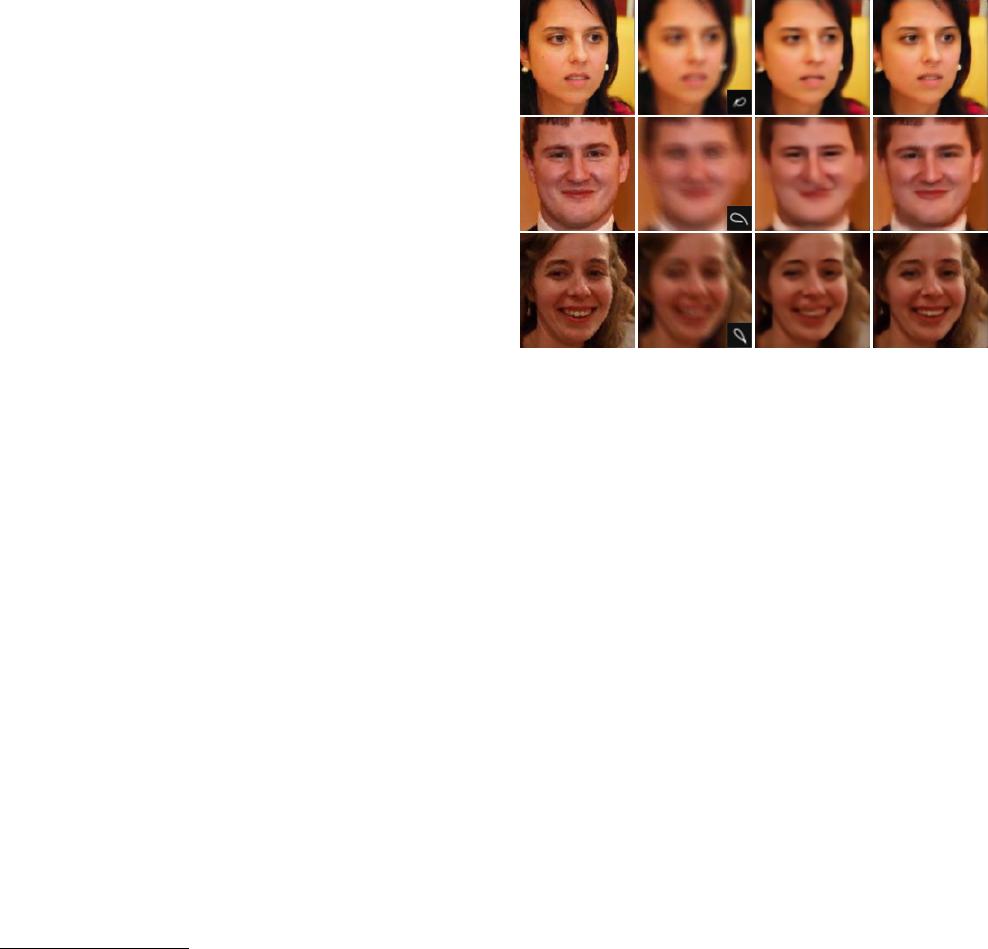
Figure 1. Face deblurring results. We exploit the semantic in-
formation of face within an end-to-end deep CNN for face image
deblurring. (a) Ground truth images (b) Blurred images (c) Ours
w/o semantics (d) Ours w/ semantics.
al. [29] propose to search a similar face exemplar from an
external dataset and extract the contour as reference edges.
However, a similar reference image may not always exist to
cover the diversity of face images in the wild. Furthermore,
those methods based on the MAP framework typically en-
tail heavy computational cost due to the iterative optimiza-
tion of latent images and blur kernels. The long execution
time limits the applications on resource-sensitive platforms,
e.g., cloud and mobile devices.
In this work, we focus on deblurring face images and
propose an efficient as well as effective solution using
deep CNNs. Since face images are highly structured and
composed of similar components, the semantic information
serves as a strong prior for restoration. Therefore, we pro-
pose to leverage the face semantic labels as global priors
and local constraints for deblurring face images. Specifi-
cally, we first generate the semantic labels of blurred input
images using a face parsing network. The face deblurring
network then takes the blurred image and semantic labels
as input to restore a clear image in a coarse-to-fine man-
1
arXiv:1803.03345v2 [cs.CV] 16 Mar 2018
ner. To encourage the network for generating fine details,
we further impose a local structure loss on important face
components (e.g., eyes, noses, and mouths). Figure 1 shows
deblurred examples with and without the proposed seman-
tic priors and losses. The proposed method is able to recon-
struct better facial details than the network trained with only
the pixel-wise L
1
loss function (i.e., without using seman-
tics). As our method is end-to-end without any blur kernel
estimation or post-processing, the execution time is much
shorter than the state-of-the-art MAP-based approaches.
To handle blurred images produced by unknown blur
kernels, existing methods typically synthesize blur kernels
by modeling the camera trajectories [4, 12] and generate a
large number of blurred images for training. Instead of si-
multaneously using all synthetic blurred images for train-
ing, we propose an incremental training strategy by first
training the network on a set of small blur kernels and then
incorporating larger blur kernels sequentially. We show that
the proposed incremental training strategy facilitates the
convergence and improves the performance of our deblur-
ring network on various sizes of blur kernels. Finally, we
impose a perceptual loss [14] and an adversarial loss [10] to
generate photo-realistic deblurred results.
We make the following contributions in this work:
• We propose a deep multi-scale CNN that exploits
global semantic priors and local structural constraints
for face image deblurring.
• We present an incremental strategy to train CNNs to
better handle unknown motion blur kernels.
• We demonstrate that the proposed method performs fa-
vorably against state-of-the-art deblurring approaches
in terms of restoration quality, face recognition and ex-
ecution speed.
2. Related Work
Single image deblurring can be categorized into non-
blind and blind deblurring based on whether the blur kernel
is available or not. We focus our discussion on blind image
deblurring in this section.
Generic methods. The recent progress in single im-
age blind deblurring can be attributed to the development
of effective natural image priors, including sparse image
gradient prior [8, 23], normalized sparsity measure [17],
patch prior [42], L
0
gradient [48], color-line model [18],
low-rank prior [34], self-similarity [27] and dark channel
prior [31]. Through optimizing the image priors within the
MAP framework, those approaches implicitly restore strong
edges for estimating the blur kernels and latent sharp im-
ages. However, solving complex non-linear priors involve
several optimization steps and entail high computational
loads. As such, edge-selection based methods [6, 46] adopt
simple image priors (e.g., L
2
gradients) with image filters
(e.g., shock filter) to explicitly restore or select strong edges.
While generic image deblurring methods demonstrate state-
of-the-art performance, face images have different statisti-
cal properties than natural scenes and cannot be restored
well using the above approaches.
Domain-specific methods. To handle images from spe-
cific categories, several domain-specific image deblurring
approaches have been developed. Pan et al. [30] introduce
the L
0
-regularized priors on both intensity and image gradi-
ents for text image deblurring as text images usually contain
nearly uniform intensity. To handle extreme cases such as
low-light images, Hu et al. [13] detect the light streaks in
images for estimating blur kernels. Anwar et al. [2] pro-
pose a frequency-domain class-specific prior to restore the
band-pass frequency components. In addition, a number
of approaches use reference images as guidance for non-
blind [43] and blind deblurring [11]. However, the perfor-
mance of such methods hinges on the similarity of the ref-
erence images and quality of dense correspondence.
As face images have fewer textures and edges, existing
algorithms based on implicit or explicit edge restoration are
less effective. Pan et al. [29] search for similar faces from
a face dataset and extract reference exemplar contours for
estimating blur kernels. However, this approach requires
manual annotations of the face contours and involves com-
putationally expensive optimization processes of blur ker-
nels and latent images in the MAP framework. In contrast,
we train an end-to-end deep CNN to bypass the blur ker-
nel estimation step and do not use any reference images or
manual annotations when deblurring an image.
CNN-based methods. Deep CNNs have been adopted
for several image restoration tasks, such as denois-
ing [26], JPEG deblocking [7], dehazing [35] and super-
resolution [16, 19]. Recent approaches apply deep CNNs
for image deblurring in several aspects, including non-blind
deconvolution [37, 47, 50], blur kernel estimation [38] and
dynamic scene deblurring [28]. Chakrabarti et al. [4] train
a deep network to predict the Fourier coefficients of a de-
convolution filter. Despite computational efficiency, these
CNN-based methods do not perform as well as the state-of-
the-art MAP-based approaches, especially on large motion
kernels.
Since text images usually contain uniform intensities
with fewer texture regions, an end-to-end deep network [12]
performs well, especially under large noise levels. Xu
et al. [49] aim to jointly deblur and super-resolve low-
resolution blurred face and text images, which are typically
degraded by Gaussian-like blur kernels. In this work, we
focus on deblurring face images from complex motion blur.
We exploit global and local semantic cues as well as per-
ceptual [14] and adversarial [10] losses to restore photo-
realistic face images with fine details.
of 11
50墨值下载
【版权声明】本文为墨天轮用户原创内容,转载时必须标注文档的来源(墨天轮),文档链接,文档作者等基本信息,否则作者和墨天轮有权追究责任。如果您发现墨天轮中有涉嫌抄袭或者侵权的内容,欢迎发送邮件至:contact@modb.pro进行举报,并提供相关证据,一经查实,墨天轮将立刻删除相关内容。
下载排行榜

评论