



学习智能对话框用于边界框注释.pdf
50墨值下载
Learning Intelligent Dialogs for Bounding Box Annotation
Ksenia Konyushkova
CVLab, EPFL
ksenia.konyushkova@epfl.ch
∗
Jasper Uijlings
Google AI Perception
jrru@google.com
Christoph H. Lampert
IST Austria
chl@ist.ac.at
Vittorio Ferrari
Google AI Perception
vittoferrari@google.com
Abstract
We introduce Intelligent Annotation Dialogs for bounding
box annotation. We train an agent to automatically choose
a sequence of actions for a human annotator to produce
a bounding box in a minimal amount of time. Specifically,
we consider two actions: box verification [
34
], where the
annotator verifies a box generated by an object detector, and
manual box drawing. We explore two kinds of agents, one
based on predicting the probability that a box will be posi-
tively verified, and the other based on reinforcement learning.
We demonstrate that (1) our agents are able to learn efficient
annotation strategies in several scenarios, automatically
adapting to the image difficulty, the desired quality of the
boxes, and the detector strength; (2) in all scenarios the re-
sulting annotation dialogs speed up annotation compared to
manual box drawing alone and box verification alone, while
also outperforming any fixed combination of verification and
drawing in most scenarios; (3) in a realistic scenario where
the detector is iteratively re-trained, our agents evolve a
series of strategies that reflect the shifting trade-off between
verification and drawing as the detector grows stronger.
1. Introduction
Many recent advances in computer vision rely on super-
vised machine learning techniques that are known to crave
for huge amounts of training data. Object detection is no
exception as state-of-the-art methods require a large number
of images with annotated bounding boxes around objects.
However, drawing high quality bounding boxes is expensive:
The official protocol used to annotate ILSVRC [
38
] takes
about 30 seconds per box [
43
]. To reduce this cost, recent
works explore cheaper forms of human supervision such as
image-level labels [
6
,
21
,
53
], box verification series [
34
],
point annotations [27, 33], and eye-tracking [31].
Among these forms, the recent work on box verification
series [
34
] stands out as it demonstrated to deliver high
quality detectors at low cost. The scheme starts from a given
∗
This work was done during an internship at Google AI Perception
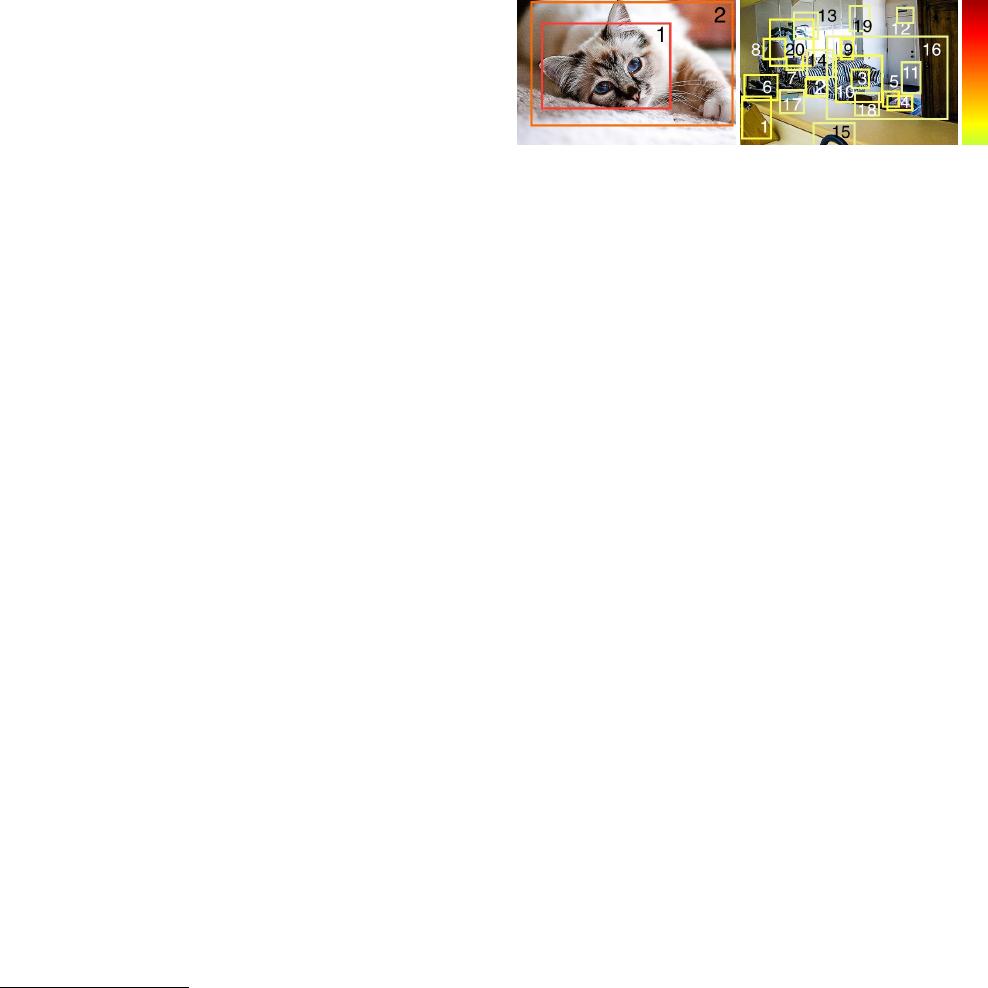
Figure 1: Left: an image with a target class cat. The weak
detector identified two box proposals with high scores. The
best strategy in this case is to do a series of box verifications.
Right: an image with a target class potted plant. The weak
detector identified many box proposals with low scores. The
best strategy is to draw a box.
weak detector, typically trained on image labels only, and
uses it to localize objects in the images. For each image, the
annotator is asked to verify whether the box produced by
the algorithm covers an object tightly enough. If not, the
process iterates: the algorithm proposes another box and the
annotator verifies it.
The success of box verification series depends on a variety
of factors. For example, large objects on homogeneous back-
grounds are likely to be found early in the series, and hence
require little annotation time (Fig. 1, left). However, small
objects in crowded scenes might require many iterations, or
could even not be found at all (Fig. 1, right). Furthermore,
the stronger the detector is, the more likely it is to correctly
localize new objects, and to do so early in the series. Finally,
the higher the desired box quality (i.e. how tight they should
be), the lower the rate of positively verified boxes. This
causes longer series, costing more annotation time. There-
fore, in some situations manual box drawing [
32
,
43
] is
preferable. While more expensive than one verification, it
always produces a box annotation. When an annotation
episode consists of many verifications, its duration can be
longer than the time to draw a box, depending on the relative
costs of the two actions. Thus, different forms of annotation
are more efficient in different situations.
In this paper we introduce Intelligent Annotation Dialogs
(IAD) for bounding box annotation. Given an image, detec-
tor, and target class to be annotated, the aim of IAD is to
automatically choose the sequence of annotation actions that
1
arXiv:1712.08087v3 [cs.CV] 20 Nov 2018

results in producing a bounding box in the least amount of
time. We train an IAD agent to select the type of action based
on previous experience in annotating images. Our method au-
tomatically adapts to the difficulty of the image, the strength
of the detector, the desired quality of the boxes, and other fac-
tors. This is achieved by modeling the episode duration as a
function of problem properties. We consider two alternative
ways to do this, either a) by predicting whether a proposed
box will be positively or negatively verified (Sec. 4.1), or
b) by directly predicting the episode duration (Sec. 4.2).
We evaluate IAD by annotating bounding boxes in the
PASCAL VOC 2007 dataset [
15
] in several scenarios:
a) with various desired quality levels; b) with detectors of
varying strength; and c) with two ways to draw bounding
boxes, including a recent method which only takes 7s per
box [
32
]. In all scenarios our experiments demonstrate that
thanks to its adaptive behavior IAD speeds up box annotation
compared to manual box drawing alone, or box verification
series alone. Moreover, it outperforms any fixed combina-
tion of them in most scenarios. Finally, we demonstrate
that IAD learns useful strategies in a complex realistic sce-
nario where the detector is continuously improved with the
growing amount of the training data. Our IAD code is made
publicly available
1
.
2. Related work
Drawing bounding boxes
Fully supervised object detec-
tors are trained on data with manually annotated bounding
boxes, which is costly. The reference box drawing inter-
face [
43
] used to annotate ILSVRC [
38
] requires 25.5s for
drawing one box. Recently, a more efficient interface re-
duces costs to 7.0s without compromising on quality [
32
].
We consider both interfaces in this paper.
Training object detectors from image-level labels
Weakly Supervised Object Localization (WSOL) [
6
,
13
,
14
,
16
,
21
,
53
] methods train object detectors from images la-
beled only as containing certain object classes, but without
bounding boxes. This avoids the cost of box annotation,
but leads to considerably weaker detectors than their fully
supervised counterparts [
6
,
16
,
21
,
53
]. To produce better
object detectors, extra human annotation is required.
Other forms of weak supervision
Several works aim to
reduce annotation cost of manual drawing by using ap-
proximate forms of annotation. Eye-tracking is used for
training object detectors [
31
] and for action recognition in
videos [
26
]. Point-clicks are used to derive bounding box
annotations in images [
33
] and video [
27
], and to train se-
mantic segmentation models [
2
,
3
,
50
]. Other works train
semantic segmentation models using scribbles [25, 51].
In this paper we build on box verification series [
34
],
where boxes are iteratively proposed by an object detector
1
https://github.com/google/intelligent_annotation_dialogs
and verified by a human annotator. Experiments show that
humans can perform box verification reliably (Fig.
6
of [
34
]).
Besides, the Open Images dataset [
23
] contains
2.5
Million
boxes annotated in this manner, demonstrating it can be done
at scale.
Interactive annotation
Several works use human-
machine collaboration to efficiently produce anno-
tations. These works address interactive segmenta-
tion [
8
,
37
,
12
,
18
,
17
,
30
], attribute-based fine-grained
image classification [
10
,
35
,
7
,
49
], and interactive video
annotation [
48
]. Branson et al. [
9
] transform different
types of location information (e.g. parts, bounding boxes,
segmentations) into each other with corrections from an
annotator. These works follow a predefined annotation pro-
tocol, whereas we explore algorithms that can automatically
select questions, adapting to the input image, the desired
quality of the annotation, and other factors.
The closest work [
39
] to ours proposes human-machine
collaboration for bounding box annotation. Given a reper-
toire of questions, the problem is modeled with a Markov
decision process. Our work differs in several respects.
(1) While Russakovsky et al. [
39
] optimizes the expected
precision of annotations over the whole dataset, our method
delivers quality guarantees on each individual box. (2) Our
approach of Sec 4.1 is mediated by predicting the probability
of a box to be accepted by an annotator. Based on this, we
provide a provably optimal strategy which minimizes the
expected annotation time. (3) Our reinforcement learning
approach of Sec. 4.2 learns a direct mapping from from
measurable properties to annotation time, while avoiding
any explicit modelling of the task. (4) Finally, we address a
scenario where the detector is iteratively updated (Sec. 5.3),
as opposed to keeping it fixed.
Active learning (AL)
In active learning the goal is to train
a model while asking human annotations for unlabeled ex-
amples which are expected to improve the model accuracy
the most. It is used in computer vision to train whole-image
classifiers [
20
,
22
], object class detectors [
47
,
52
], and se-
mantic segmentation [
41
,
45
,
46
]. While the goal of AL is
to select a subset of the data to be annotated, this paper aims
at minimizing the time to annotate each of the examples.
Reinforcement learning
Reinforcement learning (RL)
traditionally aims at learning policies that allow autonomous
agents to act in interactive environments. Reinforcement
learning has a long tradition e.g. in robotics [
1
,
28
,
24
]. In
computer vision, it has mainly been used for active vision
tasks [
11
,
4
,
19
], such as learning a policy for the spatial
exploration of large images or panoramic images. Our use
of RL differs from this, as we learn a policy for image anno-
tation, not for image analysis. The learned policy enables
the system to dynamically choose the annotation mechanism
by which to interact with the user.
of 11
50墨值下载
【版权声明】本文为墨天轮用户原创内容,转载时必须标注文档的来源(墨天轮),文档链接,文档作者等基本信息,否则作者和墨天轮有权追究责任。如果您发现墨天轮中有涉嫌抄袭或者侵权的内容,欢迎发送邮件至:contact@modb.pro进行举报,并提供相关证据,一经查实,墨天轮将立刻删除相关内容。
下载排行榜

评论