



LG电子-基于环视监控系统的场景理解自主驾驶网络.pdf
50墨值下载

Scene Understanding Networks for Autonomous Driving based on Around View
Monitoring System
JeongYeol Baek
1,*
, Ioana Veronica Chelu
2,*
, Livia Iordache
2
, Vlad Paunescu
2
, HyunJoo Ryu
1
,
Alexandru Ghiuta
2
, Andrei Petreanu
2
, YunSung Soh
1
, Andrei Leica
2
, and ByeongMoon Jeon
1,†
1
Convergence Center, LG Electronics, Korea
2
Arnia Software, Romania
Abstract
Modern driver assistance systems rely on a wide range
of sensors (RADAR, LIDAR, ultrasound and cameras) for
scene understanding and prediction. These sensors are typ-
ically used for detecting traffic participants and scene ele-
ments required for navigation. In this paper we argue that
relying on camera based systems, specifically Around View
Monitoring (AVM) system has great potential to achieve
these goals in both parking and driving modes with de-
creased costs. The contributions of this paper are as fol-
lows: we present a new end-to-end solution for delimiting
the safe drivable area for each frame by means of identi-
fying the closest obstacle in each direction from the driving
vehicle, we use this approach to calculate the distance to the
nearest obstacles and we incorporate it into a unified end-
to-end architecture capable of joint object detection, curb
detection and safe drivable area detection. Furthermore,
we describe the family of networks for both a high accuracy
solution and a low complexity solution. We also introduce
further augmentation of the base architecture with 3D ob-
ject detection.
1. Introduction
Visual environment perception plays a key role in the
development of autonomous vehicles, providing fundamen-
tal information on the driving scene, including free space
area and surrounding obstacles. These perception tasks can
gather information from various sensors - LIDARs, cam-
eras, RADARs or a fusion of them. Dense laser scanners
are capable of creating a dynamic three-dimensional map of
the environment and are best-suited for the task. However,
their costs are still very high to be integrated in reasonably
* These two authors contributed equally to this work.
† E-mail: bm.jeon@lge.com
priced vehicles. Driven by the latest advances in the field
of computer vision, we propose using only camera-based
systems, which have the potential to reach dense laser-scan
performance with lower cost. In particular, deep learning
has fueled an improvement in accuracy of classic object de-
tection and segmentation at an accelerated rate. However,
object detection systems alone are usually not sufficient for
autonomous emergency-braking and forward-collision sys-
tems, since the variety of possible road obstacles (e.g. tree
branches, small animals) and road structure (e.g. country
roads, different textures) make it impractical to train only
typical object detection networks and road segmentation
networks for scene understanding. To tackle these prob-
lems, we present two main contributions:
• A new solution for delimiting the closest obstacles in
all directions of the driving vehicle through bottom
point estimation and curb detection, while also deter-
mining the exact distance to the nearest obstacles in
each direction.
• Integrating the obstacle detection network into a uni-
fied end-to-end solution capable of jointly delimiting
the free drivable area by means of obstacle bottom
point estimation, curb detection and 2D multi-scale ob-
ject detection for a low complexity solution.
Scene understanding systems require high accuracy to
ensure safety. However, model deployment on embedded
platforms calls for real-time inference speed for prompt
control and small model size for power-efficiency. We ad-
dress these requirements by developing a low complexity
solution which uses a light encoder network, benefits from
sharing computations (i.e sharing the encoder) amongst the
proposed perception tasks and uses single shot detection.
We demonstrate the viability of our unified solution by
showing that it achieves 16.7 fps on the Nvidia TX2 em-
bedded platform.
arXiv:1805.07029v1 [cs.CV] 18 May 2018
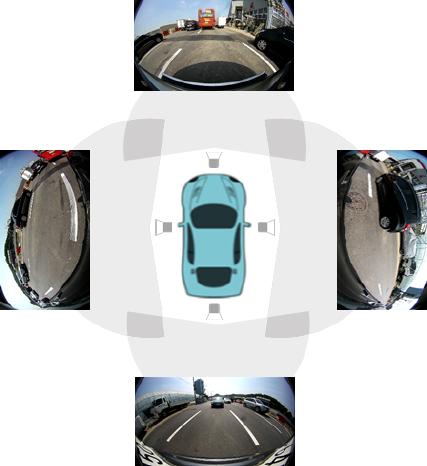
Figure 1. AVM camera system
Since 2D object detection sometimes provides insuffi-
cient information for scene understanding, we need to aug-
ment current solutions with 3D information to find the exact
pose of objects in the 3D world. We propose augmenting
the high accuracy solution to detect the orientation and di-
mension of each object.
This paper mainly focuses on detecting fundamental
scene information for safe driving: object detection, curb
detection, free drivable area segmentation, object distance
from the camera and object orientation. We test our ap-
proach on a novel dataset consisting of fisheye images. A
fisheye image is a wide-angle and distorted image which
is generally used for Around View Monitoring (AVM) sys-
tems (Figure 1). The advantage of using fisheye cameras in
the field of autonomous driving is obvious, as they offer a
much wider field of view (190°) than conventional cameras,
thus capturing more relevant information of the car’s sur-
roundings (pedestrians, obstacles, etc.). The four cameras
are positioned at the front, rear, left, and right side of the
vehicle and give drivers a 360° view of their surroundings
so as to check for obstructions around the vehicle.
2. Related Work
In this section we present a review on recent approaches
for the tasks that we explore in the rest of the paper, i.e.
object detection, classification, free space segmentation and
3D orientation.
Free space detection: State-of-the-art methods for de-
tecting drivable area surface usually frame the problem in
terms of road segmentation. Fully Convolutional Networks
(FCN) [8] use a convolutional network to perform spatially
dense prediction tasks like semantic segmentation using
transposed convolutions to model upsample layers. Later,
dilated convolutions [16] were also introduced to augment
the receptive field of the network. The existing research
generally tackles pixel segmentation networks or depth map
derivation using stereo cameras. With these methods, un-
classified pixels require complex post-processing to handle
them. In this paper we propose using a simpler architecture
for detecting obstacles and free space detection by identi-
fying the bottom points of each obstacle in all directions of
the driving vehicle.
Object detection: Modern neural network approaches
to object detection can be divided into two categories: re-
gion proposal based methods and single-shot methods. The
former category covers approaches like Faster R-CNN [10]
that have a two-step process which involves first generating
region proposals using an RPN (region proposal network)
and then scoring them using a secondary module. In the
single-shot network approach [7], the region proposal and
classification stages are integrated into one single stage, by
using predefined anchor boxes (priors) like a sliding win-
dow that moves through each spatial position on the feature
map to concurrently predict bounding boxes and class confi-
dence scores. Performing region proposal and classification
network simultaneously makes this approach extremely fast
in comparison with two-stage methods.
3D Object detection: 3D object detection has gathered
significant consideration lately due to its key contribution
in applications that require interactions with objects in real-
world scenarios, as in autonomous driving. This issue has
been addressed from a purely geometric point of view (e.g.
estimating the pose of an object with 6DoF from a single
image), as well as using DCNNs (deep convolutional neu-
ral networks) in order to reconstruct 3D models. In [11],
Rothganger et al. use local affine-invariant image descrip-
tors in order to construct 3D models of object instances in
2D images and then matching them with 3D poses in the
image. In [3], Hara et al. demonstrate DCNN effectiveness
in estimating the 0° to 360° orientation of objects. Mousa-
vian et al. [9] use a DCNN to regress stable 3D object fea-
tures, while other methods exploit depth information from
stereo images [1], or combine temporal information using
structure from motion algorithms in order to augment 2D
detections with 3D information.
3. Networks for Scene Understanding
In this section we give a detailed description of network
architectures which we propose for AVM scene understand-
ing, including object detection, free/drivable area segmen-
tation, object distance and object orientation. For 2D object
detection we investigate standard object detection networks
such as Faster R-CNN and SSD [7]. We also experiment
of 9
50墨值下载
【版权声明】本文为墨天轮用户原创内容,转载时必须标注文档的来源(墨天轮),文档链接,文档作者等基本信息,否则作者和墨天轮有权追究责任。如果您发现墨天轮中有涉嫌抄袭或者侵权的内容,欢迎发送邮件至:contact@modb.pro进行举报,并提供相关证据,一经查实,墨天轮将立刻删除相关内容。
下载排行榜

评论