



仔细研究域名转换:语义一致域适应的类别级别对手.pdf
50墨值下载
Taking A Closer Look at Domain Shift:
Category-level Adversaries for Semantics Consistent Domain Adaptation
Yawei Luo
1,2
, Liang Zheng
3
, Tao Guan
1
, Junqing Yu
1
, Yi Yang
2
1
School of Computer Science & Technology, Huazhong University of Science & Technology
2
CAI, University of Technology Sydney
3
Research School of Computer Science, Australian National University
Abstract
We consider the problem of unsupervised domain adapta-
tion in semantic segmentation, in which the source domain is
fully annotated, and the target domain is unlabeled. The key
in this campaign consists in reducing the domain shift, i.e.,
enforcing the data distributions of the two domains to be sim-
ilar. A popular strategy is to align the marginal distribution
in the feature space through adversarial learning. However,
this global alignment strategy does not consider the local
category-level feature distribution. A possible consequence
of the global movement is that some categories which are
originally well aligned between the source and target may
be incorrectly mapped. To address this problem, this paper
introduces a category-level adversarial network, aiming to
enforce local semantic consistency during the trend of global
alignment. Our idea is to take a close look at the category-
level data distribution and align each class with an adaptive
adversarial loss. Specifically, we reduce the weight of the
adversarial loss for category-level aligned features while
increasing the adversarial force for those poorly aligned. In
this process, we decide how well a feature is category-level
aligned between source and target by a co-training approach.
In two domain adaptation tasks, i.e., GTA5
→
Cityscapes
and SYNTHIA
→
Cityscapes, we validate that the proposed
method matches the state of the art in segmentation accuracy.
1. Introduction
Semantic segmentation aims to assign each pixel of a
photograph to a semantic class label. Currently, the achieve-
ment is at the price of large amount of dense pixel-level
annotations obtained by expensive human labor [
4
,
18
]. An
alternative would be resorting to simulated data, such as com-
puter generated scenes [
24
,
25
], so that unlimited amount
of labels are made available. However, models trained with
the simulated images do not generalize well to realistic do-
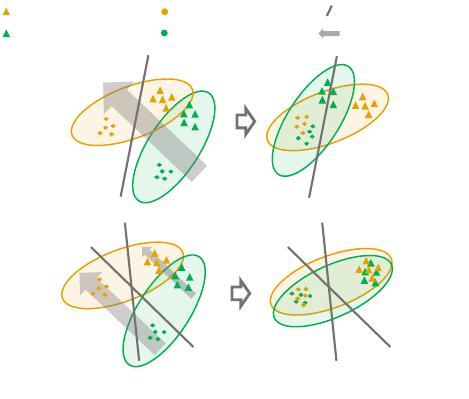
Source sample, class A
Target sample, class A
Source sample, class B
Target sample, class B
(a) Classical adversarial loss
(b) Self-adaptive adversarial loss
Classifier boundary
Adversarial loss
Source
Source
Source
Source
Target
Target
Target
Target
Figure 1. (Best viewed in color.) Illustration of traditional and the
proposed adversarial learning. The size of the solid gray arrow
represents the weight of the adversarial loss. (a) Traditional adver-
sarial learning ignores the semantic consistency when pursuing the
marginal distribution alignment. As a result, the global movement
might cause the well-aligned features (class A) to be mapped onto
different distributions. (b) The proposed self-adaptive adversar-
ial learning re-weights the adversarial loss for each feature by a
local alignment score. Our method reduces the influence of the
adversaries when discovers a high semantic alignment score on a
feature, and vice versa. As is shown, the proposed strategy achieves
category-level distribution alignment for both class A and class B.
mains. The reason lies in the different data distributions
of the two domains, typically known as domain shift. To
address this issue, domain adaptation approaches are pro-
posed to bridge the gap between the source and target do-
mains. In practice, unsupervised domain adaptation (UDA)
is concerned and studied more commonly since it minimizes
human labor. Under the UDA setting, a majority of recent
methods [
19
,
31
,
34
,
33
] aim to align the feature distributions
1
arXiv:1809.09478v2 [cs.CV] 27 Sep 2018
加入“知识星球 行业与管理资源”库,免费下载报告合集
1.
每月上传分享2000+份最新行业资源(涵盖科技、金融、教育、互联网、
房地产、生物制药、医疗健康等行研报告、科技动态、管理方案等);
2. 免费下载资源库已存行业报告。
3. 免费下载资源库已存国内外咨询公司管理方案与企业运营制度等。
4. 免费下载资源库已存科技方案、论文、报告及课件。
微信扫码二维码,免费报告轻松领
微信扫码加入“知识星球 行业与管理资源”,
获取更多行业报告、管理文案、大师笔记
加入微信群,每日获取免费3+份报告
1.
扫一扫二维码,添加客服微信(微信号:Teamkon2)
2.
添加好友请备注:姓名+单位+业务领域
3. 群主将邀请您进专业行业报告资源群
of 11
50墨值下载
【版权声明】本文为墨天轮用户原创内容,转载时必须标注文档的来源(墨天轮),文档链接,文档作者等基本信息,否则作者和墨天轮有权追究责任。如果您发现墨天轮中有涉嫌抄袭或者侵权的内容,欢迎发送邮件至:contact@modb.pro进行举报,并提供相关证据,一经查实,墨天轮将立刻删除相关内容。
下载排行榜

评论