



视觉问答的视觉-文本注意力焦点.pdf
50墨值下载
Focal Visual-Text Attention for Visual Question Answering
Junwei Liang
1
Lu Jiang
2
Liangliang Cao
3
Li-Jia Li
2
Alexander Hauptmann
1
1
Carnegie Mellon University
2
Google Inc.
3
HelloVera AI
{junweil,alex}@cs.cmu.edu, {lujiang,lijiali}@google.com, liangliang.cao@gmail.com
Abstract
Recent insights on language and vision with neural net-
works have been successfully applied to simple single-
image visual question answering. However, to tackle real-
life question answering problems on multimedia collections
such as personal photos, we have to look at whole collec-
tions with sequences of photos or videos. When answering
questions from a large collection, a natural problem is to
identify snippets to support the answer. In this paper, we
describe a novel neural network called Focal Visual-Text
Attention network (FVTA) for collective reasoning in visual
question answering, where both visual and text sequence in-
formation such as images and text metadata are presented.
FVTA introduces an end-to-end approach that makes use of
a hierarchical process to dynamically determine what me-
dia and what time to focus on in the sequential data to an-
swer the question. FVTA can not only answer the questions
well but also provides the justifications which the system re-
sults are based upon to get the answers. FVTA achieves
state-of-the-art performance on the MemexQA dataset and
competitive results on the MovieQA dataset.
1. Introduction
Language and vision have emerged as a popular re-
search area in computer vision. Visual question answer-
ing (VQA) [2] is a successful direction utilizing both com-
puter vision and natural language processing techniques to
solve an interesting problem: given a pair of image and a
question (in natural language), the goal is to learn an in-
ference model that can the answer questions according to
cues discovered from the image. A variety of methods have
been proposed to address the challenges from different as-
pects [5, 27, 14, 6, 20, 3, 16, 13], with remarkable progress
on answering about a single image.
Extending from VQA on a single image, this paper con-
siders the following problem: Suppose a user’s photos and
videos are organized in a sequence ordered by their creation
time. Some photos or videos may be associated with meta
labels or annotations such as time, GPS, captions, com-
ments, and meaningful title. We are interested in training
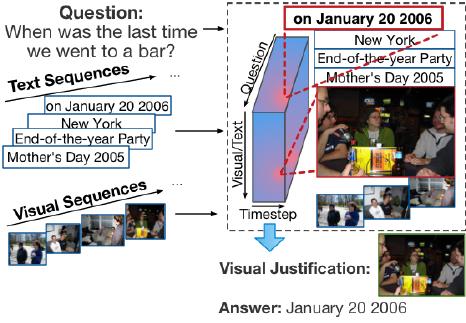
Figure 1. Focal Visual-Text Attention (FVTA) Mechanism. Given
the visual-text sequences input and the question, our temporal
visual-text attention tensor captures the temporal constraint in the
question and emphasizes the most recent image with ”bar” scene
visible. Then FVTA selects the appropriate attention region (the
“date”) and finds the correct answer.
a model to answer questions about these images and texts,
e.g. “when was the last time I went to a bar?” or “what did
my son do after his 2017 Halloween dinner party?”
There are two challenges to solve the above problem.
First, the input is provided in an unstructured form. The
question is associated with multiple sequences, in the form
of videos or images. Such sequences are temporally or-
dered, and each sequence contains multiple time steps. At
each time there are visual data, text annotations and other
metadata. In this paper, we call the format visual-text se-
quence data. Note that not all the photos and videos are
annotated, which requires a robust method to leverage in-
consistently available multimodal data.
The second challenge requires interpretable justifications
in addition to direct answer based on sequence data. To help
users with a lot of photos and videos, a natural requirement
is to identify the supporting evidence for the answer. An
example question as shown in Fig. 1, is “when was the last
time I went to a bar?” From the users’ viewpoint, a good QA
system should not only give a definite answer (e.g., January
20, 2016), but also ground evidential images or text snippets
in the input sequence to justify the reasoning process. Given
1
arXiv:1806.01873v1 [cs.CV] 5 Jun 2018

imperfect VQA models, humans often want to verify the
answer. The inspection process may be trivial for a single
image but can take a significant amount of time to examine
every image and the complete text words.
To address these two challenges, we propose a focal
visual-text attention (FVTA) model for sequential data
1
.
Our model is motivated by the reasoning process of humans.
In order to answer a question, a human would first quickly
skim the input and then focus on a few, small temporal re-
gions in the visual-text sequences to derive an answer. In
fact, statistics suggest that, on average, humans only need
1.5 images to answer a question after the skimming [9]. In-
spired by this process, FVTA first learns to localize relevant
information within a few, small, temporally consecutive re-
gions over the input sequences, and learns to infer an an-
swer based on the cross-modal statistics pooled from these
regions. FVTA proposes a novel kernel to compute the at-
tention tensor that jointly models the latent information in
three sources: 1) answer-signaling words in the question, 2)
temporal correlation within a sequence, and 3) cross-modal
interaction between the text and image. FVTA attention al-
lows for collective reasoning by the attention kernel learned
over a few, small, consecutive sub-sequences of text and
image. It can also produce a list of evidential images/texts
to justify the reasoning. As shown in Fig. 1, the highlighted
cubes are regions of high activations in the proposed FVTA.
To summarize, the contribution of this paper is threefold:
• We propose a novel attention kernel for VQA on
visual-text data. Experiments show that it outperforms
existing attention methods.
• The proposed attention tensor can be used to localize
evidential image and text snippets to explain the rea-
soning process. We quantitatively verify that the evi-
dence produced by our method are more correlated to
that of human annotators.
• Our method achieves the state-of-the-art results on two
VQA benchmarks.
2. Related Work
Visual Question Answering. Image-based visual ques-
tion answering has received a large amount of interest in the
computer vision community. A lot of efforts have been con-
ducted on single image QA datasets [2, 12, 31, 17, 26, 1],
where a common practice is to train a classifier by combin-
ing both question feature and visual features. A recent di-
rection is on the question answering based on videos, which
is more relevant to this work. A number of research stud-
ies have been carried on MovieQA [22, 10, 15], with movie
clips, scripts, and descriptions. Because it is expensive to
1
Code and models are released at https://memexqa.cs.cmu.
edu/fvta.html
annotate the video-based QA datasets, some research stud-
ies generate QA datasets by harvesting online videos and
descriptions [30, 29], while a recent study [7] considers
question answering using animated GIFs. This work dif-
fers from the existing video-based QA in two aspects: (1)
video-based QA is to answer questions based on a single
video, while our work can handle general visual-text se-
quences, where one user may have more than one video or
albums of photos. (2) most existing video-based QA meth-
ods map one video sequence with text into a context feature
vector, while our work explores a more fine-grained model
by modeling the correlation between query and sequence
data at every time step. To this end, we experiment on the
MemexQA dataset [9]. The sequential data in MemexQA
involves multiple modalities, including titles, timestamps,
GPS and visual content, render it an ideal test bed for QA
research over visual-text sequence data. Unlike the model
in [9], our method also uses the text embedding of the an-
swer choices as the input to answer a question.
Attention Mechanism. This work can be viewed as a
novel attention model for multiple variable-length sequen-
tial inputs, to take into account not only the visual-text in-
formation but also the temporal dependency. Our work ex-
tends the previous studies of using attention model for Im-
age QA [20, 4, 26, 13, 27, 16, 5, 3]. A key difference
between our method and classical attention model lies in
the fact we are modeling the correlation at every time step,
across multiple sequences. Existing attention mechanisms
for VQA mainly focus on attention within spatial regions of
an image [31] or within a single sequence [7], and hence,
may not fully exploit the multiple sequences and multiple
time steps nature. As Fig. 3 shows, our attention is applied
to a three-dimensional tensor, while the classic soft atten-
tion model is applied to a vector or matrix.
3. Approach
3.1. Problem Formulation
We start the discussion by formally defining the prob-
lem. Let Q = q
1
, · · · , q
M
represent a question of M words
Q ∈ Z
M
, where each word is an integer index in the vocab-
ulary. Define a context visual-text sequence of T examples
X = x
1
, · · · , x
T
, where for each example, x
img
t
represents
an image. x
txt
t
is its corresponding text sentence, where its
i-th word is indexed by x
txt
ti
. Following [2, 31], the answer
to a question is an integer y ∈ [1, L] over the answer vocab-
ulary of size L. Given a collection of n questions and their
context sequences, we are interested in learning a model
maximizing the following likelihood:
argmax
Θ
n
X
i=1
log P (y
i
|Q
i
, X
i
; Θ) (1)
where Θ represents the model parameters. Given the visual-
text sequence input X
img
, X
txt
, we obtain a good joint
of 10
50墨值下载
【版权声明】本文为墨天轮用户原创内容,转载时必须标注文档的来源(墨天轮),文档链接,文档作者等基本信息,否则作者和墨天轮有权追究责任。如果您发现墨天轮中有涉嫌抄袭或者侵权的内容,欢迎发送邮件至:contact@modb.pro进行举报,并提供相关证据,一经查实,墨天轮将立刻删除相关内容。
下载排行榜

评论