



Principles of Transaction-Oriented Database Recovery
免费下载
Principles of Transaction-Oriented Database Recovery
THEO HAERDER
Fachbereich Informatik, University of Kaiserslautern, West Germany
ANDREAS
REUTER 1
IBM Research Laboratory, San Jose, California 95193
In this paper, a terminological framework is provided for describing different transaction-
oriented recovery schemes for database systems in a conceptual rather than an
implementation-dependent way. By introducing the terms materialized database,
propagation strategy, and checkpoint, we obtain a means for classifying arbitrary
implementations from a unified viewpoint. This is complemented by a classification
scheme for logging techniques, which are precisely defined by using the other terms. It is
shown that these criteria are related to all relevant questions such as speed and scope of
recovery and amount of redundant information required. The primary purpose of this
paper, however, is to establish an adequate and precise terminology for a topic in which
the confusion of concepts and implementational aspects still imposes a lot of problems.
Categories and Subject Descriptors: D.4.5
[Operating Systems]:
Reliability--fau/t
tolerance;
H.1.0
[Models and
Principles]: General; H.2.2
[Database Management]:
Physical
Design--recovery and restart;
H.2.4
[Database Management]:
Systems--
transactmn processing;
H.2.7 [Database Management]: Database Administration--
logging and recovery
General Terms: Databases, Fault Tolerance, Transactions
INTRODUCTION
Database technology has seen tremendous
progress during the past ten years. Con-
cepts and facilities that evolved in the sin-
gle-user batch environments of the early
days have given rise to efficient multiuser
database systems with user-friendly inter-
faces, distributed data management, etc.
From a scientific viewpoint, database sys-
tems today are established as a mature
discipline with well-approved methods and
1
Permanent address: Fachbereich Informatik, Uni-
versity of Kaiserslautern, West Germany.
technology. The methods and technology
of such a discipline should be well repre-
sented in the literature by systematic sur-
veys of the field. There are, in fact, a num-
ber of recent publications that attempt to
summarize what is known about different
aspects of database management [e.g., As-
trahan et al. 1981; Stonebraker 1980; Gray
et al. 1981; Kohler 1981; Bernstein and
Goodman 1981; Codd 1982]. These papers
fall into two categories: (1) descriptions of
innovative prototype systems and (2) thor-
ough analyses of special problems and their
solutions, based on a clear methodological
and terminological framework. We are con-
Permission to copy without fee all or part of this material is granted provided that the copies are not made or
distributed for direct commercial advantage, the ACM copyright notice and the title of the publication and its
date appear, and notice is given that copying is by permission of the Association for Computing Machinery. To
copy otherwise, or to republish, requires a fee and/or specific permission.
© 1983 ACM 0360-0300/83/1200-0287 $00.75
Computing
Surveys, Vol. 1•, No. 4, December 1983
288 • T. Haerder and A. Reuter
CONTENTS
INTRODUCTION
1. DATABASE RECOVERY: WHAT IT IS
EXPECTED TO DO
1.1 What Is a Transaction?
1.2 Which Failures Have to Be Anticipated
1.3 Summary of Recovery Actions
2. THE MAPPING HIERARCHY OF A DBMS
2.1 The Mapping Process: Objects and Operations
2.2 The Storage Hierarchy: Implementational
Environment
2.3 Different Views of a Database
2.4 Mapping Concepts for Updates
3. CRASH RECOVERY
3.1 State of the Database after a Crash
3.2 Types of Log Information to Support
Recovery Actions
3.3 Examples of Recovery Techniques
3.4 Examples of Logging
and
Recovery Components
3 5 Evaluation of Logging
and
Recovery Concepts
4. ARCHIVE RECOVERY
5 CONCLUSION
ACKNOWLEDGMENTS
REFERENCES
v
tributing to the second category in the field
of database recovery. In particular, we are
establishing a systematic framework for es-
tablishing and evaluating the basic con-
cepts for fault-tolerant database operation.
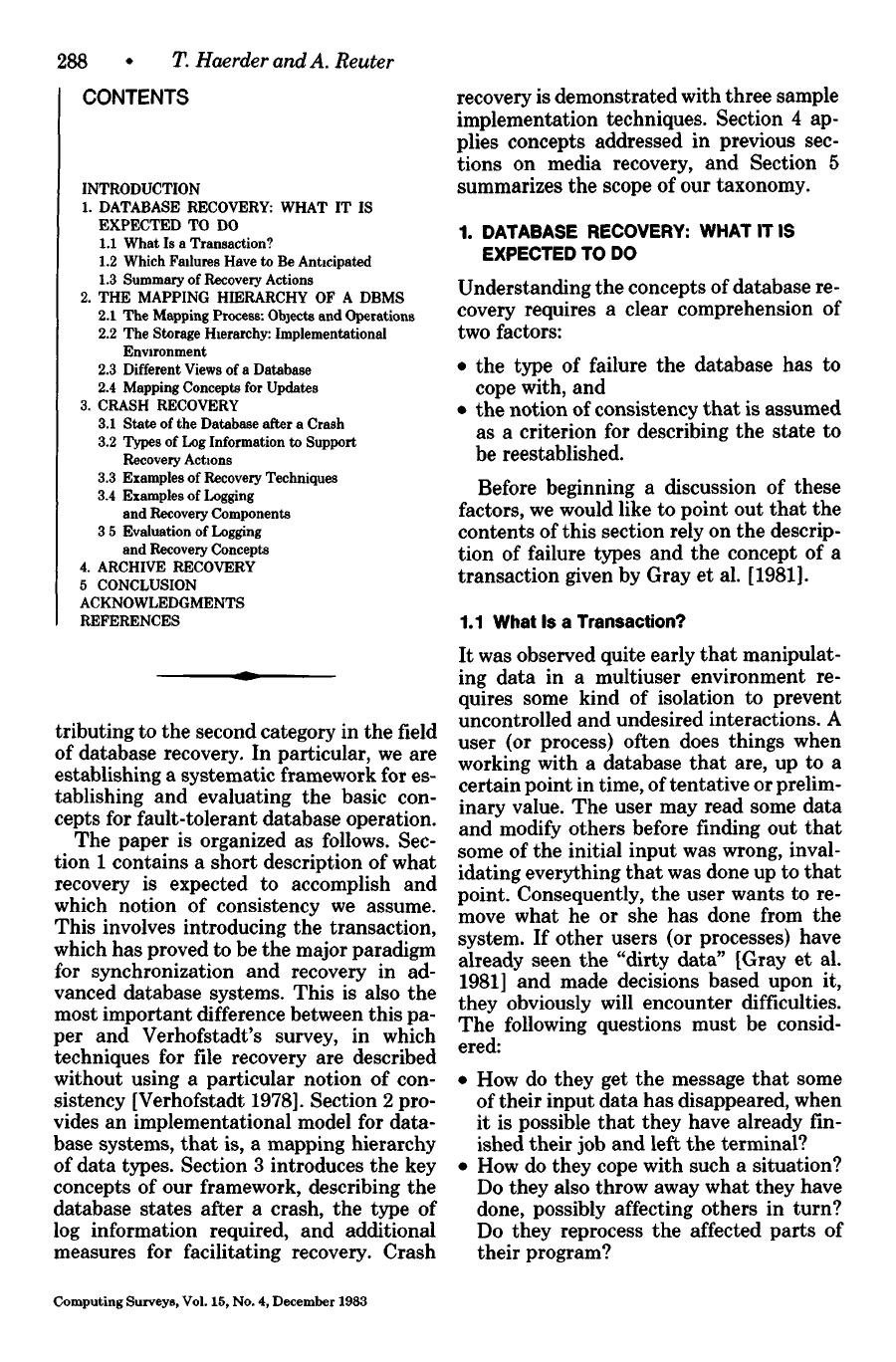
The paper is organized as follows. Sec-
tion 1 contains a short description of what
recovery is expected to accomplish and
which notion of consistency we assume.
This involves introducing the transaction,
which has proved to be the major paradigm
for synchronization and recovery in ad-
vanced database systems. This is also the
most important difference between this pa-
per and Verhofstadt's survey, in which
techniques for file recovery are described
without using a particular notion of con-
sistency [Verhofstadt 1978]. Section 2 pro-
vides an implementational model for data-
base systems, that is, a mapping hierarchy
of data types. Section 3 introduces the key
concepts of our framework, describing the
database states after a crash, the type of
log information required, and additional
measures for facilitating recovery. Crash
recovery is demonstrated with three sample
implementation techniques. Section 4 ap-
plies concepts addressed in previous sec-
tions on media recovery, and Section 5
summarizes the scope of our taxonomy.
1. DATABASE RECOVERY: WHAT IT IS
EXPECTED TO DO
Understanding the concepts of database re-
covery
requires a clear comprehension of
two factors:
• the type of failure the database has to
cope with, and
• the notion of consistency that is assumed
as a criterion for describing the state to
be reestablished.
Before beginning a discussion of these
factors, we would like to point out that the
contents of this section rely on the descrip-
tion of failure types and the concept of a
transaction given by Gray et al. [1981].
1.1
What Is a Transaction?
It was observed quite early that manipulat-
ing data in a multiuser environment re-
quires some kind of isolation to prevent
uncontrolled and undesired interactions. A
user (or process) often does things when
working with a database that are, up to a
certain point in time, of tentative or prelim-
inary value. The user may read some data
and modify others before finding out that
some of the initial input was wrong, inval-
idating everything that was done up to that
point. Consequently, the user wants to re-
move what he or she has done from the
system. If other users (or processes) have
already seen the "dirty data" [Gray et al.
1981] and made decisions based upon it,
they obviously will encounter difficulties.
The following questions must be consid-
ered:
• How do they get the message that some
of their input data has disappeared, when
it is possible that they have already fin-
ished their job and left the terminal?
• How do they cope with such a situation?
Do they also throw away what they have
done, possibly affecting others in turn?
Do they reprocess the affected parts of
their program?
Computing Surveys, Vol. 15, No. 4, December 1983
of 31
免费下载
【版权声明】本文为墨天轮用户原创内容,转载时必须标注文档的来源(墨天轮),文档链接,文档作者等基本信息,否则作者和墨天轮有权追究责任。如果您发现墨天轮中有涉嫌抄袭或者侵权的内容,欢迎发送邮件至:contact@modb.pro进行举报,并提供相关证据,一经查实,墨天轮将立刻删除相关内容。
下载排行榜

评论