



17-Temporal Network Representation Learning via Historical Neighborhoods Aggregation.pdf
100墨值下载
Temporal Network Representation Learning via
Historical Neighborhoods Aggregation
Shixun Huang
†
Zhifeng Bao
†
Guoliang Li
‡
Yanghao Zhou
†
J. Shane Culpepper
†
†
RMIT University, Australia
‡
Tsinghua University, China
Abstract—Network embedding is an effective method to learn
low-dimensional representations of nodes, which can be applied
to various real-life applications such as visualization, node clas-
sification, and link prediction. Although significant progress has
been made on this problem in recent years, several important
challenges remain, such as how to properly capture temporal
information in evolving networks. In practice, most networks
are continually evolving. Some networks only add new edges or
nodes such as authorship networks, while others support removal
of nodes or edges such as internet data routing. If patterns exist
in the changes of the network structure, we can better understand
the relationships between nodes and the evolution of the network,
which can be further leveraged to learn node representations
with more meaningful information. In this paper, we propose the
Embedding via Historical Neighborhoods Aggregation (EHNA)
algorithm. More specifically, we first propose a temporal random
walk that can identify relevant nodes in historical neighborhoods
which have impact on edge formations. Then we apply a deep
learning model which uses a custom attention mechanism to in-
duce node embeddings that directly capture temporal information
in the underlying feature representation. We perform extensive
experiments on a range of real-world datasets, and the results
demonstrate the effectiveness of our new approach in the network
reconstruction task and the link prediction task.
I. INTRODUCTION
Network embedding has become a valuable tool for solving
a wide variety of network algorithmic problems in recent years.
The key idea is to learn low-dimensional representations for
nodes in a network. It has been applied in various applications,
such as link prediction [
1
], network reconstruction [
2
], node
classification [
3
] and visualization [
4
]. Existing studies [
1
,
2
,
3
,
4
] generally learn low-dimensional representations of nodes
over a static network structure by making use of contextual
information such as graph proximity.
However, many real-world networks, such as co-author
networks and social networks, have a wealth of temporal
information (e.g., when edges were formed). Such temporal
information provides important insights into the dynamics of
networks, and can be combined with contextual information in
order to learn more effective and meaningful representations
of nodes. Moreover, many application domains are heavily
reliant on temporal graphs, such as instant messaging networks
and financial transaction graphs, where timing information is
critical. The temporal/dynamic nature of social networks has
attracted considerable research attention due to its importance in
many problems, including dynamic personalized pagerank [
5
],
advertisement recommendation [
6
] and temporal influence
1
Zhifeng Bao is the corresponding author.
2
1
3
6
7
4
5
8
2011
2012
2011
2017
2013
2017
2016
2015
2016
2014
2018
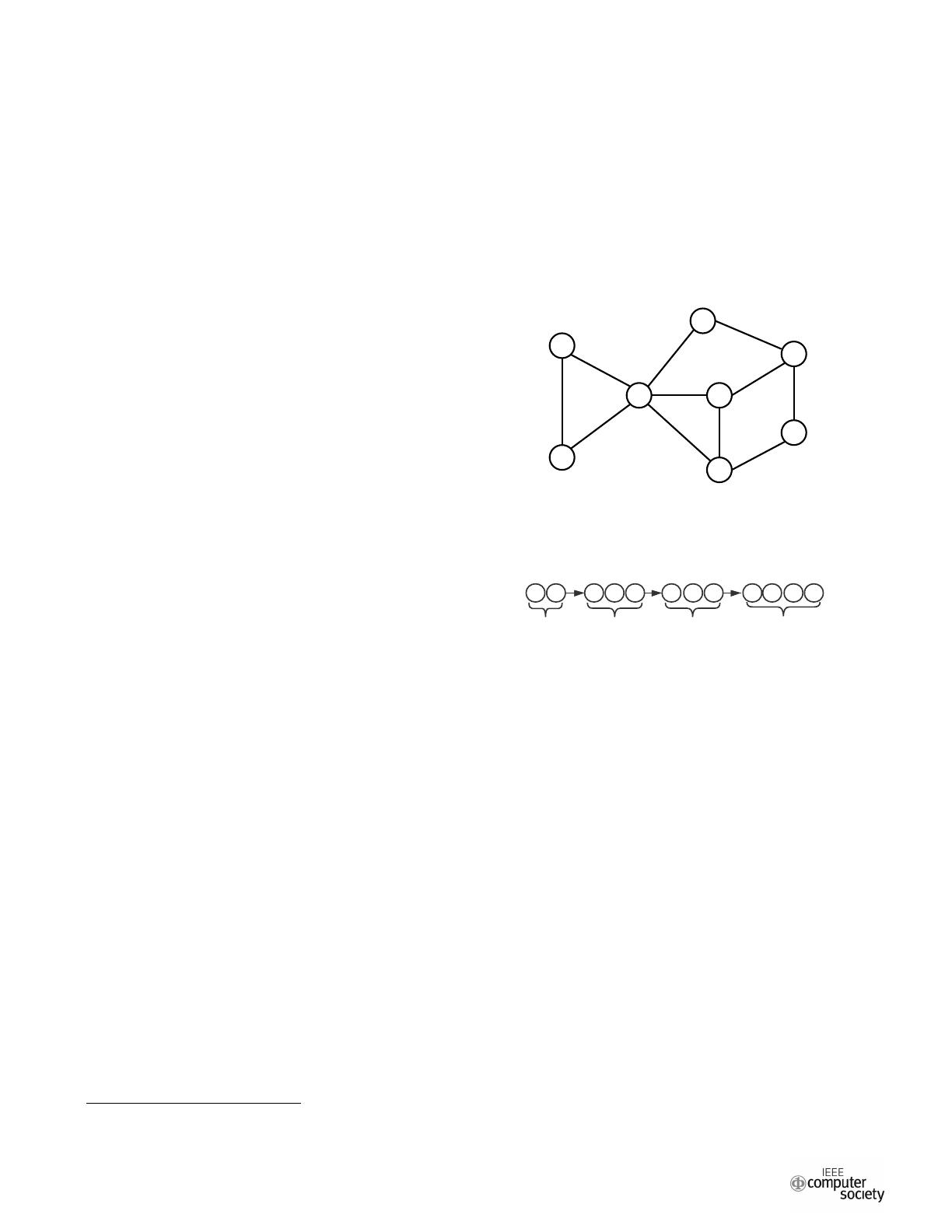
Fig. 1: An example of a co-author temporal network. Each
edge is annotated with a timestamp denoting when the edge
was created.
Fig. 2: The evolution of a set of nodes that are contextually
and temporally related to node 1.
maximization [
7
], to name a few. Despite the clear value
of such information, temporal network embeddings are rarely
applied to solve many other important tasks such as network
reconstruction and link prediction [8, 9].
Incorporating temporal information into network embeddings
can improve the effectiveness in capturing relationships between
nodes which can produce performance improvements in down-
stream tasks. To better understand the relationships between
nodes with temporal information in a network, consider Figure 1
which is an ego co-author network for a node (1). Each node
is an author, and edges represent collaborations denoted with
timestamps. Without temporal knowledge, the relationships
between nodes 2, 3, 4, 6 and 7 are indistinguishable since
they are all connected to node 1. However, when viewed from
the temporal perspective, node 1 once was ‘close’ to nodes 2
and 3 but now is ‘closer’ to nodes 4, 6 and 7 as node 1 has
more recent and frequent collaborations with the latter nodes.
Furthermore, in the static case, nodes 2 and 3 appear to be
‘closer’ to node 1 than node 5, since nodes 2 and 3 are direct
neighbors of node 1, whereas node 5 is not directly connected
to node 1. A temporal interpretation suggests that node 5 is also
important to 1 because node 5 could be enabling collaborations
between nodes 1 6, and 7. Thus, with temporal information,
1117
2020 IEEE 36th International Conference on Data Engineering (ICDE)
2375-026X/20/$31.00 ©2020 IEEE
DOI 10.1109/ICDE48307.2020.00101
Authorized licensed use limited to: Tsinghua University. Downloaded on June 01,2021 at 15:48:53 UTC from IEEE Xplore. Restrictions apply.

new interpretations of the ‘closeness’ of relationships between
node 1 and other nodes and how these relationships evolve are
now possible.
To further develop this intuition, consider the following
concrete example. Suppose node 1 began publishing as a
Ph.D. student. Thus, papers produced during their candidature
were co-authored with a supervisor (node 3) and one of
the supervisor’s collaborators (node 2). After graduation,
the student (node 1) became a research scientist in a new
organization. As a result, a new collaboration with a senior
supervisor (node 4) is formed. Node 1 was introduced to node
5 through collaborations between the senior supervisor (node
4) and node 5, and later began working with node 6 after
the relationship with node 5 was formed. Similarly, after a
collaboration between node 1 and node 6, node 1 met node
7 because of the relationships between node 5 and node 8,
node 8 and node 7, and node 6 and node 7. Hence, as shown
in Figure 2, both the formation of the relationships between
node 1 and other nodes and the levels of closeness of such
relationships evolve as new connections are made between
node 1 and related collaborators.
Thus, the formation of each edge
(x, y)
changes not only the
relationship between
x
and
y
but also relationships between
nodes in the surrounding neighborhood. Capturing how and why
a network evolves (through edge formations) can produce better
signals in learned models. Recent studies capture the signal
by periodically probing a network to learn more meaningful
embeddings. These methods model changes in the network by
segmenting updates into fixed time windows, and then learn an
embedding for each network snapshot [
10
,
11
]. The embeddings
of previous snapshots can be used to infer or indicate various
patterns as the graph changes between snapshots. In particular,
CTDNE [
12
] leveraged temporal information to sample time-
constrained random walks and trained a skip-gram model
such that nodes co-occurring in these random walks produce
similar embeddings. Inspired by the Hawkes process [
13
] which
shows that the occurrence of current events are influenced by
the historical events, HTNE [
14
] leveraged prior neighbor
formation to predict future neighbor formations. In this paper,
we show how to more effectively embed fine-grained temporal
information in all learned feature representations that are
directly influenced by historical changes in a network.
How to effectively analyze edge formations is a challenging
problem, which requires: (1) identifying relevant nodes (not
limited to direct neighbors) which may impact edge formations;
(2) differentiating the impact of relevant nodes on edge
formations; (3) effectively aggregating useful information from
relevant nodes given a large number of useful but noisy signals
from the graph data.
To mitigate these issues, we propose a deep learning method,
which we refer to as Embedding via Historical Neighborhoods
Aggregation (EHNA), to capture node evolution by probing
the information/factors influencing temporal behavior (i.e.,
edge formations between nodes). To analyze the formation
of each edge
(x, y)
, we apply the the following techniques.
First, a temporal random walk is used to dynamically identify
relevant nodes from historical neighborhoods that may influence
new edge formations. Specifically, our temporal random walk
algorithm models the relevance of nodes using a configurable
time decay, where nodes with high contextual and temporal
relevance are visited with higher probabilities. Our temporal
random walk algorithm can preserve the breadth-first search
(BFS) and depth-first search (DFS) characteristics of traditional
solutions, which can then be further exploited to provide both
micro and macro level views of neighborhood structure for
the targeted application. Second, we also introduce a two-level
(node level and walk level) aggregation strategy combined
with stacked LSTMs to effectively extract features from nodes
related to chronological events (when edges are formed). Third,
we propose a temporal attention mechanism to improve the
quality of the temporal feature representations being learned
based on both contextual and temporal relevance of the nodes.
Our main contributions to solve the problem of temporal
network representation learning are:
•
We leverage temporal information to analyze edge forma-
tions such that the learned embeddings can preserve both
structural network information (e.g., the first and second
order proximity) as well as network evolution.
•
We present a temporal random walk algorithm which
dynamically captures node relationships from historical
graph neighborhoods.
•
We deploy our temporal random walk algorithm in a
stacked LSTM architecture that is combined with a
two-level temporal attention and aggregation strategy
developed specifically for graph data, and describe how
to directly tune the temporal effects captured in feature
embeddings learned by the model.
•
We show how to effectively aggregate the resulting
temporal node features into a fixed-sized readout layer
(feature embedding), which can be directly applied to
several important graph problems such as link prediction.
•
We validate the effectiveness of our approach using four
real-world datasets for the network reconstruction and link
prediction tasks.
Organization of this paper.
Related work is surveyed in
Section II and our problem formulation is presented in Sec-
tion III. Next, we describe the problem solution in Section IV.
We empirically validate our new approach in Section V, and
conclude in Section VI.
II. R
ELATED WORK
Static network embedding.
Inspired by classic techniques
for dimensionality reduction [
15
] and multi-dimensional scal-
ing [
16
], early methods [
15
,
17
,
18
,
19
] focused on matrix-
factorization to learn graph embeddings. In these approaches,
node embeddings were learned using a deterministic measure
of graph proximity which can be approximated by computing
the dot product between learned embedding vectors. Methods
such as D
EEP
W
ALK
[
3
] and N
ODE
2V
EC
[
1
] employed a more
flexible, stochastic measure of graph proximity to learn node
embeddings such that nodes co-occurring in short random
1118
Authorized licensed use limited to: Tsinghua University. Downloaded on June 01,2021 at 15:48:53 UTC from IEEE Xplore. Restrictions apply.
of 12
100墨值下载
【版权声明】本文为墨天轮用户原创内容,转载时必须标注文档的来源(墨天轮),文档链接,文档作者等基本信息,否则作者和墨天轮有权追究责任。如果您发现墨天轮中有涉嫌抄袭或者侵权的内容,欢迎发送邮件至:contact@modb.pro进行举报,并提供相关证据,一经查实,墨天轮将立刻删除相关内容。
下载排行榜

评论