



2020-1_HybrIDX New Hybrid Index for Volume-hiding Range Queries in Data Outsourcing Services _Kui Ren.pdf
免费下载

HybrIDX: New Hybrid Index for Volume-hiding
Range Queries in Data Outsourcing Services
Kui Ren
‡
,YuGuo
†
, Jiaqi Li
‡
, Xiaohua Jia
†
, Cong Wang
†
, Yajin Zhou
‡
, Sheng Wang
§
, Ning Cao
£
, Feifei Li
§
‡
Zhejiang University,
†
City University of Hong Kong,
§
Alibaba Group,
£
Hangzhou Mishu Technology.
{kuiren, lijiaqi93, yajin
zhou}@zju.edu.cn, y.guo@my.cityu.edu.hk, {congwang, csjia}@cityu.edu.hk,
{sh.wang, lifeifei}@alibaba-inc.com, ncao@hzmstech.com
Abstract—An encrypted index is a data structure that assisting
untrusted servers to provide various query functionalities in the
ciphertext domain. Although traditional index designs can pre-
vent servers from directly obtaining plaintexts, the confidentiality
of outsourced data could still be compromised by observing
the volume of different queries. Recent volume attacks have
demonstrated the importance of sealing volume-pattern leakage.
To this end, several works are made to design secure indexes with
the volume-hiding property. However, prior designs only work
for encrypted keyword search. Due to the unpredictable range
query results, it is difficult to protect the volume-pattern leakage
while achieving efficient range queries.
In this paper, for the first time, we define and solve the chal-
lenging problem of volume-hiding range queries over encrypted
data. Our proposed hybrid index framework, called HybrIDX,
allows an untrusted server to efficiently search encrypted data
based on order conditions without revealing the exact volume size.
It resorts to the trusted hardware techniques to assist range query
processing by moving the comparison algorithm to trusted SGX
enclaves. To enable volume-hiding data retrieval, we propose to
host encrypted results outside the enclave in an encrypted multi-
maps manner. Apart from this novel hybrid index design, we
further customize a bulk refresh mechanism to enable access-
pattern obfuscation. We formally analyze the security strengths
and complete the prototype implementation. Evaluation results
demonstrate the feasibility and practicability of our designs.
I. INTRODUCTION
An encrypted index offers a secure interface for data owners
to outsource private data to an untrusted server, while se-
lectively retrieving data without server-side decryption. It is
recognized as a fundamental component of building privacy-
preserving applications. Early studies on secure index con-
struction mainly focus on the direction of keyword search [1]–
[7]. Along with the development of data outsourcing paradigm,
enabling efficient range queries over secure indexes has at-
tracted a lot of attention from both academia and industry [8]–
[12]. A typical example in the encrypted database commu-
nity [13]–[18] is finding all matched records according to order
conditions such as indexed values or timestamps.
Over the past decade, the demand for designing range-based
indexes has been expected to be addressed by the innovation
of cryptographic techniques, e.g., order-preserving/revealing
encryption (OPE/ORE) schemes [19]–[28], which allow order
comparisons to be performed directly on ciphertexts. In prac-
tice, however, these schemes are developed as cryptographic
primitives and can hardly accommodate system-wise security
requirements [29]–[36]. Specifically, different queries reveal
the associations between the query tokens and the number of
return results (i.e., volume-pattern). An attacker can determine
the indexed value relations by observing the distribution of
the result size. Recent leakage-abuse attacks [29]–[31] have
shown how the volume-pattern leakage can be exploited to
learn sensitive information about the queries and outsourced
data. To mitigate this leakage concern, a simple approach is to
apply naive padding. However, this approach would introduce
expensive storage overhead because the result set of each index
entry is padded to the maximum length.
In the literature, only a few recent works [37]–[39] have
started to study practical index designs with the protection
of volume-pattern. In [37], Kamara et al. proposed the first
practical volume-hiding encryption scheme by using the multi-
map data structure [38]. The follow-up design [39] utilized
cuckoo hashing and differential privacy to further reduce the
volume and storage overhead. Unfortunately, neither of the
existing schemes can support volume-hiding range queries
because of two challenging issues. Firstly, unlike keyword
search functions, the result size of different range queries
cannot be pre-defined. Clients without pre-knowledge of the
result size have to download all the data in order to hide the
volume-pattern leakage, which demands a large amount of
bandwidth overhead. Secondly, the results (i.e., access-pattern)
of different range queries have multiple unique intersections,
which can be exploited for inferring the plaintext distribution.
For example, the result set associated with the endpoint values
must appear in all the other range query results. By observing
the intersections of different range query results, an attacker
can still learn the data distribution even if the volume-pattern
has been well-protected. Therefore, how to enable volume-
hiding range queries over encrypted indexes is still challenging
and remains to be fully explored.
In this paper, for the first time, we solve the problem of
volume-hiding range queries in the data outsourcing paradigm.
Our proposed hybrid index framework, called HybrIDX, can
effectively address the aforementioned challenges while being
efficient in supporting range queries. To achieve our design
goals on both security and usability, we propose to bring
together the advancement of both applied cryptography and
trusted hardware to build the desired index construction. To
hide the result size of different range queries, we first propose
to utilize the trusted enclave to securely convert any range
query with large result size into multiple independent sub-
23
2020 IEEE 40th International Conference on Distributed Computing Systems (ICDCS)
2575-8411/20/$31.00 ©2020 IEEE
DOI 10.1109/ICDCS47774.2020.00014
2020 IEEE 40th International Conference on Distributed Computing Systems (ICDCS) | 978-1-7281-7002-2/20/$31.00 ©2020 IEEE | DOI: 10.1109/ICDCS47774.2020.00014
Authorized licensed use limited to: Ant Financial. Downloaded on January 13,2022 at 03:26:33 UTC from IEEE Xplore. Restrictions apply.
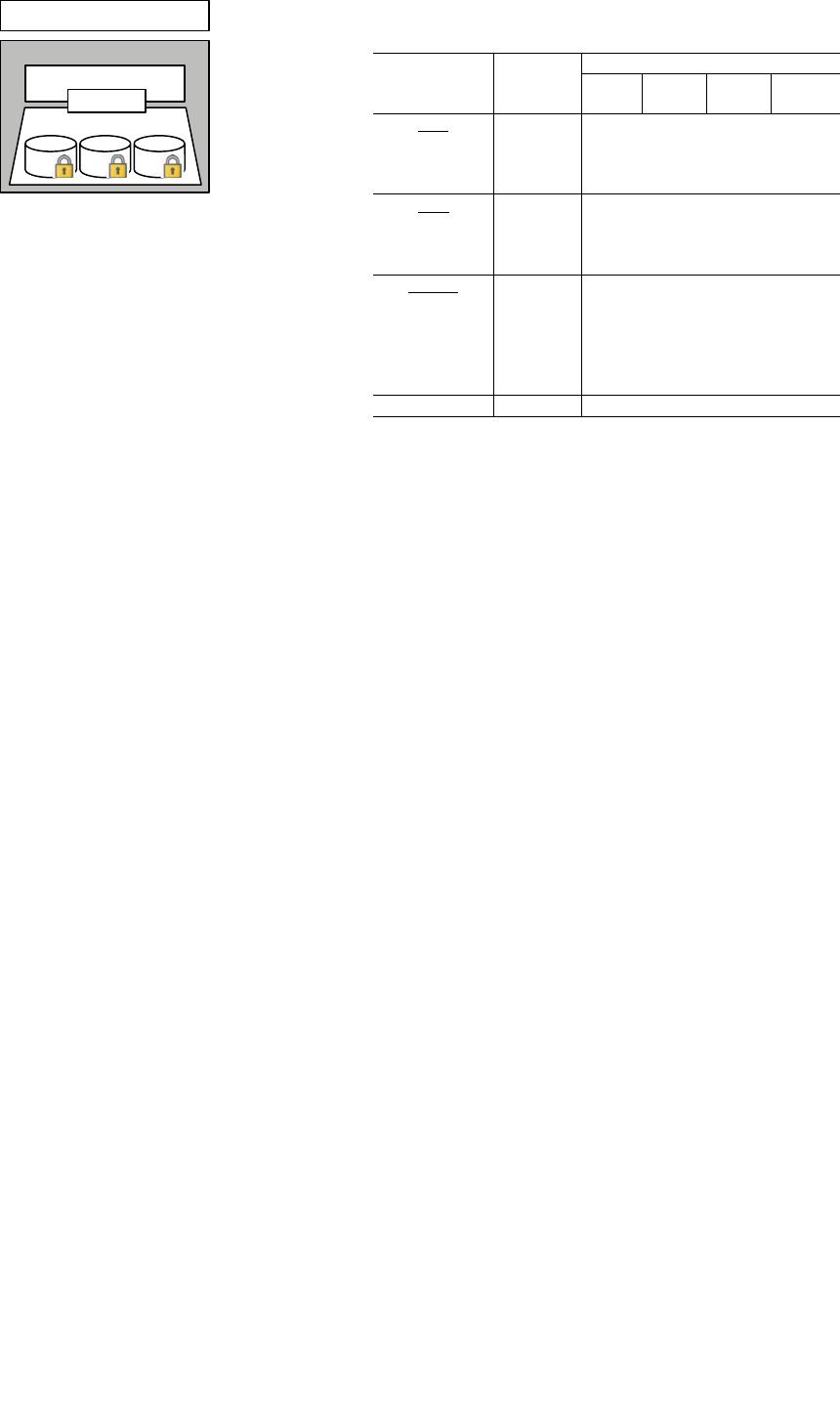
Untrusted Host
Enc. MM Indexes
Data Applications
Enclave Indexes
HybrIDX
Fig. 1: Overview of main HybrIDX components.
queries with smaller but equal fixed volume. While seemingly
inconvenient, this way of query processing is actually con-
sistent with the rationale of many practical applications in
information retrieval, which would on demand display a partial
result set to the client upon request [40].
1
In order to concretely achieve the fixed volume for sub-
queries, we explore the existing volume-hiding encryption
scheme from the multi-map data structure [37] to convert
result sets of different values into multiple block ciphertexts
with fixed length (Fig.1: Enc.MM). As directly outsourcing
the resulting multi-map indexes cannot support secure range
queries, we devise a range-based index (Fig.1: Enclave) inside
the enclave platform to indicate the corresponding multi-map
indexes and customize a batch query protocol for our purpose
to retrieve range query results in a volume-hiding manner.
Under this hybrid index framework, we then consider how
to further mitigate the access-pattern leakage among different
range queries. Particularly, we propose a secure bulk refresh
mechanism that caches retrieved results inside the enclave and
refresh them periodically. With the assistance of an enclave-
based refresh mechanism, not only can we efficiently obfuscate
the access-pattern leakage among different queries, but also we
can avoid high communicational cost between the client and
servers. We believe the proposed hybrid index design provides
useful guidelines and new insights on designing secure indexes
for modern data outsourcing services. The main contributions
of this paper can be summarized as follows:
• We present HybrIDX, the first hybrid index framework
that enabling volume-hiding range queries over encrypted
data. It stores data records of indexed values in the form
of multi-maps and conducts efficient range comparisons
inside the enclave.
• We carefully tailor a secure batch query protocol and
a bulk refresh mechanism enabling volume-hiding result
retrieval and access-pattern obfuscation.
• We provide thorough analysis investigating security and
efficiency guarantees of the proposed designs. By char-
acterizing and analyzing the leakage profiles from both
the index construction and the query protocol, we prove
the security of our schemes.
• We implement the system prototype and conduct a com-
prehensive evaluation. The experiment results show that
1
Similar insight has also been utilized by prior art Oblix [41], but for ranked
keyword search that is different from our focus on range queries.
TABLE I: Security characterization of representative
schemes for secure range query operations
Primitives
Query
Efficiency
Leakage Protection
Order
Result
Search
Pattern
Access
Pattern
Volume
Pattern
OPE
ROPF [24] O(log m) BS
Ideal-OPE [25]
O(log m) AS
POPE [23]
O(log m) BS
ORE
CLWW [21] O(m) AS
Lewi-Wu [19]
O(m) AS
PHORE [20]
O(m) AS
Enclave
HardIDX [42] O(log m)
Opaque [43]
O(log m) N/S
ZeroTrace [44]
O(log n) N/S
Oblix [41]
O(log
2
n) N/S
∗
EnclaveDB [45] O(log m)
HybrIDX O(log m)
1
∗
: result may be lossy.
2 BS: before search ⊂ AS: after search.
3 n: number of total records; m: number of indexed values, n>>m.
4 N/S: the feature may be potentially supported, but not explicitly handled.
our range query protocol can fetch all matched results
within a short latency, and achieve better query efficiency
compared with existing cryptographic solutions.
The rest of this paper is organized as follows. Section II
introduces background knowledge and related work involved
in our designs. Section III presents our system architecture
and threat assumptions. Section IV introduces our system
design. Our security analysis is conducted in Section V, and
an extensive array of evaluation results is shown in Section VI.
Finally, we conclude the paper in Section VII.
II. RELATED WORK
A. Encrypted Range Queries
Searchable encryption (SE) scheme for secure range queries
has been an active research area in the past decade [19]–
[28]. To make a clear comparison, we have summarized the
representative solutions and compiled their security features in
Table I. The early studies, known as order-preserving encryp-
tion (OPE) [24], can preserve the original orders of plaintexts
by using a random order-preserving function (ROPF). Thus, an
untrusted server is able to make numeric comparisons between
ciphertexts as if it had operated on plaintexts. However,
orders are directly leaked from OPE ciphertexts, which make
OPE ciphertexts suffer from the sorted attacks [33]. In [25],
Popa et al. proposed an ideal OPE scheme (Ideal-OPE) by
encrypting values via standard encryption, but it requires
multiple interactions for client-side comparison. To mitigate
the order leakage, the notion of order-revealing encryption
(ORE) was proposed [27]. ORE ciphertext has no particular
order, while order relations are revealed during dedicated com-
parison protocols [19]–[21]. However, ORE schemes would
24
Authorized licensed use limited to: Ant Financial. Downloaded on January 13,2022 at 03:26:33 UTC from IEEE Xplore. Restrictions apply.
of 11
免费下载
【版权声明】本文为墨天轮用户原创内容,转载时必须标注文档的来源(墨天轮),文档链接,文档作者等基本信息,否则作者和墨天轮有权追究责任。如果您发现墨天轮中有涉嫌抄袭或者侵权的内容,欢迎发送邮件至:contact@modb.pro进行举报,并提供相关证据,一经查实,墨天轮将立刻删除相关内容。
下载排行榜

评论