



Net2net_ Accelerating learning via knowledge transfer.pdf
免费下载

Published as a conference paper at ICLR 2016
Net2Net: ACCELERATING LEARNING
VIA KNOWLEDGE TRANSFER
Tianqi Chen
∗
, Ian Goodfellow, and Jonathon Shlens
Google Inc., Mountain View, CA
tqchen@cs.washington.edu, {goodfellow,shlens}@google.com
ABSTRACT
We introduce techniques for rapidly transferring the information stored in one
neural net into another neural net. The main purpose is to accelerate the train-
ing of a significantly larger neural net. During real-world workflows, one often
trains very many different neural networks during the experimentation and de-
sign process. This is a wasteful process in which each new model is trained from
scratch. Our Net2Net technique accelerates the experimentation process by in-
stantaneously transferring the knowledge from a previous network to each new
deeper or wider network. Our techniques are based on the concept of function-
preserving transformations between neural network specifications. This differs
from previous approaches to pre-training that altered the function represented by
a neural net when adding layers to it. Using our knowledge transfer mechanism
to add depth to Inception modules, we demonstrate a new state of the art accuracy
rating on the ImageNet dataset.
1 INTRODUCTION
We propose a new kind of operation to perform on large neural networks: rapidly transfering knowl-
edge contained in one neural network to another neural network. We call this the Net2Net fam-
ily of operations. We use Net2Net as a general term describing any process of training a stu-
dent network significantly faster than would otherwise be possible by leveraging knowledge from a
teacher network that was already trained on the same task. In this article, we propose two specific
Net2Net methodologies. Both are based on the idea of function-preserving transformations of
neural networks. Specifically, we initialize the student to be a neural network that represents the
same function as the teacher, but using a different parameterization. One of these transformations,
Net2WiderNet allows replacing a model with an equivalent model that is wider (has more units in
each hidden layer). Another of these transformations, Net2DeeperNet allows replacing a model
that satisfies some properties with an equivalent, deeper model. After initializing the larger network
to contain all of the knowledge previously acquired by the smaller network, the larger network may
be trained to improve its performance.
Traditionally, machine learning algorithms have been designed to receive a fixed dataset as input,
initialize a new model with no knowledge, and train that model to convergence on that dataset. Real
workflows are considerably more complicated than this idealized scenario. We advocate Net2Net
operations as a useful tool for accelerating real-world workflows.
One way that real workflows deviate from the idealized scenario is that machine learning practition-
ers usually do not train only a single model on each dataset. Instead, one typically trains multiple
models, with each model designed to improve upon the previous model in some way. Each step in
the iterative design process relies on fully training and evaluating the innovation from the previous
step. For many large models, training is a long process, lasting for a week or even for a month. This
makes data-driven iterative design slow, due to the latency of evaluating whether each change to the
model caused an improvement.
Net2Net operations accelerate these workflows by rapidly transferring knowledge from the pre-
vious best model into each new model that an experimenter proposes. Instead of training each
considered design of model for as much as a month, the experimenter can use Net2Net to train the
∗
Tianqi Chen is also a PhD student at University of Washington.
1
arXiv:1511.05641v4 [cs.LG] 23 Apr 2016
Published as a conference paper at ICLR 2016
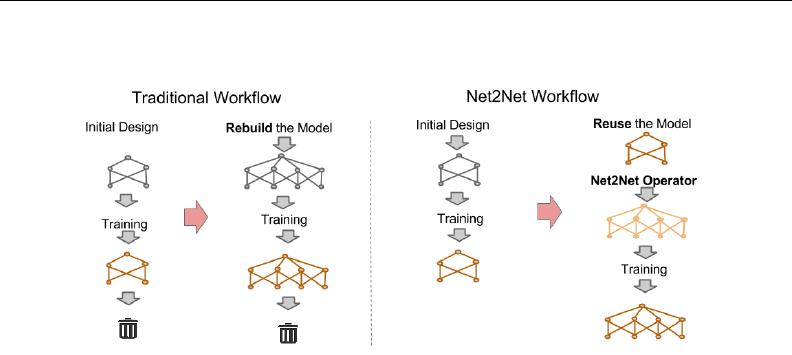
Figure 1: Comparison between a traditional workflow and the Net2Net Workflow; Net2Net
reuses information from an already trained model to speed up the training of a new model.
model for a shorter period of time beginning from the function learned by the previous best model.
Fig 1 demonstrates the difference of this approach from traditional one.
More ambitiously, real machine learning systems will eventually become lifelong learning sys-
tems (Thrun, 1995; Silver et al., 2013; Mitchell et al., 2015). These machine learning systems need
to continue to function for long periods of time and continually experience new training examples
as these examples become available. We can think of a lifelong learning system as experiencing a
continually growing training set. The optimal model complexity changes as training set size changes
over time. Initially, a small model may be preferred, in order to prevent overfitting and to reduce
the computational cost of using the model. Later, a large model may be necessary to fully utilize
the large dataset. Net2Net operations allow us to smoothly instantiate a significantly larger model
and immediately begin using it in our lifelong learning system, rather than needing to spend weeks
or months re-train a larger model from scratch on the latest, largest version of the training set.
2 METHODOLOGY
In this section, we describe our new Net2Net operations and how we applied them on real deep
neural nets.
2.1 FEATURE PREDICTION
We briefly experimented with a method that proved not to offer a significant advantage: training a
large student network beginning from a random initialization, and introducing a set of extra “teacher
prediction” layers into the student network. Specifically, several convolutional hidden layers of the
student network were provided as input to new, learned, convolutional layers. The cost function
was modified to include terms encouraging the output of these auxiliary layers to be close to a
corresponding layer in the teacher network. In other words, the student is trained to use each of its
hidden layers to predict the values of the hidden layers in the teacher.
The goal was that the teacher would provide a good internal representation for the task that the stu-
dent could quickly copy and then begin to refine. The approach resembles the FitNets (Romero et al.,
2014) strategy for training very thin networks of moderate depth. Unfortunately, we did not find that
this method offered any compelling speedup or other advantage relative to the baseline approach.
This may be because our baseline was very strong, based on training with batch normalization (Ioffe
& Szegedy, 2015). Mahayri et al. (2015) independently observed that the benefits of the FitNets
training strategy were eliminated after changing the model to use batch normalization.
The FitNets-style approach to Net2Net learning is very general, in the sense that, if successful, it
would allow any architecture of student network to learn from any architecture of teacher network.
Though we were not able to make this general approach work, we encourage other researchers to
attempt to design fully general Net2Net strategies in the future. We instead turned to different
Net2Net strategies that were limited in scope but more effective.
2.2 FUNCTION-PRESERVING INITIALIZATIONS
We introduce two effective Net2Net strategies. Both are based on initializing the student network
to represent the same function as the teacher, then continuing to train the student network by normal
means. Specifically, suppose that a teacher network is represented by a function y = f(x; θ) where
2
of 12
免费下载
【版权声明】本文为墨天轮用户原创内容,转载时必须标注文档的来源(墨天轮),文档链接,文档作者等基本信息,否则作者和墨天轮有权追究责任。如果您发现墨天轮中有涉嫌抄袭或者侵权的内容,欢迎发送邮件至:contact@modb.pro进行举报,并提供相关证据,一经查实,墨天轮将立刻删除相关内容。
下载排行榜

评论