



基于注意力机制的规范化矩阵分解推荐算法-张青博 , 王斌 , 崔宁宁 , 宋晓旭 , 秦婧.pdf
免费下载

软件学报 ISSN 1000-9825, CODEN RUXUEW E-mail: jos@iscas.ac.cn
Journal of Software,2020,31(3):778−793 [doi: 10.13328/j.cnki.jos.005913] http://www.jos.org.cn
©中国科学院软件研究所版权所有. Tel: +86-10-62562563
基于注意力机制的规范化矩阵分解推荐算法
∗
张青博
,
王
斌
,
崔宁宁
,
宋晓旭
,
秦
婧
(东北大学 计算机科学与工程学院,辽宁 沈阳 110189)
通讯作者: 王斌, E-mail: binwang@mail.neu.edu.cn
摘 要: 近年来,矩阵分解(MF)技术因其有效性和简便性在推荐系统中得到广泛应用.但是,数据稀疏和冷启动问
题导致 MF 学习到的用户特征向量不能准确地代表用户的偏好以及反映用户间的相似关系,影响了模型的性能.为
了解决该问题,规范化矩阵分解(RMF)技术引起了研究者的关注.挖掘用户间可靠的相似关系,是 RMF 需要解决的
问题.此外,MF 将目标用户特征向量和目标项目特征向量的内积作为目标用户对目标项目的评分,这种简单的线性
关系忽略了用户对项目各个属性特征不同的关注度.如何分析用户对项目属性特征的关注度,获取用户更准确的偏
好,仍然是一个挑战.针对上述问题,提出了基于注意力机制的规范化矩阵分解模型(ARMF).具体地,为了获取用户间
可靠的相似关系解决数据稀疏和冷启动问题,该模型同时依据用户信任网络和评分记录构建用户-项目异构网络,
并基于该异构网络挖掘用户间的相似关系;为了进一步提升模型性能,通过在 MF 中引入注意力机制,分析用户对项
目各个属性特征不同的关注度来获取用户更准确的偏好.最后,在两个真实数据集上对比 ARMF 与现有工作,实验
结果证明,ARMF 有更好的准确性和健壮性.
关键词: 推荐系统;矩阵分解;数据稀疏;冷启动;社交网络;注意力机制
中图法分类号: TP18
中文引用格式: 张青博,王斌,崔宁宁,宋晓旭,秦婧.基于注意力机制的规范化矩阵分解推荐算法.软件学报,2020,31(3 ):
778−793. http://www.jos.org.cn/1000-9825/5913.htm
英文引用格式: Zhang QB, Wang B, Cui NN, Song XX, Qin J. Attention-based regularized matrix factorization for recommenda-
tion. Ruan Jian Xue Bao/Journal of Software, 2020,31(3):778−793 (in Chinese). http ://www.jos.org.cn/10 00-9825/5913.htm
Attention-ba sed Reg ularized Ma trix Factori zation for Recommenda tion
ZHANG Qing-Bo, WANG Bin, CUI Ning-Ning, SONG Xiao-Xu, QIN Jing
(School of Computer Science and Engineering, North eastern University, Shenyang 110189, China)
Abstra ct : In recent years, matrix factorization (MF) has b een exploited commonly in recommender syst em because of its capability and
simplification. However, data sparsity and cold-start problems make the l atent feature of users learned by MF cannot represent the us ers’
preferences and the similarity relation among users exactly, which limits the performance of MF. To remedy it, the regularized matrix
factorization (RMF) draws rese archers’ attention. And the problem demanding pro mpt solution in RMF is capturing the reliable similarity
relation among users. Besides, MF simply regards th e inner product between the latent features of both target user and target item as the
score that target user may rate th e target item, ignoring the user ’s different attentions on various features of the item. How t o analyz e the
user ’s attenti on on item’s featur es and capt ure mo re ac curat e pref eren ce of t he use r is s till a chall enge . To add ress t hese i ssues, a model is
∗ 基金项目: 国家重点研发计划(2018YFB1700404); 国家自然科学基金(U1736104, 61572122, 61532021); 中央高校基本科研专
项资金(N171602003)
Foundation item: National Key Research and Development Program of China (2018YFB1700404); National Natural Science
Foundation of China (U1736104, 61572122, 61532021); Fundamental Research Funds for the Central Universiti es (N171602003)
本文由人工智能赋能的数据管理、分析与系统专刊特约编辑李战怀教授、于戈教授和杨晓春教授推荐.
收稿时间: 2019-08-13; 修改时间: 2019-09-10; 采用时间: 2019-11-25; jos 在线出版时间: 2020-01-10
CNKI 网络优先出版: 2020-01-10 13:34:56, http://kns.cnki.net/kcms/d etail/11.2560.TP.20200110.1334.013.html
张青博 等:基于注意力机制的规范化矩阵分解推荐算法
779
put forward named attention-based regularized matrix factorization, abbreviated as ARMF. Specifically, to settle the problems of data
sparsity and cold-start and obtain reliable similar relationships among users, the model builds a user-item heterogeneous network
according to the so cial network and th e rating record, and the si milarities among us ers can be obtained based on i t. Incorporating attention
mechan ism into MF allo ws us to analyz e the att ention of users on differ ent item’s featur es and capture moreac curate preferen ces of users,
which improves the precision of MF further. At last, the proposed model is compared with the state-of-the-art models on two real-world
datasets and the result demonstr ates th e better pr ecision and robustness of ARMF.
Key words: recommender system; matrix factorization; data sparsity; cold-start; social network; attention mechanism
随着互联网技术的发展以及智能手机的普及,信息超载问题也亟待解决.推荐系统
[1]
作为解决信息超载问
题的有效工具,已被成功应用于各个领域,包括电子商务、电影、音乐和基于位置的服务等
[2,3]
.推荐系统通过分
析用户与系统交互的历史数据来获取用户偏好,使不同的用户进入系统时能够得到个性化推荐结果.由于推荐
系统需要依赖于用户的历史数据,所以一般是作为一个应用存在于不同的网站中
[4]
.为方便系统获取用户偏好,
大多数网站都允许用户对自己购买或体验过的项目(商品、电影、音乐等)评分,推荐系统则可以根据用户-项目
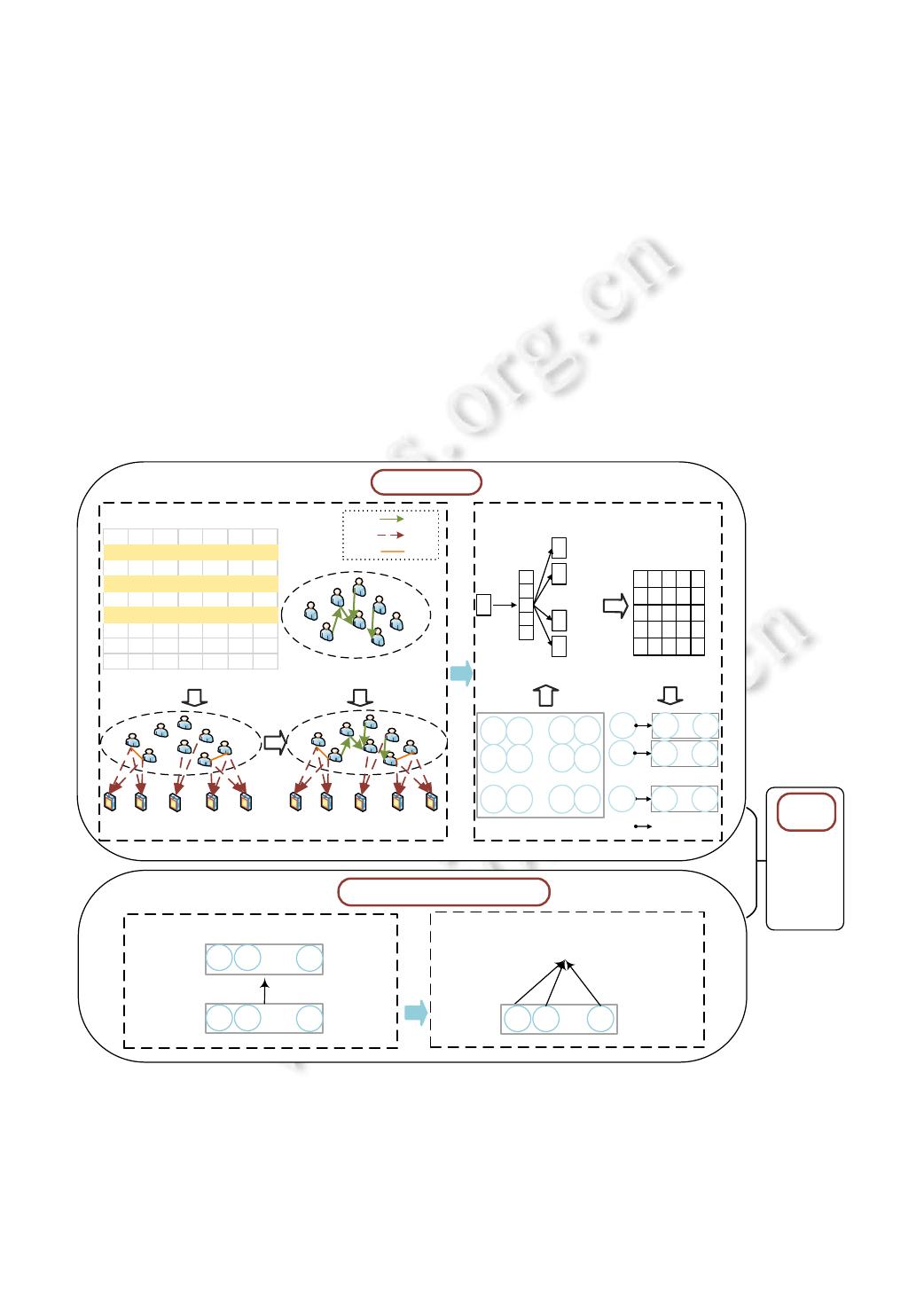
评分矩阵(如图 1(a)所示,其中,u 代表用户,i 代表项目)分析用户的偏好,并为其推荐可能感兴趣的项目.
i
1
i
2
i
3
i
4
i
5
i
6
u
1
2
u
2
4
u
3
45 2
u
4
45
u
5
35 2
u
6
34
u
7
3
u
8
1
(a)评分矩阵R
8
×
6
u
4
u
5
u
1
u
3
u
8
u
2
u
6
u
7
i
1
i
2
i
3
i
4
i
5
(b)异构网络U-I Net1
(d)异构网络U-I Net2
u
4
u
5
u
1
u
3
u
8
u
2
u
6
u
7
i
1
i
2
i
3
i
4
i
5
u
4
u
5
u
1
u
3
u
8
u
2
u
6
u
7
(c)信任网络TN
异构网络构建
...
(e)Walks
u
1
u
2
u
3
u
6
u
7
u
2
u
1
u
3
...
u
8
u
7
u
2
u
4
...
...
...
...
...
...
...
...
...
...
(g)用户特征矩阵E
异构网络嵌入
w
o
w
o-t
w
o-(t-1)
w
o+(t-1)
w
o+t
...
(f)Skip-gram模型
S
u
...
...
...
...
...
...
u
8
u
3
u
5
...
u
1
u
4
u
6
...
u
2
u
6
u
7
...
(h)u
相似关系挖掘
构建目标函
数,并采用
SGD优化模
型参数
u T
u
u I
u
u D
u
基于注意力机制的评分预测函数构建
...
P
u
ω
u
W
用户偏好获取
...
ω
u1
ω
uf
...
评分预测
...
R
u,i
’
=
ω
u
Q
i
ω
u2
Q
i
模型参
数优化
Fig.1 Arc hitecture of our pro posed attenti ve matrix factorizati on with re gula tion
图 1 基于注意力机制的规范化矩阵分解模型框架
近年来,推荐系统的实用价值使其在工业界和学术界都得到了广泛的研究.在众多推荐方法中,协同过滤算
法
[5]
应用最为普遍,其主要思想是:基于评分矩阵中的已有项来预测未知项,继而为用户推荐预测分值较高的项
of 16
免费下载
【版权声明】本文为墨天轮用户原创内容,转载时必须标注文档的来源(墨天轮),文档链接,文档作者等基本信息,否则作者和墨天轮有权追究责任。如果您发现墨天轮中有涉嫌抄袭或者侵权的内容,欢迎发送邮件至:contact@modb.pro进行举报,并提供相关证据,一经查实,墨天轮将立刻删除相关内容。
下载排行榜

评论