



SLOG - Serializable, Low-latency, Geo-replicated Transactions.pdf
免费下载
SLOG: Serializable, Low-latency, Geo-replicated
Transactions
Kun Ren
eBay Inc
kuren@ebay.com
Dennis Li
UMD College Park
dli12348@umd.edu
Daniel J. Abadi
UMD College Park
abadi@cs.umd.edu
ABSTRACT
For decades, applications deployed on a world-wide scale have
been forced to give up at least one of (1) strict serializability (2)
low latency writes (3) high transactional throughput. In this pa-
per we discuss SLOG: a system that avoids this tradeoff for work-
loads which contain physical region locality in data access. SLOG
achieves high-throughput, strictly serializable ACID transactions
at geo-replicated distance and scale for all transactions submitted
across the world, all the while achieving low latency for transac-
tions that initiate from a location close to the home region for data
they access. Experiments find that SLOG can reduce latency by
more than an order of magnitude relative to state-of-the-art strictly
serializable geo-replicated database systems such as Spanner and
Calvin, while maintaining high throughput under contention.
PVLDB Reference Format:
Kun Ren, Dennis Li, and Daniel J. Abadi. SLOG: Serializable, Low-latency,
Geo-replicated Transactions. PVLDB, 12(11): 1747-1761, 2019.
DOI: https://doi.org/10.14778/3342263.3342647
1. INTRODUCTION
Many modern applications replicate data across geographic re-
gions in order to (a) achieve high availability in the event of region
failure and (b) serve low-latency reads to clients spread across the
world. Existing database systems that support geographic replica-
tion force the user to give up one at least one of the following essen-
tial features: (1) strict serializability (2) low-latency writes (3) high
throughput multi-region transactions — even under contention.
(1) Strict serializability [16, 17, 41, 64], in the context of dis-
tributed database systems, implies both strong isolation (one-copy
serializable [10]) and real-time ordering guarantees. More pre-
cisely, concurrent transaction processing must be equivalent to exe-
cuting transactions in a one-copy serial order, S, such that for every
pair of transactions X and Y, if X starts after Y completes, then X
follows Y in S. This implies that all reads within a transaction must
see the value of any writes that committed before the transaction
began, no matter where that write was performed world-wide. Fur-
thermore, if a transaction, A, begins after (in real time) transaction
B completes, no client can see the effect of A without the effect
This work is licensed under the Creative Commons Attribution-
NonCommercial-NoDerivatives 4.0 International License. To view a copy
of this license, visit http://creativecommons.org/licenses/by-nc-nd/4.0/. For
any use beyond those covered by this license, obtain permission by emailing
info@vldb.org. Copyright is held by the owner/author(s). Publication rights
licensed to the VLDB Endowment.
Proceedings of the VLDB Endowment, Vol. 12, No. 11
ISSN 2150-8097.
DOI: https://doi.org/10.14778/3342263.3342647
of B. Strict serializability reduces application code complexity and
bugs, since it behaves like a system that is running on a single ma-
chine processing transactions sequentially [4, 5].
By giving up strict serializability, it is straightforward to achieve
the other two properties mentioned above (low-latency writes and
high multi-region transactional throughput). If reads are allowed
to access stale data, then reads can be served by any replica (which
improves read latency) and replication can be entirely asynchronous
(which improves write latency) . Furthermore, avoiding the multi-
region coordination necessary to enforce strict serializability facil-
itates throughput scalability of distributed database systems [11].
Much research effort has been spent in designing systems that
reduce the consistency level below strict serializability, while still
providing useful guarantees to the application. For example, Dy-
namo [26], Cassandra [47], and Riak [3] use eventual consistency;
PNUTs [20] supports timeline consistency; COPS [51], Eiger [52],
and Contrarian [27] support a variation of causal consistency; Lynx
(Transaction Chains) [95] supports non-strict serializability with
read-your-writes consistency [81]; Walter [77], Jessy [8], and Blot-
ter [56] support variations of snapshot consistency.
(2) Low latency writes. Despite the suitability of these weaker
consistency models for numerous classes of applications, they of-
ten expose applications to potential race condition bugs, and typi-
cally require skilled application programmers. Thus, the demand
for systems that support strict serializability has only increased.
Many recent geo-replicated data stores, including from two of the
three major cloud vendors (Google with several systems [12, 22,
76] and Microsoft with Cosmos DB) support strong consistency
models at least under some configurations. Spanner [22] is widely
used throughout Google, and is now available in the Google Cloud
for anybody to use. Other examples in industry include TiDB,
comdb2, FaunaDB, and (with a few caveats) CockroachDB and
YugaByte. Examples from the research community include Helios
[59], MDCC [46], Calvin [87], Carousel [93], and TAPIR [94].
Every single one of these above cited strictly serializable systems
pays at least one cross-region round trip (coordination) message to
commit a write transaction. This type of coordination enables strict
serializability, but increases the latency of every write. The farther
apart the regions, the longer it takes to complete a write.
(3) High transaction throughput Cross-region coordination on
every write is not necessary to guarantee strict serializability. If ev-
ery read of a data item is served from the location of the most recent
write to that data item, then there is no need to synchronously repli-
cate writes across regions. For example, if one region is declared
as the master region for a data item ([20, 23, 38, 61, 66, 67]), and
all writes and consistent reads of that data item are directed to this
region, such as done by NuoDB [66, 67] and G-Store [23], then it
is possible to achieve strict serializability along with low latency
1747
0
10000
20000
30000
40000
50000
60000
70000
80000
90000
0 1 5 10 20 50 100
throughput (txns/sec)
% cross-region transactions
Low contention
High contention
Figure 1: Single-master throughput under contention.
reads and writes — as long as those reads and writes initiate from
a region near the master region for the data being accessed.
Many workloads have a locality in their access patterns. For
example, for applications that revolve around users, the data as-
sociated with a user is heavily skewed to being accessed from the
physical location of that user. Thus, for these workloads, it is possi-
ble to achieve strict serializability and low latency writes. However,
arbitrary transactions may access multiple data items, where each
data item is mastered at a different region. For such transactions,
achieving strict serializability requires coordination across regions.
Existing approaches prevent conflicting transactions from running
during this coordination. Cross-region coordination is time con-
suming since messages must be sent over a WAN. Thus, the time
window that conflicting transactions cannot run is large, which re-
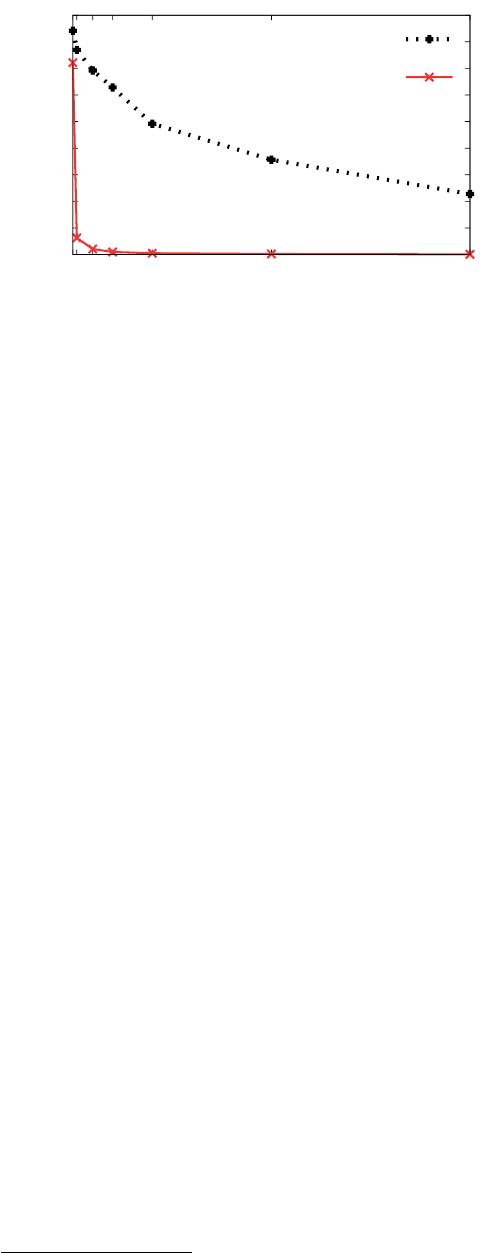
duces system throughput. For example, we implemented a version
of NuoDB
1
, and ran some benchmarks (see Section 4) where we
varied the contention level and percentage of multi-region transac-
tions. As shown in Figure 1, under high contention, the through-
put of the system dropped dramatically at even low percentages
of multi-region transactions, and also fell (although less dramati-
cally) at low contention. For this reason, many systems that allow
different data to be controlled by different regions do not support
multi-region transactions, such as PNUTS [20] and DPaxos [58].
In this paper, we present the design of a system, SLOG, that is
the first (to the best of our knowledge) to achieve all three: (1)
strict serializability (2) low-latency reads and writes (on at least
some transactions) and (3) high throughput. SLOG uses locality in
access patterns to assign a home region to each data granule. Reads
and writes to nearby data occur rapidly, without cross-region com-
munication. However, reads and writes to remote data, along with
transactions that access data from multiple regions, must pay cross-
region communication costs. Nonetheless, SLOG uses a determin-
istic architecture to move most of this communication outside of
conflict boundaries, thereby enabling these transactions to be pro-
cessed at high throughput, even for high contention workloads.
SLOG supports two availability levels: one in which the only
synchronous replication is internally within a home region (which
is susceptible to unavailability in the event of an entire region fail-
ure), and one in which data is synchronously replicated to one or
more nearby regions (or availability zones) to achieve an availabil-
1
NuoDB declined to give us their software, so we implemented our
own version. NuoDB uses a MVCC protocol that is susceptible to
write skew anomalies. Our version used locking instead in order to
guarantee strict serializability.
ity similar to Amazon Aurora [89, 90] where the system remains
available even in the event of a failure of an entire region. Unlike
Spanner, Cosmos DB, Aurora, or the other previously cited systems
that support synchronous cross-region replication, SLOG’s deter-
ministic architecture ensures that its throughput is unaffected by
the presence of synchronous cross-region replication.
2. BACKGROUND
SLOG supports strictly serializable transactions that access data
mastered in multiple regions. Unlike systems such as L-Store [49]
and G-Store [23], which remaster data on the fly so that all data
accessed by a transaction becomes mastered at the same physical
location, SLOG does not remaster data as part of executing a trans-
action. Instead, it utilizes a coordination protocol across regions to
avoid data remastership. One important technique used by SLOG
to overcome the scalability and throughput limitations caused by
coordination across partitions is to leverage a deterministic execu-
tion framework. Our technique is inspired by the work on Lazy
Transactions [30], Calvin [87, 88], T-Part [92], PWV [31], and Fau-
naDB [1] which use determinism to move coordination outside of
transactional boundaries, thereby enabling conflicting transactions
to run during this coordination process.
In the above-cited deterministic systems, all nodes involved in
processing a transaction — all replicas and all partitions within a
replica — run an agreement protocol prior to processing a batch
of transactions that plans out how to process the batch. This plan
is deterministic in the sense that all replicas that see the same plan
must have only one possible final state after processing transactions
according to this plan. Once all parties agree to the plan, processing
occurs (mostly) independently on each node, with the system rely-
ing on the plan’s determinism in order to avoid replica divergence.
This approach prevents the dramatic reductions in throughput under
data contention that are observed in systems such as NuoDB [66,
67] and the strictly serializable transaction implementation on top
of FuzzyLog [53] that perform coordination inside transactional
boundaries, and G-Store and L-Store which prevent contended data
access during the remastering operations.
Determinism also reduces latency and improves throughput by
eliminating any possibility of distributed and local deadlock [7, 70,
78, 79, 87], and reducing (or eliminating) distributed commit pro-
tocols such as two-phase commit [7, 83, 84, 86, 87].
Unfortunately, in order to create a deterministic plan of execu-
tion, more knowledge about the transaction is needed prior to pro-
cessing it relative to traditional nondeterministic systems. Most
importantly, the entire transaction must be present during this plan-
ning process. This makes deterministic database systems a poor fit
for ORM tools and other applications that submit transactions to
the database in pieces.
Second, advanced planning usually requires knowledge regard-
ing which data will be accessed by a transaction [33, 34, 83, 87].
Most deterministic systems do not require the client to specify this
information when the transaction is submitted. Instead they at-
tempt to statically derive this knowledge from inspecting the trans-
action code [87], make conservative estimates [31], and/or specu-
latively execute parts of the transaction, such as the OLLP protocol
in Calvin or the multi-stage execution process in FaunaDB.
SLOG’s use of determinism causes it to inherit both of these re-
quirements. As we will describe in Section 4, we implement SLOG
inside the open source version of Calvin’s codebase. Since Calvin
uses a combination of static analysis and OLLP to determine read
and write sets prior to transaction execution, our implementation
also uses these techniques.
1748
of 15
免费下载
【版权声明】本文为墨天轮用户原创内容,转载时必须标注文档的来源(墨天轮),文档链接,文档作者等基本信息,否则作者和墨天轮有权追究责任。如果您发现墨天轮中有涉嫌抄袭或者侵权的内容,欢迎发送邮件至:contact@modb.pro进行举报,并提供相关证据,一经查实,墨天轮将立刻删除相关内容。
下载排行榜

评论