



disk_failures.pdf
免费下载

Appears in the Proceedings of the 5th USENIX Conference on File and Storage Technologies (FAST’07), February 2007
Failure Trends in a Large Disk Drive Population
Eduardo Pinheiro, Wolf-Dietrich Weber and Luiz Andr
´
e Barroso
Google Inc.
1600 Amphitheatre Pkwy
Mountain View, CA 94043
{edpin,wolf,luiz}@google.com
Abstract
It is estimated that over 90% of all new information produced
in the world is being stored on magnetic media, most of it on
hard disk drives. Despite their importance, there is relatively
little published work on the failure patterns of disk drives, and
the key factors that affect their lifetime. Most available data
are either based on extrapolation from accelerated aging exper-
iments or from relatively modest sized field studies. Moreover,
larger population studies rarely have the infrastructure in place
to collect health signals from components in operation, which
is critical information for detailed failure analysis.
We present data collected from detailed observations of a
large disk drive population in a production Internet services de-
ployment. The population observed is many times larger than
that of previous studies. In addition to presenting failure statis-
tics, we analyze the correlation between failures and several
parameters generally believed to impact longevity.
Our analysis identifies several parameters from the drive’s
self monitoring facility (SMART) that correlate highly with
failures. Despite this high correlation, we conclude that mod-
els based on SMART parameters alone are unlikely to be useful
for predicting individual drive failures. Surprisingly, we found
that temperature and activity levels were much less correlated
with drive failures than previously reported.
1 Introduction
The tremendous advances in low-cost, high-capacity
magnetic disk drives have been among the key factors
helping establish a modern society that is deeply reliant
on information technology. High-volume, consumer-
grade disk drives have become such a successful prod-
uct that their deployments range from home computers
and appliances to large-scale server farms. In 2002, for
example, it was estimated that over 90% of all new in-
formation produced was stored on magnetic media, most
of it being hard disk drives [12]. It is therefore critical
to improve our understanding of how robust these com-
ponents are and what main factors are associated with
failures. Such understanding can be particularly useful
for guiding the design of storage systems as well as de-
vising deployment and maintenance strategies.
Despite the importance of the subject, there are very
few published studies on failure characteristics of disk
drives. Most of the available information comes from
the disk manufacturers themselves [2]. Their data are
typically based on extrapolation from accelerated life
test data of small populations or from returned unit
databases. Accelerated life tests, although useful in pro-
viding insight into how some environmental factors can
affect disk drive lifetime, have been known to be poor
predictors of actual failure rates as seen by customers
in the field [7]. Statistics from returned units are typi-
cally based on much larger populations, but since there
is little or no visibility into the deployment characteris-
tics, the analysis lacks valuable insight into what actu-
ally happened to the drive during operation. In addition,
since units are typically returned during the warranty pe-
riod (often three years or less), manufacturers’ databases
may not be as helpful for the study of long-term effects.
A few recent studies have shed some light on field
failure behavior of disk drives [6, 7, 9, 16, 17, 19, 20].
However, these studies have either reported on relatively
modest populations or did not monitor the disks closely
enough during deployment to provide insights into the
factors that might be associated with failures.
Disk drives are generally very reliable but they are
also very complex components. This combination
means that although they fail rarely, when they do fail,
the possible causes of failure can be numerous. As a
result, detailed studies of very large populations are the
only way to collect enough failure statistics to enable
meaningful conclusions. In this paper we present one
such study by examining the population of hard drives
under deployment within Google’s computing infras-
tructure.
We have built an infrastructure that collects vital in-
formation about all Google’s systems every few min-
utes, and a repository that stores these data in time-
series format (essentially forever) for further analysis.
The information collected includes environmental fac-
tors (such as temperatures), activity levels and many of
the Self-Monitoring Analysis and Reporting Technology
(SMART) parameters that are believed to be good indi-
cators of disk drive health. We mine through these data
and attempt to find evidence that corroborates or con-
tradicts many of the commonly held beliefs about how
various factors can affect disk drive lifetime.
Our paper is unique in that it is based on data from a
disk population size that is typically only available from
vendor warranty databases, but has the depth of deploy-
ment visibility and detailed lifetime follow-up that only
an end-user study can provide. Our key findings are:
• Contrary to previously reported results, we found
very little correlation between failure rates and ei-
ther elevated temperature or activity levels.
• Some SMART parameters (scan errors, realloca-
tion counts, offline reallocation counts, and proba-
tional counts) have a large impact on failure proba-
bility.
• Given the lack of occurrence of predictive SMART
signals on a large fraction of failed drives, it is un-
likely that an accurate predictive failure model can
be built based on these signals alone.
2 Background
In this section we describe the infrastructure that was
used to gather and process the data used in this study,
the types of disk drives included in the analysis, and in-
formation on how they are deployed.
2.1 The System Health Infrastructure
The System Health infrastructure is a large distributed
software system that collects and stores hundreds of
attribute-value pairs from all of Google’s servers, and
provides the interface for arbitrary analysis jobs to pro-
cess that data.
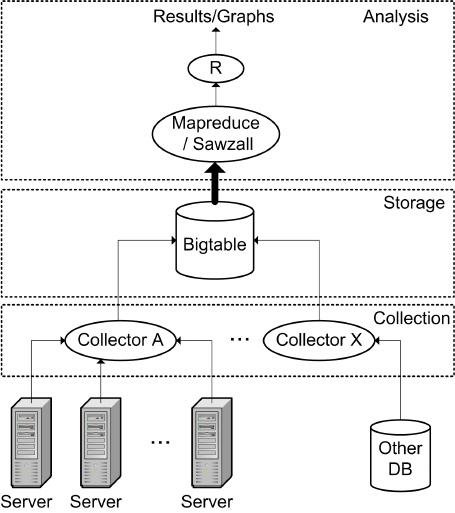
The architecture of the System Health infrastructure
is shown in Figure 1. It consists of a data collection
layer, a distributed repository and an analysis frame-
work. The collection layer is responsible for getting in-
formation from each of thousands of individual servers
into a centralized repository. Different flavors of col-
lectors exist to gather different types of data. Much of
the health information is obtained from the machines di-
rectly. A daemon runs on every machine and gathers
local data related to that machine’s health, such as envi-
ronmental parameters, utilization information of various
Figure 1: Collection, storage, and analysis architecture.
resources, error indications, and configuration informa-
tion. It is imperative that this daemon’s resource usage
be very light, so not to interfere with the applications.
One way to assure this is to have the machine-level col-
lector poll individual machines relatively infrequently
(every few minutes). Other slower changing data (such
as configuration information) and data from other exist-
ing databases can be collected even less frequently than
that. Most notably for this study, data regarding ma-
chine repairs and disk swaps are pulled in from another
database.
The System Health database is built upon Bigtable
[3], a distributed data repository widely used within
Google, which itself is built upon the Google File Sys-
tem (GFS) [8]. Bigtable takes care of all the data layout,
compression, and access chores associated with a large
data store. It presents the abstraction of a 2-dimensional
table of data cells, with different versions over time mak-
ing up a third dimension. It is a natural fit for keeping
track of the values of different variables (columns) for
different machines (rows) over time. The System Health
database thus retains a complete time-ordered history of
the environment, utilization, error, configuration, and re-
pair events in each machine’s life.
Analysis programs run on top of the System Health
database, looking at information from individual ma-
chines, or mining the data across thousands of machines.
Large-scale analysis programs are typically built upon
Google’s Mapreduce [5] framework. Mapreduce auto-
mates the mechanisms of large-scale distributed compu-
of 13
免费下载
【版权声明】本文为墨天轮用户原创内容,转载时必须标注文档的来源(墨天轮),文档链接,文档作者等基本信息,否则作者和墨天轮有权追究责任。如果您发现墨天轮中有涉嫌抄袭或者侵权的内容,欢迎发送邮件至:contact@modb.pro进行举报,并提供相关证据,一经查实,墨天轮将立刻删除相关内容。
下载排行榜

评论