



HYPERSONIC A Hybrid Parallelization Approach for Scalable Complex Event Processing.pdf
免费下载

HYPERSONIC: A Hybrid Parallelization Approach for Scalable
Complex Event Processing
Maor Yankovitch
Technion, Israel Institute of
Technology
Haifa, Israel
yankovitch@cs.technion.ac.il
Ilya Kolchinsky
Technion, Israel Institute of
Technology
Haifa, Israel
ikolchin@cs.technion.ac.il
Assaf Schuster
Technion, Israel Institute of
Technology
Haifa, Israel
assaf@cs.technion.ac.il
ABSTRACT
The ability to promptly and eciently detect arbitrarily complex
patterns in massive real-time data streams is a crucial requirement
in many modern applications. The ever-growing scale of these
applications and the sophistication of the patterns involved makes it
imperative to employ advanced solutions that can optimize pattern
detection. One of the most prominent and well-established ways
to achieve the above goal is to apply complex event processing
(CEP) in a parallel manner, using a multi-core machine and/or a
distributed environment. However, the inherent tightly coupled
nature of CEP severely limits the scalability of the parallelization
methods currently available.
In this paper, we introduce a novel parallelization mechanism for
ecient complex event processing over data streams. This mech-
anism is based on a hybrid two-tier model combining multiple
layers of parallelism. By employing a ne-grained load balancing
model, this multi-layered approach leads to a substantial increase
in event detection throughput, while at the same time reducing the
latency and the memory consumption. An extensive experimental
evaluation on multiple real-life datasets shows that our approach
consistently outperforms state-of-the-art CEP parallelization meth-
ods by a factor of two to three orders of magnitude.
CCS CONCEPTS
• Information systems
→
Stream management; Query opti-
mization; • Computing methodologies
→
Parallel algorithms;
Distributed algorithms.
KEYWORDS
Complex Event Processing, Parallel Query Processing, Distributed
Query Processing, Query Optimization
ACM Reference Format:
Maor Yankovitch, Ilya Kolchinsky, and Assaf Schuster. 2022. HYPERSONIC:
A Hybrid Parallelization Approach for Scalable Complex Event Processing.
In Proceedings of the 2022 International Conference on Management of Data
(SIGMOD ’22), June 12–17, 2022, Philadelphia, PA, USA. ACM, New York, NY,
USA, 17 pages. https://doi.org/10.1145/3514221.3517829
Permission to make digital or hard copies of all or part of this work for personal or
classroom use is granted without fee provided that copies are not made or distributed
for prot or commercial advantage and that copies bear this notice and the full citation
on the rst page. Copyrights for components of this work owned by others than ACM
must be honored. Abstracting with credit is permitted. To copy otherwise, or republish,
to post on servers or to redistribute to lists, requires prior specic permission and/or a
fee. Request permissions from permissions@acm.org.
SIGMOD ’22, June 12–17, 2022, Philadelphia, PA, USA
© 2022 Association for Computing Machinery.
ACM ISBN 978-1-4503-9249-5/22/06.. .$15.00
https://doi.org/10.1145/3514221.3517829
1 INTRODUCTION
Complex event processing (CEP) is a leading technology for robust
and high-performance real-time detection of arbitrarily complex
patterns in massive data streams [
26
,
27
,
32
]. It is widely employed
in many areas where the data is continuously generated in a stream-
ing manner and needs to be promptly and eciently analyzed on-
the-y. Online nance [
29
], credit card fraud detection [
68
], sensor
networks [
36
], healthcare industry [
15
], and IoT applications [
79
]
are among the many examples.
CEP engines treat the data items that make up the input streams
as primitive events arriving from event sources. As new primitive
events are observed, they are assembled into higher-level complex
events that match the user-dened patterns. Detecting complex
events is performed by collecting primitive events and incremen-
tally combining them into partial matches. As more events are added
to a partial match, a full pattern match is eventually formed and
reported. The loose order of constructing and extending partial
matches is dened by a graph-based structure, typically an automa-
ton or a tree, composed of a set of states. Each state represents
some intermediate stage of pattern detection. Figure 1 (and 1(b) in
particular) illustrates this principle.
As discussed by multiple authors [
7
,
45
,
54
], the processing time,
latency, and resource consumption of the CEP execution grows ex-
ponentially with the length of the pattern being detected. The main
factor contributing to this growth is the need to explicitly examine a
large number of sets of events to determine whether they comprise
valid pattern matches, which leads to a crucial performance bottle-
neck. The situation is exacerbated by the tight real-time constraints
imposed on these systems, as well as by a common requirement to
simultaneously process multiple patterns and streams. Therefore,
advanced optimization techniques are essential for achieving an
acceptable quality of service.
Parallelizing CEP evaluation ows is one of the most prominent
avenues for improving the performance of event processing appli-
cations. Various techniques for allocating the workload of a CEP
system to multiple execution units and managing their parallel
execution have been proposed, addressing multi-core and fully dis-
tributed scenarios. These solutions can be roughly divided into two
separate categories: data-parallel and state-parallel methods.
Data-parallel approaches [
12
,
37
,
51
] operate by splitting the
input data stream into dierent partitions according to predened
criteria and routing each partition to a dedicated execution unit;
this unit may be a thread, a process, or a separate machine. Each
unit then applies the same pattern matching process on the data it
receives, and the resulting pattern matches are merged and jointly
returned to the end users. Figure 1(a) presents an example of a
1
Session 15: Streaming and Sensor Networks 2
SIGMOD ’22, June 12–17, 2022, Philadelphia, PA, USA
1093
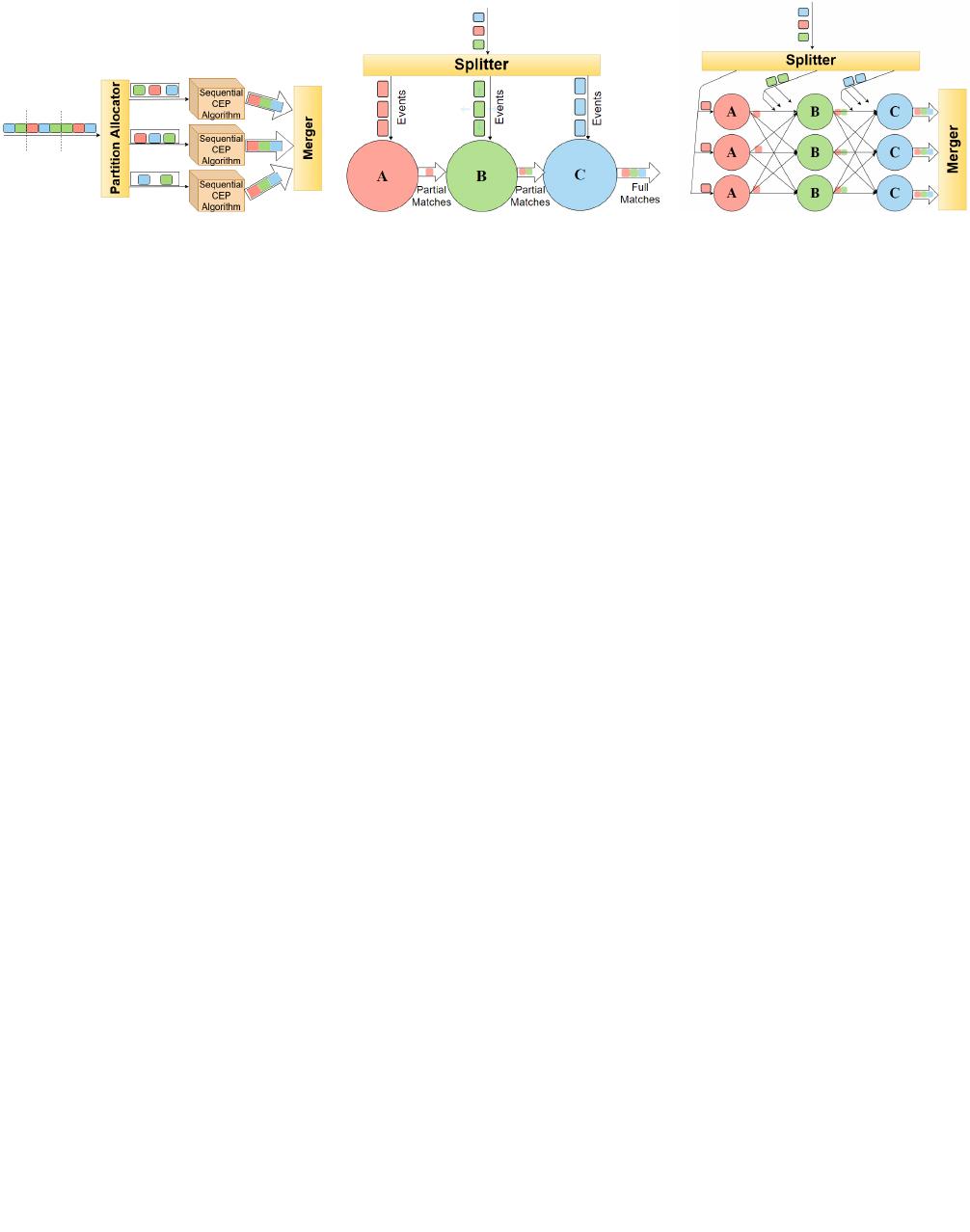
(a) Data parallelism (b) State parallelism (c) Hybrid parallelism
Figure 1: Parallelism classes: (a) input is split into partitions and handled separately by each execution unit; (b) each building block is
represented by a dedicated execution unit that receives a substream of events and performs a well-dened sequential task; (c) a two-layer
approach combining both data parallelism and state parallelism.
parallel CEP system architecture implemented according to this
paradigm. While this scheme was proven highly ecient in many
cases, its inherent limitation lies in the diculty of designing a
good partitioning scheme. Since any subset of data items can repre-
sent a pattern match, at least a fraction of the sub-streams must be
duplicated to multiple units to avoid missing results and to guaran-
tee detection correctness. It is also exceptionally hard to achieve
ne-grained load balancing in presence of data skew.
The second category of CEP parallelization methods is known
as state-parallel [
12
,
25
,
73
]. This approach assigns a dedicated exe-
cution unit to each building block of the pattern detection model,
making it exclusively responsible for some functional part of the
sequential pattern matching algorithm. The units are arranged ac-
cording to a predened topology and the intermediate results of the
pattern match construction process are passed between them. An
example is shown in Figure 1(b). This parallelization scheme avoids
the data stream duplication problem that plagues data-parallel meth-
ods. However, it imposes a hard limit on the degree of parallelism as
the number of execution units is bounded by the number of states.
In this paper, we propose HYPERSONIC: a HYbrid ParallElization
appRoach for Scalable cOmpLex eveNt processIng appliCations.
HYPERSONIC implements a new paradigm for parallelizing CEP
applications, which we refer to as a hybrid-parallel approach. In a
hybrid-parallel system, the execution units are organized in two
layers, and the workload distribution proceeds in two stages. First,
a state-parallel procedure allocates a set of execution units to each
state according to its expected load. Second, a data-parallel routine is
applied within each state to share the work performed by this state
between the individual units. This process is repeated continuously
during the system run. In this way, the system can dynamically
adapt to the ever-changing data arrival rates, system properties,
and resource availability. Figure 1(c) illustrates this scheme.
By providing two distinct layers of parallelism, our approach
combines the strengths of data-parallel and state-parallel solutions
while overcoming their limitations. Unlike that of a pure state-
parallel system, the degree of parallelism in HYPERSONIC is un-
bounded. In addition, no duplicate data transmission is required:
the outer parallelization layer mimics the evaluation ow of the
state-parallel approach and only passes the data once between ad-
jacent states, while the inner parallelization layer avoids the need
for an explicit partitioning scheme by utilizing shared memory
between execution units. This latter communication mechanism
is designed in a way allowing an extension to a fully distributed
share-nothing environment. The two-tier dynamic load balancing
scheme of HYPERSONIC ensures ecient allocation of execution
units to states and of the input data to execution units based on
up-to-date data characteristics and system load.
Rather than merely constituting a load balancing scheme, HY-
PERSONIC is an end-to-end system for ecient and scalable parallel
execution of complex event processing workloads. Any method for
CEP parallelization faces a multitude of CEP-specic challenges
stemming from the inherent tightly coupled nature of the problem.
These challenges include avoiding data duplication, enabling data
sharing between the execution units, and supporting highly com-
plex operators. As we elaborate later on, our solution successfully
tackles these challenges.
The contributions of this paper can be summarized as follows:
•
A novel hybrid-parallel approach for eciently distributing
CEP workloads between multiple execution units.
•
A two-level load balancing scheme based on the above sys-
tem architecture, and a thorough analysis of its performance.
•
Practical extensions to the basic hybrid-parallel method al-
lowing us to further improve the performance and the re-
source utilization of pattern detection.
•
An extensive experimental evaluation of our method, demon-
strating its superiority over state-of-the-art CEP paralleliza-
tion mechanisms as well as a superlinear speedup over the
sequential baseline.
The remainder of this paper is organized as follows. Section 2
presents the necessary background and formally denes the tar-
geted problem. The core design of HYPERSONIC is described in
Section 3 with important extensions covered in Section 4. We re-
port the results of our experimental study in Section 5. Section 6
discusses the related work and Section 7 concludes the paper.
2
Session 15: Streaming and Sensor Networks 2
SIGMOD ’22, June 12–17, 2022, Philadelphia, PA, USA
1094
of 15
免费下载
【版权声明】本文为墨天轮用户原创内容,转载时必须标注文档的来源(墨天轮),文档链接,文档作者等基本信息,否则作者和墨天轮有权追究责任。如果您发现墨天轮中有涉嫌抄袭或者侵权的内容,欢迎发送邮件至:contact@modb.pro进行举报,并提供相关证据,一经查实,墨天轮将立刻删除相关内容。
下载排行榜

评论