



Triton Join Efficiently Scaling to a Large Join State on GPUs with Fast Interconnects.pdf
免费下载
Triton Join: Eiciently Scaling to a Large Join State
on GPUs with Fast Interconnects
Clemens Lutz
∗
clemens.lutz@tu-berlin.de
TU Berlin
Berlin, Germany
Sebastian Breß
†
sebastian.bress@snowake.com
Snowake
Berlin, Germany
Steen Zeuch
steen.zeuch@dfki.de
DFKI GmbH
Berlin, Germany
Tilmann Rabl
tilmann.rabl@hpi.de
HPI, University of Potsdam
Potsdam, Germany
Volker Markl
volker.markl@tu-berlin.de
DFKI GmbH, TU Berlin
Berlin, Germany
ABSTRACT
Database management systems are facing growing data volumes.
Previous research suggests that GPUs are well-equipped to quickly
process joins and similar stateful operators, as GPUs feature high-
bandwidth on-board memory. However, GPUs cannot scale joins
to large data volumes due to two limiting factors: (1) large state
does not t into the on-board memory, and (2) spilling state to main
memory is constrained by the interconnect bandwidth. Thus, CPUs
are often the better choice for scalable data processing.
In this paper, we propose a new join algorithm that scales to
large data volumes by taking advantage of fast interconnects. Fast
interconnects such as NVLink 2.0 are a new technology that connect
the GPU to main memory at a high bandwidth, and thus enable
us to design our join to eciently spill its state. Our evaluation
shows that our Triton join outperforms a no-partitioning hash join
by more than 100
×
on the same GPU, and a radix-partitioned join
on the CPU by up to 2
.
5
×
. As a result, GPU-enabled DBMSs are
able to scale beyond the GPU memory capacity.
CCS CONCEPTS
• Information systems
→
Database management system en-
gines; Join algorithms.
KEYWORDS
Modern hardware, GPU, data transfer bottleneck, out-of-core, TLB
ACM Reference Format:
Clemens Lutz, Sebastian Breß, Steen Zeuch, Tilmann Rabl, and Volker
Markl. 2022. Triton Join: Eciently Scaling to a Large Join State on GPUs
with Fast Interconnects. In Proceedings of the 2022 International Conference on
Management of Data (SIGMOD ’22), June 12–17, 2022, P hiladelphia, PA, USA.
ACM, New York, NY, USA, 16 pages. https://doi.org/10.1145/3514221.3517911
∗
Research partially conducted while the author was employed by DFKI GmbH.
†
Work done while the author was employed by TU Berlin.
Permission to make digital or hard copies of all or part of this work for personal or
classroom use is granted without fee provided that copies are not made or distributed
for prot or commercial advantage and that copies bear this notice and the full citation
on the rst page. Copyrights for components of this work owned by others than the
author(s) must be honored. Abstracting with credit is permitted. To copy otherwise, or
republish, to post on servers or to redistribute to lists, requires prior specic permission
and/or a fee. Request permissions from permissions@acm.org.
SIGMOD ’22, June 12–17, 2022, Philadelphia, PA, USA
© 2022 Copyright held by the owner/author(s). Publication rights licensed to ACM.
ACM ISBN 978-1-4503-9249-5/22/06.. . $15.00
https://doi.org/10.1145/3514221.3517911
GPU TLB
GPU
Memory
CPU > GPU
GPU > CPU
Our contribution
0.00
0.75
1.50
2.25
0 512 1024 1536 2048
Build & Probe Relation Size (Million Tuples / Relation)
Throughput (G Tuples/s)
CPU Radix Join GPU No-Partitioning Join GPU Triton Join
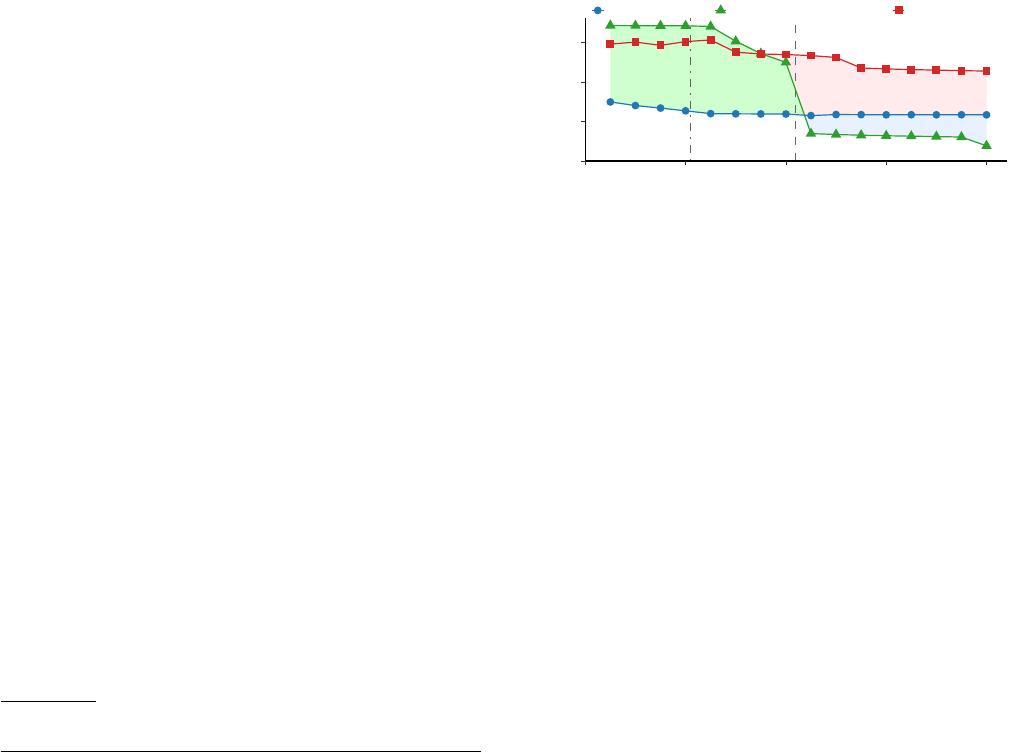
Figure 1: Out-of-core state results in a performance cli and
a slow-down, despite using a fast interconnect. In contrast,
our Triton join gracefully scales to joins with a large state.
1 INTRODUCTION
GPUs are being commercially adopted to accelerate query process-
ing [
86
]. They are available from all major cloud vendors, including
Amazon EC2, Google Compute Engine, and Microsoft Azure, and
are being integrated into academic [
24
,
29
,
39
,
51
,
106
,
122
] and
commercial GPU-enabled database management systems [
78
,
121
].
These GPU-enabled DBMSs see the most benet for join and group-
by aggregation queries with an in-GPU state [
23
,
39
,
43
,
47
,
132
,
145
].
However, database research suggests that GPUs cannot eciently
scale to large, out-of-core state due to the data transfer bottle-
neck [39, 43, 119, 132, 145].
The data transfer bottleneck is caused by the low bandwidth and
high latency of the interconnect between the GPU and the CPU [
81
].
This hardware limitation leads to a narrow scope where DBMSs
benet from GPUs. However, as we illustrate in Figure 1, higher
interconnect bandwidth is necessary, but not sucient for high
scalability. Even if the GPU is given a faster interconnect, the CPU
outperforms the GPU when joining two large data sets. Therefore,
we identify three fundamental challenges that need to be addressed
to widen the applicability of GPUs:
Scalability. GPU joins store their state in GPU memory to in-
crease throughput [
48
,
66
,
92
,
105
,
132
]. Due to the limited capac-
ity of GPU memory, GPU joins cannot eciently scale to a large
state [
81
]. In contrast, CPUs [
7
,
59
,
139
] have two orders-of-mag-
nitude higher memory capacity than GPUs [
6
,
97
,
100
]. Thus, we
must adapt GPU joins to spill their state to CPU memory in order
to achieve scalability.
Session 14: Modern Hardware and In-memory DBMS
SIGMOD ’22, June 12–17, 2022, Philadelphia, PA, USA
1017
Robustness. Spilling the join state to CPU memory results in a
performance cli [
81
]. These sharp performance drops are dicult
to account for in query optimizers, because cardinality estimates can
be signicantly wrong [
28
,
87
]. Thus, GPU-enabled DBMSs must
gracefully scale to large data sizes for a consistent user experience.
Eciency. State-of-the-art approaches reduce interconnect trans-
fers by shifting computations from the GPU to the CPU [
42
,
44
,
113
,
134
,
140
]. However, both interconnect bandwidth and CPU
cycles are scarce resources. DBMSs should use the GPU to ooad
computations from the CPU, while maximizing performance.
A newly emerging technology, fast GPU interconnects, has the
potential to help us address the above challenges. Fast interconnects
provide GPUs with high-bandwidth, cache-coherent access to main
memory. Recent examples include NVLink 2.0 [
97
] and 4.0 [
53
],
Innity Fabric [6], and Compute Express Link 2.0 [31].
In this work, we investigate how fast interconnects can improve
GPU join throughput. Our goal is to enable GPUs to process joins
with a state that exceeds the GPU memory capacity. Thus, we
consider joins smaller and larger than the GPU memory. For large
joins, we partition data out-of-core in CPU memory using the fast
interconnect to achieve data locality during the join. In contrast,
small joins require us to cache all intermediate results in GPU
memory to avoid unnecessary data transfers. We combine the GPU-
based partitioning and the caching in our new,
h
ierarchical
h
ybrid
hash join algorithm:
3
H
+
≡ the Triton join.
Overall, our contributions are as follows:
(1)
We investigate the requirements of an out-of-core GPU join
in regard to fast interconnects, and identify hardware bottle-
necks that limit scalability (Section 3).
(2)
We propose a new GPU radix partitioning algorithm that
takes advantage of fast interconnects to achieve a high band-
width and scale to large data volumes (Section 4).
(3)
We present our new Triton join algorithm, a scalable radix-
partitioned GPU hash join that partitions data using the GPU
and caches partitioned data in GPU memory (Section 5).
The further structure of this paper is as follows. In Section 2,
we briey introduce modern GPU hardware and joins. Next, we
motivate our approach by revisiting out-of-core GPU joins in Sec-
tion 3. After that, we demonstrate our out-of-core radix partitioning
approach in Section 4, and then overcome these challenges with our
Triton join in Section 5. In Section 6, we show our evaluation and
discuss our insights. Finally, we review related work in Section 7
and conclude in Section 8.
2 BACKGROUND
In this section, we provide an overview of the hardware architecture
of a fast-interconnect system, and of hardware-sensitive joins.
2.1 GPUs and Fast Interconnects
Fast interconnects are able to connect a GPU and a CPU with high
bandwidth, a unied address space, and system-wide cache-coher-
ence [
6
,
58
,
97
,
104
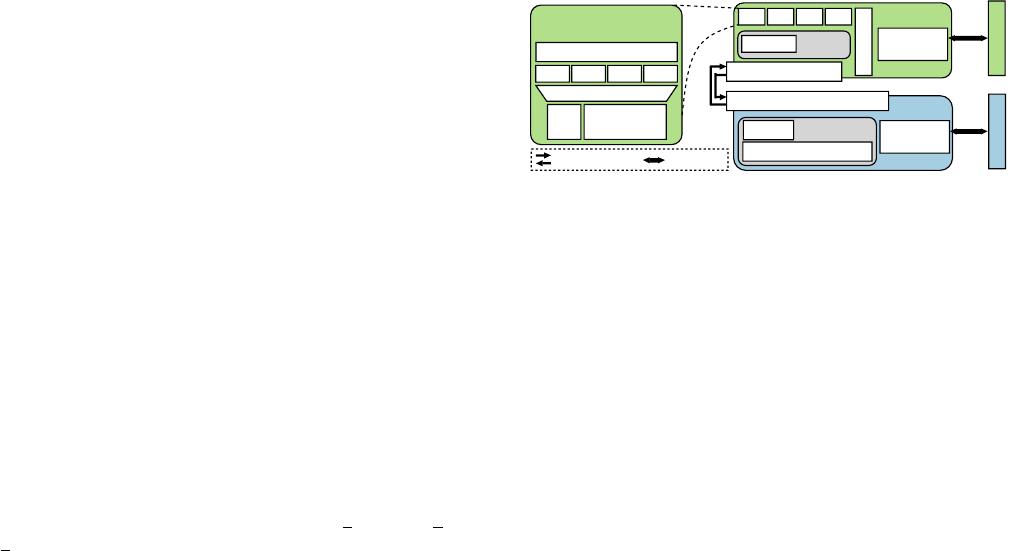
]. As an example, we show the architecture of an
IBM AC922 system [
93
] with an IBM POWER9 CPU and an Nvidia
V100 GPU in Figure 2. Although we focus on NVLink 2.0, other
fast interconnects such as Compute Express Link [
31
], Innity Fab-
ric [6], and OpenCAPI [103] specify a similar system architecture.
Streaming
GPU
CPU
Core Core Core Core
Coalescing Unit
L1 Cache &
Scratchpad
L1
TLB
SM SM SM SM
L2 Cache
L2 TLB
IOMMU
Memory
Controller
IOTLB
Page Table Walkers
NVLink Processing Unit
GPU Mem
CPU Mem
High-Speed Hub
NVLink 2.0
Memory
Controller
MMU
75 GB/s
Memory
GB/s
170
GB/s
900
Multiprocessor
Registers
Figure 2: Hardware architecture of a system with a fast inter-
connect. The electrical bandwidths are annotated.
Overview. The system consists of one or more multi-core CPUs
and discrete GPUs. Each GPU is attached to a CPU by NVLink 2.0,
and has at least 16 GiB of on-board memory with 900 GB/s of
bandwidth [
97
]. Each CPU comes with up to 4 TiB of memory
attached at 170 GB/s [139].
GPU Architecture. GPUs such as Nvidia “Volta” [
27
,
97
] and
AMD “Vega” [
3
] execute threads in parallel on up to 84 streaming
multiprocessors (SM). Each SM schedules threads in hardware [
79
],
and provides up to 65 thousand registers to hide memory latencies
of up to 2 µs [
38
]. Each SM consists of 32–128 cores, on which 32
threads are physically executed together as a warp [
101
]. GPU pro-
gramming languages abstract multiple warps as a thread block [
5
,
101
]. Warps coalesce (i.e., group) adjacent memory accesses into a
single memory transaction to improve memory transfer eciency [
32
,
94
] and to reduce the memory address translation request rate [
118
].
The GPU caches memory accesses in its L1 and L2 caches [27].
Address Translation. CPUs and GPUs share a single address
space [
27
]. A program’s virtual addresses are translated into physi-
cal addresses on a memory access [
27
]. Translations are cached in
a hierarchy of translation lookaside buers (TLBs) [
126
]. Although
GPU vendors do not publish details, it is widely accepted that
“Pascal” and newer GPUs have two TLB levels [
61
,
64
,
65
,
69
,
75
].
The L1 TLB is private to each SM, while multiple SMs share a
L2 TLB [
10
,
69
]. In addition, CPU memory accesses are translated
by an I/O memory management unit (IOMMU) [21, 22, 27, 57]. The
IOMMU is part of the CPU and contains an IOTLB and 12 par-
allel page table walkers [
21
,
56
,
57
]. On a IOTLB miss, the page
table walkers fetch a translation from a page table stored as a radix
tree in CPU memory [
56
,
62
]. GPUs are able to coalesce page ta-
ble walks [
69
,
110
,
111
], and thus the IOMMU returns up to 16
translations at a time [
57
]. Both the GPU and the IOMMU support
4 KiB, 64 KiB and 2 MiB pages [
21
,
56
,
57
,
98
], and the IOMMU also
supports 1 GiB pages [21, 56].
NVLink 2.0. The GPU connects to the CPU at 75 GB/s in both
directions, for a total of 150 GB/s [
93
]. The connection is mediated
by a high-speed hub on the GPU [
96
], and an NVLink processing
unit on the CPU [
57
]. These units send and receive packets con-
sisting of a 16-byte header and 1–256 bytes of payload [
38
,
57
].
Small payloads incur additional overhead. Small reads are padded
to a 32-byte payload [
38
]. Small writes require a 16-byte “byte en-
able” header extension [
38
], that species which payload bytes to
write [
103
]. The GPU SMs support packets up to 128 bytes (i.e.,
an L1 cacheline [
65
,
71
]), and direct memory access copy engines
handle packets up to 256 bytes [
57
]. We calculate that the maximum
eective bandwidth is 62–65.7 GiB/s per direction.
Session 14: Modern Hardware and In-memory DBMS
SIGMOD ’22, June 12–17, 2022, Philadelphia, PA, USA
1018
of 16
免费下载
【版权声明】本文为墨天轮用户原创内容,转载时必须标注文档的来源(墨天轮),文档链接,文档作者等基本信息,否则作者和墨天轮有权追究责任。如果您发现墨天轮中有涉嫌抄袭或者侵权的内容,欢迎发送邮件至:contact@modb.pro进行举报,并提供相关证据,一经查实,墨天轮将立刻删除相关内容。
下载排行榜

评论