



2022SIGMOD论文_LevelIndex Towards Efficient Query Processing in Continuous Preference Space.pdf
免费下载

𝜏-LevelIndex: Towards Eicient ery Processing in
Continuous Preference Space
Jiahao Zhang
†
, Bo Tang
‡§
, Man Lung Yiu
†
, Xiao Yan
‡§
, Keming Li
‡§ ∗
†
Department of Computing, Hong Kong Polytechnic University
§
Research Institute of Trustworthy Autonomous Systems, Southern University of Science and Technology
‡
Department of Computer Science and Engineering, Southern University of Science and Technology
{csjhzhang,csmlyiu}@comp.polyu.edu.hk,{tangb3@,yanx@,likm2020@mail.}sustech.edu.cn
ABSTRACT
Top-
𝑘
related queries in continuous preference space (e.g., k-shortlist
preference query
kSPR
, uncertain top-
𝑘
query
UTK
, output-size
specied utility-based query
ORU
) have numerous applications but
are expensive to process. Existing algorithms process each query via
specialized optimizations, which are dicult to generalize. In this
work, we propose a novel and general index structure
𝜏
-
LevelIndex
,
which can be used to process various queries in continuous pref-
erence space eciently. We devise ecient approaches to build
the
𝜏
-
LevelIndex
by fully exploiting the properties of continuous
preference space. We conduct extensive experimental studies on
both real- and synthetic- benchmarks. The results show that (i)
our proposed index building approaches have low costs in terms
of both space and time, and (ii)
𝜏
-
LevelIndex
signicantly outper-
forms specialized solutions for processing a spectrum of queries in
continuous preference space, and the speedup can be two to three
orders of magnitude.
CCS CONCEPTS
• Information systems → Top-k retrieval in databases.
KEYWORDS
k-level index, preference space, top-𝑘 query processing
ACM Reference Format:
Jiahao Zhang, Bo Tang, Man Lung Yiu, Xiao Yan, Keming Li. 2022.
𝜏
-
LevelIndex: Towards Ecient Query Processing in Continuous Preference
Space. In Proceedings of the 2022 International Conference on Management
of Data (SIGMOD’22), June 12–17, 2022, Philadelphia, PA, USA. ACM, New
York, NY, USA, 14 pages. https://doi.org/10.1145/3514221.3526182
1 INTRODUCTION
The preference model is widely used in many applications, e.g.,
recommender system, multi-criteria decision making, and prod-
uct ranking. Specically, each option in the market has several
∗
Dr. Bo Tang is the corresponding author.
Permission to make digital or hard copies of all or part of this work for personal or
classroom use is granted without fee provided that copies are not made or distributed
for prot or commercial advantage and that copies bear this notice and the full citation
on the rst page. Copyrights for components of this work owned by others than ACM
must be honored. Abstracting with credit is permitted. To copy otherwise, or republish,
to post on servers or to redistribute to lists, requires prior specic permission and/or a
fee. Request permissions from permissions@acm.org.
SIGMOD’22, June 12–17, 2022, Philadelphia, PA, USA.
© 2022 Association for Computing Machinery.
ACM ISBN 978-1-4503-9249-5/22/06.. . $15.00
https://doi.org/10.1145/3514221.3526182
attributes and the value of each attribute models the competitive-
ness of the option. For example, each hotel in the online portals
(e.g, Booking [
1
] and TripAdvisor [
6
]) includes value, facility, and
cleanliness attributes. The attribute values of Crowne Plaza Hotel
in Booking are 0.83, 0.86, 0.89, respectively. We denote an option
with
𝑑
attributes as r
= (𝑟 [
1
], 𝑟 [
2
], · · · , 𝑟 [𝑑])
and all options form
the dataset
D
. A user chooses options based on her preference
weight vector w
= (𝑤 [
1
], 𝑤 [
2
], · · · , 𝑤 [𝑑])
, which species a nu-
meric weight for each attribute. To compute the score of each option
for the user, a linear scoring function (i.e.,
S
w
(
r
) =
Í
𝑑
𝑖=1
𝑟 [𝑖]𝑤 [𝑖]
)
is used and the top-
𝑘
products with the highest scores are appeal-
ing to the user. In the past decades, the database community has
conducted extensive studies on shortlisting product options for
users, i.e., top-
𝑘
query [
22
,
39
], skyline query [
11
,
32
], and hybrids
of top-
𝑘
and skyline queries [
14
,
28
].
Rtree
and its variants [
10
,
19
]
are widely used to accelerate the above query processing.
Besides nding top-
𝑘
options for users, it is also important to
consider user preferences from the perspective of product providers.
For instance, a hotel manager may want to identify potential cus-
tomers who rank his hotel as top-
𝑘
, which should be targeted in
advertising campaigns. Recently, many queries (e.g., Monochromatic
reverse top-
𝑘
[
42
],
MaxRank
[
31
],
kSPR
[
37
], restricted skyline [
14
],
UTK
[
30
], and
ORU
[
28
]) are proposed to explore the entire user
preference space (i.e., the continuous space dened by preference
weight w) instead of discrete user preference weights in traditional
top-
𝑘
ranking queries (i.e., points in the preference space). These
queries can help product providers analyze the competitiveness of
their products in the market, identify target users, adjust the design
of products to attract more users, etc. For example, the
MaxRank
query [
31
] reports the maximum rank a product can have among
all possible users’ preferences, which tells the product provider the
market status of his product.
Many algorithms have been proposed to accelerate the query
processing in continuous preference space, but they are still inade-
quate in two aspects. First, the query processing complexity is high
even with state-of-the-art solutions as many expensive geometric
operations are involved. For example, our experiments show that
an ORU query can take more than 1000 seconds. Second, Existing
algorithms develop specialized techniques for each query and there
lacks a general index structure that accelerates a wide range of
queries in continuous preference space, i.e., an analogue of
Rtree
for top-𝑘 ranking queries.
In this work, we devise a general index (
𝜏
-
LevelIndex
) for queries
in continuous preference space, where
𝜏
is a user-specied param-
eter. A general index is favorable as it not only reduces query
Session 28: Spatial, Temporal, and Multimedia Databases
SIGMOD ’22, June 12–17, 2022, Philadelphia, PA, USA
2149
processing complexity by avoiding expensive geometric operations
but also amortizes the index construction and storage costs among
queries (either of the same or dierent types).
Specically, each option r in the dataset corresponds to a hy-
perplane
S
w
(
r
)
in continuous preference space, and the cell in
𝜏
-
LevelIndex
is dened by a set of halfspaces, which is formed
by option hyperplanes. As we will elaborate in Section 4, many
queries in continuous preference space can be processed by nd-
ing some cells in
𝜏
-
LevelIndex
or the options associated with cer-
tain cells. Constructing
𝜏
-
LevelIndex
can be converted to the fa-
mous
𝜏-𝑙𝑒𝑣𝑒𝑙
problem [
8
] in computational geometry. However, the
𝜏-𝑙𝑒𝑣𝑒𝑙
problem is only solved theoretically with time complexity
𝑂 (𝑛
⌊
𝑑
2
⌋
𝜏
⌈
𝑑
2
⌉
)
[
9
], where
𝑛
is the number of options in the dataset
D
, and
𝑑
is the dimensionality of each option. The challenges of de-
signing an eective index structure and ecient building procedure
for 𝜏-LevelIndex are:
•
Generality and query eciency. There are many types of
queries in continuous preference space, e.g.,
kSPR
,
UTK
,
ORU
.
How to design the structure of
𝜏
-
LevelIndex
such that it can support
all these queries and process them eciently?
•
Index size. As proved in [
9
], the total number of cells at level
ℓ ∈
[
1
, 𝜏]
of
𝜏
-
LevelIndex
is
𝑂 (𝑛
⌊
𝑑
2
⌋
ℓ
⌈
𝑑
2
⌉
)
, and each cell is dened
by the intersection of a set of halfspaces. Thus,
𝜏
-
LevelIndex
will
be overwhelmingly large if cells are expressed explicitly. How to
dene cells and arrange them in
𝜏
-
LevelIndex
to make the index
size practical?
•
Index building time. Using [
9
] to build
𝜏
-
LevelIndex
has time
complexity
𝑂 (𝑛
⌊
𝑑
2
⌋
𝜏
⌈
𝑑
2
⌉
)
. Moreover, computing the cells in
𝜏
-
LevelIndex
requires expensive computational geometric opera-
tions (e.g.,
Intersect
and
Containment
). How to build
𝜏
-
LevelIndex
eciently with a reasonable time cost?
To overcome the above challenges, we rst dene the basic unit
of
𝜏
-
LevelIndex
(i.e., cell) in a compact manner by implicitly ex-
ploiting its geometric properties, and connect two cells in adjacent
levels of
𝜏
-
LevelIndex
if they have a parent-child relation. This struc-
ture not only reduces the index size but also enables
𝜏
-
LevelIndex
to process many queries (if not all) eciently, as usually only a
small number of cells need to be visited. We then propose three
approaches (i.e., the
UTK
2
-adapted approach BSL, the insertion-
based approach
IBA
and the partition-based approach
PBA
) to build
𝜏
-
LevelIndex
. BSL and
IBA
are simple but inecient. However, they
provide insights (i.e., avoid redundant halfspaces in cells and reduce
unnecessary cell insertion checking) to devise novel and ecient
PBA
. We further utilize the dominance relations among options to
improve the performance of PBA.
To the best of our knowledge, this is the rst work in the database
community that proposes a general index for a spectrum of queries
in continuous preference space. Moreover, this work also proposes
the rst practical solution to the well-known
𝜏-𝑙𝑒𝑣𝑒𝑙
problem (i.e.,
building
𝜏
-
LevelIndex
) in the computational geometry community.
In addition to answering continuous preference space queries in
database community,
𝜏
-
LevelIndex
may also nd applications in
computational geometry, e.g., simplex range searching [
7
], Voronoi
0
Yotel
(0.26,0.64)
VibesInn
(0.62,0.76)
Artezen
(0.90,0.48)
citizenM
(0.73,0.33)
0
1
service (𝑟[2])
value (𝑟[1])
1
𝑜𝑅
Royalton
(0.30,0.24)
Artezen
VibesInn
𝑤[1]
0
1
top-2 hotels
VibesInn
Yotel
0.60
0.40
0.18
(a) Product space (b) Preference space
Figure 1: Discrete and continuous space
diagram computing [
23
], graph drawing [
15
]. To sum up, the tech-
nical contributions of our work are as follows:
•
We design a succinct structure for
𝜏
-
LevelIndex
with a novel
implicit cell representation and formally dene the
𝜏
-
LevelIndex
building problem in Section 3.
•
For three representative queries (i.e.,
kSPR
,
UTK
, and
ORU
) in
continuous preference space, we show how to use
𝜏
-
LevelIndex
to process them eciently in Section 4.
•
We propose three building approaches for
𝜏
-
LevelIndex
with a
suite of optimization techniques, which have low costs in both
space and time, in Sections 5 and 6.
•
We conduct extensive experiments on both synthetic- and real-
datasets to validate the eciency of our proposals for
𝜏
-
LevelIndex
building problem. Moreover, for three representative queries, we
demonstrate the advantage of
𝜏
-
LevelIndex
in query processing
eciency over their state-of-the-art solutions in Section 7.
The remainder of this paper is organized as follows. Section 2
presents the preliminary and reviews the related work. Section 3
illustrates the
𝜏
-
LevelIndex
building problem. Section 4 shows how
to process three representative queries via
𝜏
-
LevelIndex
. Sections 5
and 6 present our devised approaches for
𝜏
-
LevelIndex
building.
Section 7 evaluates the eectiveness of our proposals by extensive
experiments, and Section 8 concludes this work.
2 PRELIMINARY AND RELATED WORK
In this part, we introduce the preliminary of ranking queries in
Section 2.1, then discuss the related work in Section 2.2.
2.1 Preliminary
Ranking queries have been extensively studied in the database
community. Usually, it ranks products in the market by the users’
preferences. Consider the option dataset
D = {
r
1
,
r
2
, · · · ,
r
𝑛
}
in
product space, it contains
𝑛
options, which correspond to prod-
ucts such as hotels, laptops or phones in the market. Each product
option r
= (𝑟 [
1
], 𝑟 [
2
], · · · , 𝑟 [𝑑]) ∈ D
is a discrete point in the
𝑑
-
dimensional option space
R
𝑑
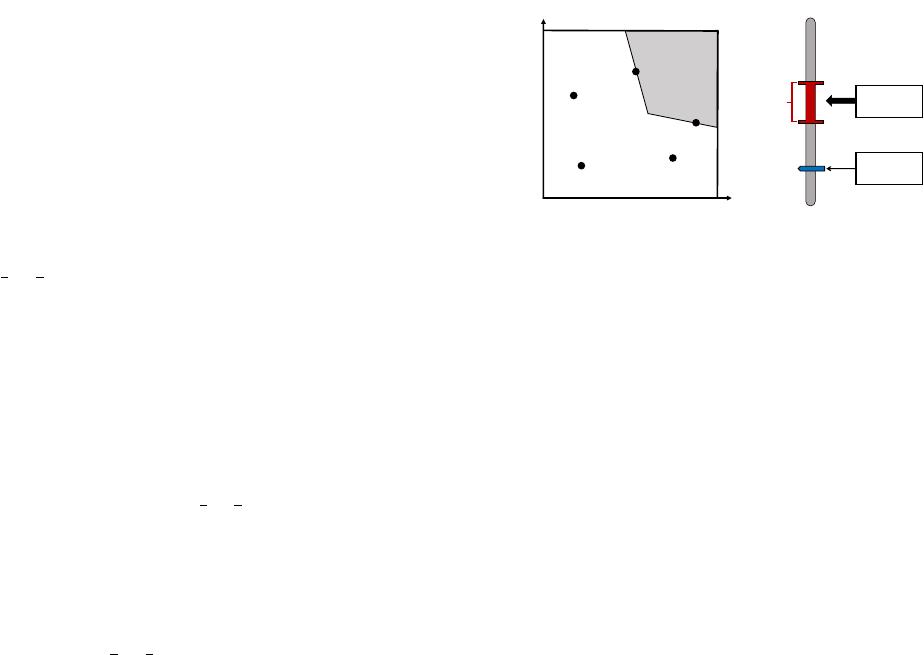
, see discrete black points in Figure 1(a),
in which each dimension models an attribute of the product. The
hotel dataset in Figure 1(a) has 5 hotels, each has two attributes
value
(𝑟 [
1
])
and service
(𝑟 [
2
])
. For example, the attributes value and
service of Artezen are 0.90 and 0.48, respectively. The gray area in
Figure 1(a) shows a continuous region
𝑜𝑅
in product space, we will
elaborate it shortly. A user’s preference for the attributes is captured
Session 28: Spatial, Temporal, and Multimedia Databases
SIGMOD ’22, June 12–17, 2022, Philadelphia, PA, USA
2150
of 14
免费下载
【版权声明】本文为墨天轮用户原创内容,转载时必须标注文档的来源(墨天轮),文档链接,文档作者等基本信息,否则作者和墨天轮有权追究责任。如果您发现墨天轮中有涉嫌抄袭或者侵权的内容,欢迎发送邮件至:contact@modb.pro进行举报,并提供相关证据,一经查实,墨天轮将立刻删除相关内容。
下载排行榜

评论