



P4DB - The Case for In-Network OLTP.pdf
免费下载
P4DB - The Case for In-Network OLTP
Matthias Jasny
Technical University of
Darmstadt
Lasse Thostrup
Technical University of
Darmstadt
Tobias Ziegler
Technical University of
Darmstadt
Carsten Binnig
Technical University of
Darmstadt
ABSTRACT
In this paper we present a new approach for distributed DBMSs
called P4DB, that uses a programmable switch to accelerate OLTP
workloads. The main idea of P4DB is that it implements a transac-
tion processing engine on top of a P4-programmable switch. The
switch can thus act as an accelerator in the network, especially
when it is used to store and process hot (contended) tuples on the
switch. In our experiments, we show that P4DB hence provides
signicant benets compared to traditional DBMS architectures
and can achieve a speedup of up to 8×.
CCS CONCEPTS
• Information systems
→
Distributed database transactions;
• Networks → In-network processing.
KEYWORDS
Distributed Databases, Transactions, Programmable Switches, P4
ACM Reference Format:
Matthias Jasny, Lasse Thostrup, Tobias Ziegler, and Carsten Binnig. 2022.
P4DB - The Case for In-Network OLTP. In Proceedings of the 2022 Inter-
national Conference on Management of Data (SIGMOD ’22), June 12–17,
2022, Philadelphia, PA, USA. ACM, New York, NY, USA, 15 pages. https:
//doi.org/10.1145/3514221.3517825
1 INTRODUCTION
Motivation. The ecient use of data center networks plays a
signicant role on the performance of distributed DBMSs. Tradi-
tionally, distributed DBMSs were built on the assumption that the
network is a major bottleneck. As such, classical distributed DBMSs
were designed to mitigate the eects of the high network cost using
sophisticated techniques such as complicated partitioning schemes
[
15
,
48
,
52
,
70
], semi-join transformations [
47
,
50
,
53
], speculative
execution [
49
], new consistency levels [
35
], or even the relaxation
of atomicity guarantees [
37
,
40
]. However, data center networks
have been evolving signicantly in recent years.
A rst major trend that we have seen in the last years is that
data center networks have evolved from being slow to being fast.
For example, when looking at the network speed provided by cloud
vendors such as Amazon, Microsoft or Google for their hosted
cloud instances, we see that even for the smaller (i.e., cost-ecient)
instances, the network link has a speed of at least 10Gbps and can
Permission to make digital or hard copies of all or part of this work for personal or
classroom use is granted without fee provided that copies are not made or distributed
for prot or commercial advantage and that copies bear this notice and the full citation
on the rst page. Copyrights for components of this work owned by others than the
author(s) must be honored. Abstracting with credit is permitted. To copy otherwise, or
republish, to post on servers or to redistribute to lists, requires prior specic permission
and/or a fee. Request permissions from permissions@acm.org.
SIGMOD ’22, June 12–17, 2022, Philadelphia, PA, USA
© 2022 Copyright held by the owner/author(s). Publication rights licensed to ACM.
ACM ISBN 978-1-4503-9249-5/22/06.. . $15.00
https://doi.org/10.1145/3514221.3517825
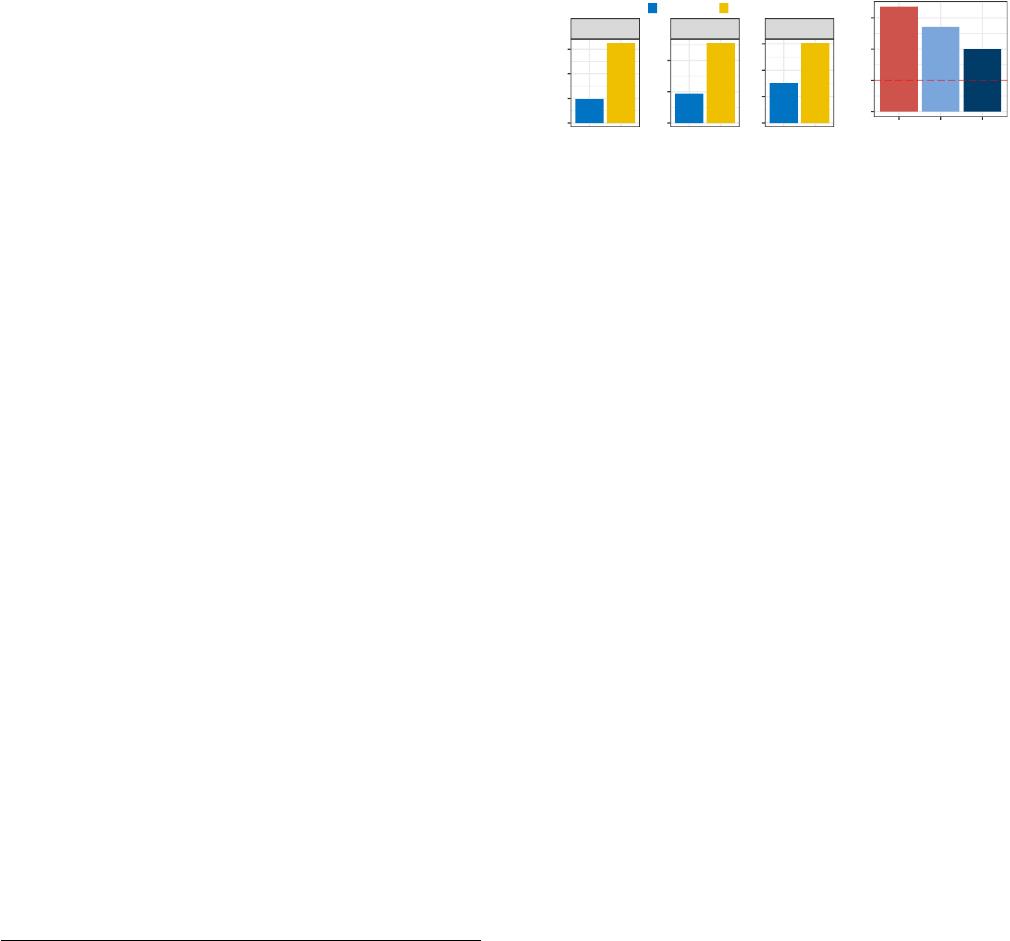
YCSB
SmallBank
TPC-C
0
1M
2M
3M
0
5M
10M
0
2M
4M
6M
Throughput [txn/sec]
No-Switch P4DB
(a) Throughput
0X
1X
2X
3X
YCSB SmallBank TPC-C
Speedup
(b) Speedup
Figure 1: OLTP processing in P4DB using a programmable
switch. Compared to a traditional DBMS without using the
switch, P4DB provides signicant speedups. Details ab out
the setup are explained in our evaluation.
reach up to 100Gbps for larger instance types. Consequently, there
are signicant eorts in database community into investigating how
these high-speed networks can be used eciently by redesigning
distributed DBMSs for zero-copy protocols such as RDMA or DPDK
to avoid the overhead of classical network stacks such as TCP/IP
[7, 30, 64, 69, 72, 74].
Another major trend that we have seen in the recent years is
that with the rise of software-dened networks [
36
], switches and
network cards have become programmable [
10
,
51
] and thus turned
networks from being passive to being active. This programmability
of the network opens up many additional opportunities to tailor the
network to the applications on top. In particular, the programma-
bility of the so-called data plane allows applications to ooad
computation to the network devices (aka in-network-processing
or INP for short). INP has shown to provide signicant benets for
distributed data processing in general, including key-value stores
[
28
,
41
,
68
] as well as distributed OLAP and ML [
8
,
39
,
42
,
57
,
61
].
However, as far as OLTP is concerned, there has been only limited
work so far which ooads only certain sub-components of OLTP,
such as lock management [68] or replication protocols [28, 73].
Contributions. As a main contribution, in this paper we present a
new, more aggressive approach for distributed DBMSs called P4DB
that involves a programmable switch more actively to accelerate
OLTP workloads. The main idea of P4DB is that it implements a
full transaction processing engine on top of a programmable switch,
using P4 as the de facto data plane programming language. That
way, P4DB exposes the switch as an “additional” database node
that, however, comes with very dierent properties compared to a
normal database node (as we discuss below). As a result, the switch
is an ideal “place” to store and process hot (contended) tuples that
typically lead to a signicant performance degradation in traditional
DBMSs. As we show in Figure 1, P4DB can thus signicantly speed
up OLTP processing in distributed DBMSs for various workloads
in case hot tuples are ooaded to the switch.
To better understand where the benets of using a switch origi-
nate from, let us rst look at the hardware characteristics of (pro-
grammable) switches that make them an interesting candidate for
hot tuples. As a main dierence to a normal database node of the
host DBMS, a programmable switch comes with two interesting
characteristics: (1) Programmable switches are designed to process
Session 19: Databases for Emerging Hardware
SIGMOD ’22, June 12–17, 2022, Philadelphia, PA, USA
1375
the aggregated load of network trac from all connected servers at
line-rate. (2) The switch can be reached from database nodes that
are directly connected to the switch with only half of the network
latency compared to the latency required to reach any other (re-
mote) database node that is connected to the same switch. Based
on these characteristics, we next argue that a programmable switch
is an ideal place for storing and processing hot items of an OLTP
workload that are most frequently accessed by transactions.
In a traditional distributed DBMS architecture, hot items that
are accessed frequently by transactions typically lead to a severely
degraded performance, as mentioned before. This is especially true,
when hot items are involved in distributed transactions, as hot items
typically suer from increased remote access latencies. The latency
increase, in turn, leads to an increased likelihood of contention on
those items and thus higher abort rates [
71
]. In contrast, P4DB can
mitigate these eects if hot items are stored and processed on a
programmable switch: This is because when hot tuples are involved
in distributed transactions, storing them on a switch reduces access
latencies, which reduces the overall contention, directly leading to
performance benets.
Surprisingly, however, as we show in our evaluation, even if an
OLTP workload is perfectly partitionable and no distributed trans-
actions are involved in a workload, or even if there is only limited
skew in a workload, P4DB can still speed up processing compared
to a traditional DBMS. The reason is that programmable switches
provide an execution model that enables a new lock-free execution
scheme for transactions, which allows the switch in P4DB to pro-
cess transactions on hot tuples at high speeds since it avoids any
contention. However, implementing a transaction engine on top of
a programmable switch does not come “for free” and many chal-
lenges need to be addressed. For example, typical programmable
switches of today, such as recent Tono-based switches [
5
], have
restrictions not only on the memory model (i.e., how data in the
switch memory can be accessed by in-switch-programs), but also
what kinds of in-switch-programs are supported by their execution
models. By making clever use of the switch memory and the execu-
tion models of programmable switches though, we can eciently
support the concurrent execution of transactions in an abort-free
manner on the switch, as mentioned before.
Finally, we think P4DB is deployable and compatible with ex-
isting datacenter networks. As a main deployment model, P4DB
targets cloud providers that have dedicated racks for database ser-
vices, which is a common scheme to provide high performance for
distributed DBMSs [
68
]. For such a deployment, P4DB only needs
to augment the Top-of-Rack (ToR) switches with a custom data
plane module for processing transactions on hot tuples. But other
deployments, e.g. hierarchies of switches or multi-tenant deploy-
ments, are clearly also interesting. While such deployments are out
of the scope of this paper and are important avenues of future work,
at the end of the paper we provide a short discussion of how we
think P4DB can generalize to such deployments.
Outline. The remainder of this paper is organized as follows:
First, in Section 2 we discuss the relevant background on pro-
grammable switches and their memory and execution models. In
Section 3 we provide an overview of P4DB before we then explain
in Section 4 and Section 5 the details of the storage and execu-
tion model we implemented to execute database transactions on
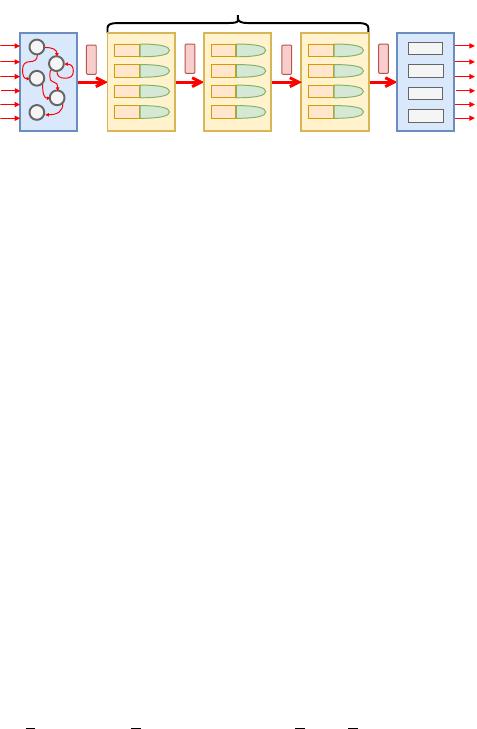
Parser
Match-Action Pipeline
MAU Stage
Table Action
Table Action
Table Action
Table Action
MAU Stage
Table Action
Table Action
Table Action
Table Action
MAU Stage
Table Action
Table Action
Table Action
Table Action
Deparser
+
+
+
Metadata
Metadata
Metadata
Metadata
Figure 2: The Protocol Independent Switch Architecture
(PISA): All stages (Parser, MAU Stages and Deparser) are pro-
grammable and allow exible packet processing in the data
plane based on packet headers and metadata.
a programmable switch. Afterwards, in Section 6 we then discuss
the integration of the in-switch transaction processing into a host
DBMS. Finally, we conclude with an extensive evaluation of P4DB
in Section 7 using various OLTP benchmarks as well as an overview
of related work in Section 8 and a summary in Section 9.
2 BACKGROUND
In the following, we discuss the relevant background on the typical
programmable switches that are commercially available today.
2.1 Programmable Switches
Programmable switches are an emerging trend on the market with
specialized ASICs from vendors such as Intel [
24
] or Cavium [
12
].
Compared to traditional switches, programmable switches provide
capabilities for exible packet processing at line-rate of up to billion
pkt/s. In-network processing (INP) enables advancements in the
programmability of the data plane by providing a recongurable
architecture [
10
] based on match-action tables. This increases the
exibility of switches to be used not only for data routing but also
for ooading application logic to the switches by implementing
customer match-action rules.
The de facto standard for programming the data plane [
9
] is
P4 (Programming Protocol-Independent Packet Processors) . P4 is
a high-level language that allows to write match-action rules to
express the processing of packets in the data plane [
9
]. Initially
designed for programmable network switches, P4 is now used in
a variety of systems which can also be used to process packets
including SmartNICs or FPGAs [6, 38, 63].
P4 programs in general operate on packet headers and specify
how to rewrite those headers. Although it uses a C-like syntax, it
does not allow the use of pointers and has many other restrictions
regarding oating-point numbers or loops to allow the processing
of P4 programs at line-rate. These constraints can be overcome
by common techniques like loop-unrolling, xed-point arithmetic
or dictionary encoding for strings. Switch vendors can also add
dierent dedicated hardware-accelerators (e.g.: a checksum-engine
or FPU) to the ASIC, which are then available through P4-externs.
2.2 Protocol Independent Switch Architecture
For executing P4 programs, the commercially available program-
mable switches typically implement the so-called Protocol Inde-
pendent Switch Architecture (PISA) as shown in Figure 2. PISA
provides protocol-independence by allowing programmers to spec-
ify how a packet should be parsed and processed in a declarative
manner using match-action tables as mentioned before. In P4DB,
for example, we use custom match-action rules to implement the
logic of the transaction engine on the switch.
Session 19: Databases for Emerging Hardware
SIGMOD ’22, June 12–17, 2022, Philadelphia, PA, USA
1376
of 15
免费下载
【版权声明】本文为墨天轮用户原创内容,转载时必须标注文档的来源(墨天轮),文档链接,文档作者等基本信息,否则作者和墨天轮有权追究责任。如果您发现墨天轮中有涉嫌抄袭或者侵权的内容,欢迎发送邮件至:contact@modb.pro进行举报,并提供相关证据,一经查实,墨天轮将立刻删除相关内容。
下载排行榜

评论