



Large Graph Convolutional Network Training with GPU-Oriented Data Communication Architecture.pdf
免费下载
Large Graph Convolutional Network Training with
GPU-Oriented Data Communication Architecture
Seung Won Min
UIUC
min16@illinois.edu
Kun Wu
UIUC
kunwu2@illinois.edu
Sitao Huang
UIUC
shuang91@illinois.edu
Mert Hidayetoğlu
UIUC
hidayet2@illinois.edu
Jinjun Xiong
IBM T.J. Watson Research Center
jinjun@us.ibm.com
Eiman Ebrahimi
NVIDIA
eebrahimi@nvidia.com
Deming Chen
UIUC
dchen@illinois.edu
Wen-mei Hwu
NVIDIA / UIUC
whwu@nvidia.com
ABSTRACT
Graph Convolutional Networks (GCNs) are increasingly adopted
in large-scale graph-based recommender systems. Training GCN
requires the minibatch generator traversing graphs and sampling
the sparsely located neighboring nodes to obtain their features.
Since real-world graphs often exceed the capacity of GPU memory,
current GCN training systems keep the feature table in host memory
and rely on the CPU to collect sparse features before sending them
to the GPUs. This approach, however, puts tremendous pressure
on host memory bandwidth and the CPU. This is because the CPU
needs to (1) read sparse features from memory, (2) write features
into memory as a dense format, and (3) transfer the features from
memory to the GPUs.
In this work, we propose a novel GPU-oriented data commu-
nication approach for GCN training, where GPU threads directly
access sparse features in host memory through zero-copy accesses
without much CPU help. By removing the CPU gathering stage,
our method signicantly reduces the consumption of the host re-
sources and data access latency. We further present two important
techniques to achieve high host memory access eciency by the
GPU: (1) automatic data access address alignment to maximize PCIe
packet eciency, and (2) asynchronous zero-copy access and kernel
execution to fully overlap data transfer with training. We incorpo-
rate our method into PyTorch and evaluate its eectiveness using
several graphs with sizes up to 111 million nodes and 1.6 billion
edges. In a multi-GPU training setup, our method is 65-92% faster
than the conventional data transfer method, and can even match
the performance of all-in-GPU-memory training for some graphs
that t in GPU memory.
PVLDB Reference Format:
Seung Won Min, Kun Wu, Sitao Huang, Mert Hidayetoğlu, Jinjun Xiong,
Eiman Ebrahimi, Deming Chen, and Wen-mei Hwu. Large Graph
Convolutional Network Training with GPU-Oriented Data Communication
Architecture. PVLDB, 14(11): 2087 - 2100, 2021.
doi:10.14778/3476249.3476264
This work is licensed under the Creative Commons BY-NC-ND 4.0 International
License. Visit https://creativecommons.org/licenses/by-nc-nd/4.0/ to view a copy of
this license. For any use beyond those covered by this license, obtain permission by
emailing info@vldb.org. Copyright is held by the owner/author(s). Publication rights
licensed to the VLDB Endowment.
Proceedings of the VLDB Endowment, Vol. 14, No. 11 ISSN 2150-8097.
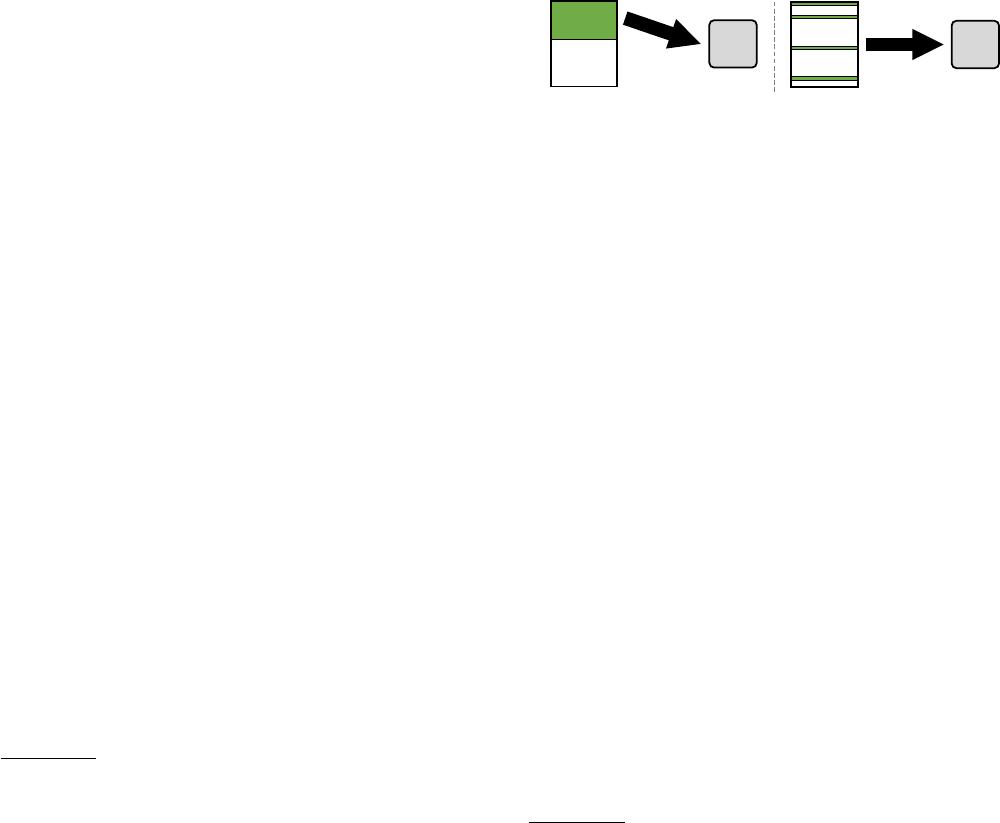
Host Memory
Block
Transfer
(a) Dense Feature (e.g. Image)
(b) Sparse Feature (e.g. Graph)
GPU
Host Memory
?
GPU
PCIe PCIe
Figure 1: Challenge of GPUs accessing ne-grained sparse
features in host memory.
PVLDB Artifact Availability:
The source code, data, and/or other artifacts have been made available at
https://github.com/K-Wu/pytorch-direct_dgl.
1 INTRODUCTION
Acceleration of modern machine learning models is often severely
limited by insucient memory bandwidth [
26
,
49
,
50
]. To provide
the best possible memory bandwidth, data is usually placed in
memory closest to the processing units of the accelerators [
45
,
54]. However, with extremely large datasets, it is inevitable to put
data farther from the processing units to take advantage of larger
capacity (e.g., host memory). In this case directly accessing remote
data from the processing units can be very inecient due to slow
external interconnects. To free processing units from spending
excessive amount of time accessing remote data, modern hardware
systems utilize direct memory access (DMA) engines.
DMA engines are specialized in transferring large blocks of
data independently. By providing source and destination memory
pointers along with the data size, DMA engines transfer data behind
the scenes while keeping processing units available for other tasks.
Initiating each DMA requires multiple interactions between the
user application and the operating system, but these overheads can
be oset by transferring large data blocks (Figure 1 (a)).
The recent adaptation of machine learning to a wide range of
tasks has led modern deep neural networks to work on more com-
plicated data structures such as graphs. Graphs are essential in
doi:10.14778/3476249.3476264
2087
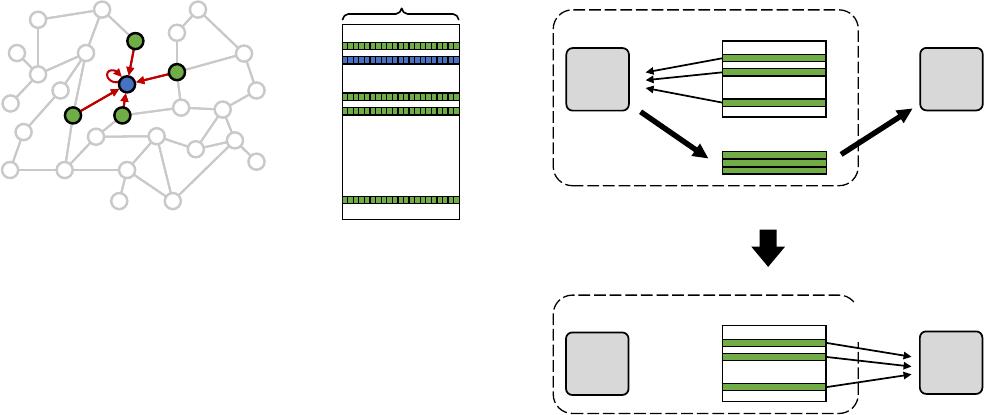
9
2
7
25
Node 2
Node 4
Node 7
Node 9
Node 25
(a) Neighbor Aggregation (b) Node Feature Tensor
4
Node Feature
Figure 2: (a) A simple example of GCN training on single
node. (b) An illustration of node features in memory. The
neighboring nodes’ features are scattered in memory.
representing real-world relational information in social networks
and e-commerce. The capability to build high-quality recommender
systems on graphs is indispensable to multiple businesses. In these
graph data structures, the data which we need to access is often
not coalesced together, but scattered in memory (Figure 1 (b)).
One of the most successful adaptations of deep neural network
models to graph data is Graph Convolutional Network (GCN) [
22
].
The core idea of GCN is to create node embeddings by iteratively
aggregating neighboring nodes’ attributes using neural networks.
Due to its neighboring node’s attribute lookup, training GCN re-
quires accessing multiple scattered locations in memory. In Figure 2
(a), we show a simple example of GCN training. To generate the
embedding of node 4, we traverse the input graph and aggregate
node 4’s features alongside the features of all neighboring nodes in
the node feature tensor. The example that we show here is only a
toy example. In real-world graphs, each node can be connected to
thousands of nodes. To collect relational information from those
neighboring nodes, we may need to access thousands of scattered
locations in memory. Without a doubt, such data access patterns
make the traditional block data transfer method ineective.
In this work, we propose a processor-oriented, software-dened
data communication architecture. Instead of using DMA engines,
we program GPU cores to directly access host memory with zero-
copy memory access. This approach allows the application devel-
opers to direct the GPU cores to exactly the locations that hold
the data needed for computation. Conventional wisdom may still
argue that since the node feature data is in host memory, CPU has
signicant bandwidth advantage over GPUs and therefore DMA
should be a better option because CPU can quickly gather the sparse
features on the y. However, recent work has shown that the ability
to issue a massive number of concurrent memory accesses enables
GPUs to tolerate latency eectively when accessing complicated
data structures like graphs that reside in host memory [
28
]. There-
fore, in GCN training, if GPUs can make targeted ne-grain host
memory accesses for sparse features while fully utilizing system in-
terconnect (e.g., PCIe) bandwidth, the proposed approach can oer
signicant advantage over the DMA approach. The removal of CPU
gathering stage not only shortens data access latency for GPUs,
but also greatly reduces the CPU and host memory utilization (Fig-
ure 3). Ooading CPU workloads to GPUs also helps on training
Contiguous Buffer
CPU
GPU
DMA Read
Write
DMA-based (Block Transfer) Approach
Zero-Copy-based Approach (This work)
Feature Tensor
CPU
GPU
Host
Host
Feature Tensor
Read
66.7% Memory
bandwidth saving
Lower end-to-end
data transfer latency
Zero-Copy
Read
Busy
Idle
Figure 3: Workload comparison between DMA-based
method and the proposed zero-copy-based method.
GCN with multiple GPUs as we can prevent the CPU becoming the
bottleneck with increasing number of workers.
In order to propose the GPU-oriented data communication ar-
chitecture for GCN training, we address three major questions in
this work. First, can zero-copy memory access fully utilize PCIe
bandwidth while training GCN considering the long latency for
accessing host memory? Second, what would be the price of con-
suming GPU cores for zero-copy memory access? Finally, after
resolving the above two questions, can we show real end-to-end
application performance benet from our method?
In this work, we answer all three questions. First, to maintain
the best possible PCIe packet eciency with zero-copy memory
access, we propose an automatic data access alignment optimiza-
tion in GPU data indexing kernel. With our optimization, zero-copy
PCIe bandwidth can match up to 93% of block transfer PCIe band-
width. Second, we propose a novel CUDA multi-process service
(MPS) [
37
] based resource provisioning optimization to minimize
GPU resource consumption of zero-copy memory accesses. Based
on careful investigation of PCIe protocol and GPU architecture,
we conclude that we can saturate PCIe even if only a few number
of GPU cores are generating zero-copy accesses. Therefore, our
optimization isolates only small portion of GPU resources for the
zero-copy accesses and leaves the rest for computationally intense
workloads.
Finally, we build an end-to-end zero-copy GCN training ow in
PyTorch. To enable zero-copy memory access, we devise a new class
of tensor called "unied tensor". This tensor provides an address
mapping of host memory for GPUs so they can directly access host
memory with zero-copy accesses. By simply declaring multiple uni-
ed tensor instances for multiple GPUs, our GCN training ow can
also support zero-copy access in multi-GPU training environment.
2088
of 14
免费下载
【版权声明】本文为墨天轮用户原创内容,转载时必须标注文档的来源(墨天轮),文档链接,文档作者等基本信息,否则作者和墨天轮有权追究责任。如果您发现墨天轮中有涉嫌抄袭或者侵权的内容,欢迎发送邮件至:contact@modb.pro进行举报,并提供相关证据,一经查实,墨天轮将立刻删除相关内容。
下载排行榜

评论