



Improving Execution Eficiency of Just-in-time Compilation based Qery Processing on GPUs.pdf
免费下载

Improving Execution Eiciency of Just-in-time Compilation
based ery Processing on GPUs
Johns Paul
National University of Singapore
idsjp@nus.edu.sg
Bingsheng He
National University of Singapore
hebs@nus.edu.sg
Shengliang Lu
National University of Singapore
lusl@nus.edu.sg
Chiew Tong Lau
Nanyang Technological University, Singapore
asctlau@ntu.edu.sg
ABSTRACT
In recent years, we have witnessed signicant eorts to improve
the performance of Online Analytical Processing (OLAP) on graph-
ics processing units (GPUs). Most existing studies have focused
on improving memory eciency since memory stalls can play an
essential role in query processing performance on GPUs. Motivated
by the recent rise of just-in-time (JIT) compilation in query process-
ing, we investigate whether and how we can further improve query
processing performance on GPU. Specically, we study the execu-
tion of state-of-the-art JIT compile-based query processing systems.
We nd that thanks to advanced techniques such as database com-
pression and JIT compilation, memory stalls are no longer the most
signicant bottleneck. Instead, current JIT compile-based query pro-
cessing encounters severe under-utilization of GPU hardware due to
divergent execution and degraded parallelism arising from resource
contention. To address these issues, we propose a JIT compile-based
query engine named Pyper to improve GPU utilization during query
execution. Specically, Pyper has two new operators, Shue and
Segment, for query plan transformation, which can be plugged into
a physical query plan in order to reduce divergent execution and
resolve resource contention, respectively. To determine the inser-
tion points for these two operators, we present an analytical model
that helps insert Shue and Segment operators into a query plan
in a cost-based manner. Our experiments show that 1) the analyti-
cal analysis of divergent execution and resource contention helps
to improve the accuracy of the cost model, 2) Pyper signicantly
outperforms other GPU query engines on TPC-H and SSB queries.
PVLDB Reference Format:
Johns Paul, Bingsheng He, Shengliang Lu, and Chiew Tong Lau. Improving
Execution Eciency of Just-in-time Compilation based Query Processing
on GPUs. PVLDB, 14(2): 202 - 214, 2021.
doi:10.14778/3425879.3425890
PVLDB Artifact Availability:
The source code, data, and/or other artifacts have been made available at
https://github.com/Xtra-Computing/Pyper.
This work is licensed under the Creative Commons BY-NC-ND 4.0 International
License. Visit https://creativecommons.org/licenses/by-nc-nd/4.0/ to view a copy of
this license. For any use beyond those covered by this license, obtain permission by
emailing info@vldb.org. Copyright is held by the owner/author(s). Publication rights
licensed to the VLDB Endowment.
Proceedings of the VLDB Endowment, Vol. 14, No. 2 ISSN 2150-8097.
doi:10.14778/3425879.3425890
1 INTRODUCTION
In recent years, we have witnessed a signicant eort in improving
the performance of Online Analytical Processing (OLAP) systems
on graphics processing units (GPUs) [
17
,
21
,
22
,
32
,
35
,
38
]. More
recently, JIT compilation-based systems (hereafter referred to as
compiled systems) [
5
–
7
,
11
] have evolved as the state-of-the-art
query execution systems on GPUs. JIT compilation has the major
advantage to reduce unnecessary materialization of intermediate
data at operator/kernel boundaries within query pipelines and to
reduce the instruction count within GPU kernels. On the other hand,
many eorts have focused on improving the memory eciency
since memory stalls play an important role in query processing
performance on GPUs [
13
,
15
–
18
,
36
]. Given all these optimizations,
it is time to revisit the query execution on GPUs and identify the
opportunities to improve query processing performance on GPUs.
Taking a closer look at existing compiled systems [
5
–
7
,
11
], we
nd that they work by rst breaking down the query plan associated
with each query into pipelines and then generating a single kernel
for each pipeline of relational operators. We refer to this compilation
strategy as a monolithic approach, since it generates a monolithic
kernel for each pipeline. While this monolithic approach eliminates
the amount of intermediate data materialization, we have identied
two major performance issues.
First, the generated kernels in the monolithic approach often have
a large number of neste d branch instructions per kernel. Hence, the
thread warps executing the kernels generated by the monolithic
approach can have a high degree of divergence, resulting in poor
utilization of a large number of GPU cores.
Second, the high resource requirements of the generated kernels
lead to low parallelism on GPU. Overall, the monolithic approach
generates kernels containing multiple relational operators, which
require even more registers and shared memory resources. That
means the monolithic approach exaggerates the problem of resource
contention on the GPUs since threads can only be scheduled for
execution on GPUs if there are enough free hardware resources
available. Therefore, the monolithic approach also leads to degraded
parallelism on GPUs and cannot fully utilize the large number of
parallel cores on the GPU.
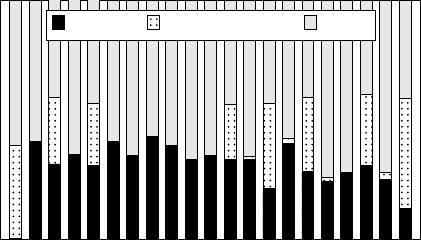
To demonstrate the impact of the two execution eciency issues,
we present the execution time break down of the code generated
from the monolithic approach for TPC-H [
1
] (queries without sub-
query) and SSB [
3
] in Figure 1. We divide the execution time
into three components: 1) estimated overhead of divergence, 2) esti-
mated overhead of resource contention, and 3) others. The overhead
202
Q1
Q3
Q5
Q6
Q10
Q12
Q14
Q19
Q1.1
Q1.2
Q1.3
Q2.1
Q2.2
Q2.3
Q3.1
Q3.2
Q3.3
Q3.4
Q4.1
Q4.2
Q4.3
0
20
40
60
80
100
Execution Time Breakdown (%)
Divergence Resource Contention
Others
Figure 1: Execution time breakdown of TPC-H and SSB
queries demonstrating the impact of divergent execution
and resource contention among threads.
of divergence and resource contention were estimated based on
the achieved execution eciency of the warps and GPU hardware
occupancy rate, both of which can be obtained using proling tools
from GPU vendors. The results of the breakdown clearly demon-
strate that divergent execution and resource contention among
the threads have a signicant impact on the overall performance
of both TPC-H and SSB queries. Overall these ineciencies can
contribute to more than 50% of the total execution time. Therefore,
divergence and resource contention have now become the most
signicant bottleneck for query processing on GPUs.
In this paper, we propose Pyper, a JIT compilation-based query
processing system to resolve GPUs’ divergence and resource con-
tention issues. Pyper introduces two new operators for query plan
transformation, Shue and Segment, to improve GPU hardware
utilization during query execution. Specically, Shue is applied
to a pipeline to reduce the execution divergence. Segment is used
to split a pipeline that has overwhelming resource usage into sev-
eral pipelines with lower resource usage but much higher thread
parallelism. The benets of the two operators come with overheads.
Thus, we develop a cost model to guide the optimal use of Shue
and Segment operators. The challenge is that we need to estimate
the impact of divergence and resource contention, which have been
overlooked in the previous studies [14, 15].
The major contributions of this paper are as follows.
•
We study the eciency of current JIT compilation-based
query processing approaches and identify their severe under-
utilization of GPU hardware due to divergent execution and
degraded parallelism arising from resource contention.
•
We propose Pyper to address the execution eciency issues
of existing JIT compilation-based systems, by introducing
two new operators (Shue and Segment) and an analytical
model to determine the usage of the two operators in a cost-
ecient manner.
•
We conduct in-depth experiments demonstrating the benet
of using the Shue and Segment operators as well as the
accuracy of our analytical model. Our experiments show
that Pyper is able to improve the performance of TPC-H
and SSB queries on average by 1.60x and 1.52x, compared
to Hawk [5]. Pyper further achieves 5.01x and 2.55x perfor-
mance improvement over Omnisci [
2
] for TPC-H and SSB
queries respectively.
The rest of this paper is organized as follows. In Section 2.1, we
present the GPU hardware’s background and the related work on
JIT query compilation. We then present the architecture design of
Pyper in Section 3. We present the details of the analytical model
and query optimizer in Sections 4 and 5, respectively. We present
the experiments in Section 6 and conclude in Section 7.
2 BACKGROUND AND RELATED WORK
2.1 GPU Hardware & CUDA
A single GPU consists of multiple streaming multiprocessors (SMs),
each of which consists of multiple CUDA cores. All CUDA cores in
an SM share resources like the registers and shared memory. Due
to this sharing, the workload scheduler in GPU only schedules new
threads for execution on an SM, if there are enough registers and
shared memory resources available. GPUs also have an L2 cache
and a global memory that are shared among all the SMs. Each
thread block is given exclusive access to shared memory, i.e., data
in shared memory cannot be shared across dierent thread blocks.
Warp-at-a-time execution model:
In the CUDA programming
model, a program executed by the GPU is known as a kernel. A
kernel is executed as a grid of thread blocks, which can further
be divided into warps (groups of 32 threads). Each thread block
is assigned to a single SM, and the CUDA cores inside each SM
executes the threads in a SIMD fashion, at the granularity of a
single warp. Hence, during any given execution cycle, an entire
warp of threads can only execute a single instruction. That means,
during each instruction issue cycle, only threads that can execute
the same instruction will be activated, and the resources allocated
to the other threads would be wasted. Thus, branch divergence can
be a serious performance issue on GPU executions.
Resource constraints per thread:
For the eciency of GPU
executions, registers, and shared memory are the key resources
that constrain the number of parallel thread executions. Warps can
only be scheduled for execution on GPUs if there are enough free
hardware resources available.
2.2 JIT Query Compilation
JIT compilation-based systems (hereafter referred to as compiled sys-
tems) [
5
–
7
,
11
] have been developed to further reduce unnecessary
materialization of intermediate data at operator/kernel boundaries
within query pipelines and to reduce the instruction count within
GPU kernels. In the following, we review the related work of JIT-
based query engines on GPUs (more related work can be found at
our technical report [29]).
LLVM based database systems like Voodoo [
31
], HetExchange [
6
],
HAPE [
7
], OmniSci (formerly known as MapD) and OpenCL based
HorseQC [
11
] and Hawk [
5
] were proposed to generate optimized
executable code for heterogeneous systems containing both CPUs
and GPUs. Both Voodoo [
31
] and Hawk [
5
] attempt to generate code
to execute on a variety of parallel architectures. HetExchange [
6
] de-
veloped abstraction for device-oblivious operators and exploited the
heterogeneous parallelism of modern servers with multiple CPUs/G-
PUs. HorseQC [
11
] extends the operator-at-a-time approach by
203
of 13
免费下载
【版权声明】本文为墨天轮用户原创内容,转载时必须标注文档的来源(墨天轮),文档链接,文档作者等基本信息,否则作者和墨天轮有权追究责任。如果您发现墨天轮中有涉嫌抄袭或者侵权的内容,欢迎发送邮件至:contact@modb.pro进行举报,并提供相关证据,一经查实,墨天轮将立刻删除相关内容。
下载排行榜

评论