



In Search of an Understandable Consensus Algorithm
免费下载

In Search of an Understandable Consensus Algorithm
(Extended Version)
Diego Ongaro and John Oust erhou t
Stanford University
Abstract
Raft is a consen sus algorithm for managing a replicated
log. It produces a result equivalent to (multi-)Paxos, and
it is as efficient as Paxos, but its structur e is different
from Paxos; this makes Raft more understandab le than
Paxos and also provides a better foundation for build-
ing practical system s. In order to enhance understandabil-
ity, Raft separates the key elements of consensus, such as
leader election, log replication, and safety, and it enforce s
a stronger degree of coherency to reduce the number of
states that must be considered. Results from a user study
demonstra te that Raft is easier for students to learn than
Paxos. Raft also includes a new m e chanism for changing
the cluster membership, which uses overlapping majori-
ties to gua rantee safety.
1 Introduction
Consensus algorithm s allow a collection of machin es
to work as a coheren t group that ca n survive the fail-
ures o f some of its members. Because of this, they play a
key role in building reliable large-scale software systems.
Paxos [15, 16] has dominated the discussion of consen-
sus algorithms over the last decade: most implementations
of consensus are based on Paxos or influenced by it, and
Paxos has become the primary vehicle used to teach stu-
dents about c onsensus.
Unfortu nately, Paxos is quite difficult to understand, in
spite of numerous attempts to make it more approachable.
Furthermore, its architecture requires complex chan ges
to support practical systems. As a result, both system
builders and students struggle with Paxos.
After struggling with Paxos ourselves, we set out to
find a new consensus algorithm that could provide a bet-
ter foundatio n for system building and education. Our ap-
proach was unusua l in that our primary goal was under-
standability: could we define a consensus algorithm for
practical systems and describe it in a way that is signifi-
cantly easier to learn than Paxos? Furtherm ore, we wanted
the algorithm to facilitate the development of intuitions
that are essential for system builders. It was important not
just for the algorithm to work, but for it to be obvious why
it works.
The result of this work is a consensus algorithm called
Raft. In designing Raft we applied specific techniques to
improve understand ability, including de composition (Raft
separates leader election, log rep lica tion, and safety) and
This tech report is an extended version of [32]; additional material is
noted with a gray bar in the margin. Published May 20, 2014.
state space reduction (relative to Paxos, Raft reduces the
degree of nondeterminism and th e ways servers can be in-
consistent with each othe r). A user study with 43 students
at two universities shows that Raft is significan tly easier
to understan d than Paxos: after learning both algorithms,
33 of these students were able to answer questions about
Raft better than questions about Paxos.
Raft is similar in m any ways to existing consensus al-
gorithms (most notably, Oki and Liskov’s Viewstamped
Replication [29, 22]), but it has several novel fea tures:
• Strong leader: Raft u ses a stronger form of leader-
ship than other consensus algorithms. For example,
log entries only flow fr om the leader to other servers.
This simplifies the management of the replicated log
and makes Raft easier to understand.
• Leader election: Raft uses randomized timers to
elect leaders. This adds only a small amount of
mechanism to the heartbeats already required for any
consensus algorithm, while resolving conflicts sim-
ply and rapidly.
• Membership changes: Raft’s mechanism for
changin g the set of servers in the cluster uses a new
joint consensus approach where the majorities of
two different configurations overlap during transi-
tions. This allows the cluster to continue opera ting
normally du ring configuration changes.
We believe that Raft is superior to Paxos and othe r con-
sensus algorithms, both for educatio nal purposes and as a
foundation for implementation. It is simpler and more un-
derstandable than other algorithms; it is described com-
pletely enough to m eet the needs of a practical system;
it has several open-source implementations and is used
by several companies; its saf ety properties have bee n for-
mally specified and proven; and its efficiency is compara-
ble to other algorithms.
The remainder of the paper intr oduces the replicated
state machine p roblem (Section 2), discusses the strength s
and weaknesses of Paxos (Section 3), describes our gen-
eral approach to u nderstandability (Section 4), presents
the Raft co nsensus algorithm (Sections 5–8), evaluates
Raft (Section 9), and discusses related work (Section 10).
2 Replicated state machines
Consensus algorithms typically arise in the context of
replicated state machines [ 37]. In this approach, state m a-
chines on a collection of servers compute identical copies
of the same state an d can continue operating even if some
of the servers are down. Replicated state machines are
1
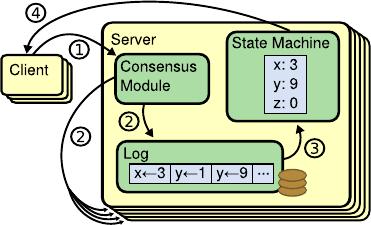
Figure 1: Replicated state machine architecture. The con-
sensus al gorithm manages a replicated log containing state
machine commands f rom clients. The state machines process
identical sequences of commands from the logs, so they pro-
duce the same outputs.
used to solve a variety of fault tolerance problems in dis-
tributed systems. For example, large-scale systems that
have a single cluster leader, such as GFS [8], HDFS [38],
and RAMCloud [33], typically use a separate replicated
state machine to manage leader election and stor e config-
uration information that must survive leader crashes. Ex-
amples of replicated state machines include Chubby [2]
and ZooKeeper [11].
Replicated state machines are typically implemented
using a replicated log, as shown in Figure 1. Each server
stores a log containing a series of comma nds, which its
state ma chine executes in order. Each log contains the
same comma nds in the same order, so each state ma-
chine processes the same seq uence of commands. Since
the state machines are determin istic, each computes the
same state and the same sequen c e of outputs.
Keeping the replicated log consistent is the job of the
consensus algorithm. The consensus modu le on a server
receives commands from clients and adds them to its log.
It communicate s with the consensus m odules on other
servers to ensure that every log eventually contains the
same requests in the same order, even if some servers fail.
Once c ommands are properly re plicated, each server’s
state m a chine processes them in log order, and the out-
puts are returned to clients. As a result, the servers appear
to form a single, high ly reliable state machine.
Consensus algorithms for practica l systems typically
have the f ollowing properties:
• They ensure safety (never returning an incorrect re-
sult) under all non-Byzantine conditions, including
network delays, partitions, and packet loss, duplica-
tion, and reo rdering.
• They are fully functional (available) as long as any
majority o f the servers are operational and can com-
municate with each other and with clients. Thus, a
typical cluster of five servers can tolerate the failure
of any two servers. Servers are assumed to fail by
stopping; they may later recover from state on stable
storage and rejoin the cluster.
• They do not depend on timing to ensure the consis-
tency of the logs: faulty clocks and extreme message
delays can, at worst, cause availability problems.
• In the co mmon case, a command can complete as
soon as a majority of the cluster has r e sponded to a
single round of remote procedure c alls; a minority of
slow servers need not impact overall system perfor-
mance.
3 What’s wrong with Paxos?
Over the last ten years, Leslie Lamport’s Paxos proto-
col [15] has become almost synonymous with consensus:
it is the protocol most commonly taught in courses, and
most imp le mentations o f consensus use it as a starting
point. Paxos first defines a protocol c apable of reaching
agreement on a single decision, such as a single replicated
log entry. We refer to this subset as single-decree Paxos.
Paxos then combines multiple instances of this protocol to
facilitate a series of decisions such as a log (m ulti-Paxos).
Paxos ensure s both safety and liveness, and it supports
changes in c luster membership. Its correctness has been
proven, and it is efficient in the normal case.
Unfortu nately, Paxos has two significant drawbacks.
The first drawback is that Paxos is exceptionally diffi-
cult to understand. The full explanation [15] is noto ri-
ously opaqu e; few pe ople succeed in und e rstanding it, and
only with great effort. As a result, there have been several
attempts to explain Paxos in simpler terms [16, 20, 21].
These explanations focus on the single-decree subset, yet
they are still ch allenging. In an informal survey of atten-
dees at NSDI 2012, we found few people who were com-
fortable with Paxos, even amon g seasoned researchers.
We struggled with Paxos ourselves; we were not able to
understand the complete protocol until after reading sev-
eral simplified explanations and designing our own a lter-
native protocol, a process that took almost a year.
We hypothesize that Paxos’ opaqueness derives from
its choice of the single-decr ee subset as its foundation.
Single-decree Paxos is dense and subtle: it is divided into
two stages that do n ot have simple intuitive explanations
and cannot be understood independently. Because of this,
it is difficult to develop intuitions about why the single-
decree protocol works. The composition rules for multi-
Paxos add significant additional complexity and subtlety.
We believe that the overall problem of reaching consensus
on multip le decisions (i.e., a log in stead of a single entry)
can be decomposed in other ways that are more direct and
obvious.
The second problem with Paxos is that it does not pro-
vide a good foundation for building practical implemen-
tations. One re ason is that there is no widely agreed-
upon algorithm for multi-Paxos. Lamport’s descriptions
are mostly about single-decree Paxos; he sketched possi-
ble approaches to multi-Paxos, but many details are miss-
ing. There have been several attempts to flesh out and op-
timize Paxos, such as [26], [39], and [13], but these differ
2
of 18
免费下载
【版权声明】本文为墨天轮用户原创内容,转载时必须标注文档的来源(墨天轮),文档链接,文档作者等基本信息,否则作者和墨天轮有权追究责任。如果您发现墨天轮中有涉嫌抄袭或者侵权的内容,欢迎发送邮件至:contact@modb.pro进行举报,并提供相关证据,一经查实,墨天轮将立刻删除相关内容。
下载排行榜

评论