



SEQUEL- A structured English query language
免费下载
SEQUEL: A STRUCIURED ~NGLISH QUERY LANGUAGE
by
Donald D. Chamberlin
Raymond F. Boyce
IBM Research Laboratory
San Jose, California
ABSTRACT: In this paper we present the data manipulation facility for a
structured English query language (SEQUEL) which can be used for accessing
data in an integrated relational data base. Without resorting to the concepts
of bound variables and quantifiers SEQUEL identifies a set of simple opera-
ticns on tabular structures, which can be shown to be of equivalent power to
the first order predicate calculus. A SECUEL user is presented with a consis-
tent set of keyword English templates which reflect how people use tables to
obtain information. Moreover, the SEQUEL user is able to conpose these basic
templates in a structured manner in order to form more complex queries.
SEQUEL is intended as a data base sublanguage for both the professional pro-
grammer and the more infrequent data base user.
Ccmputing Reviews Categories : 3.5, 3.7, 4.2
~ey Words and Phrases: Query Languages
Data Base Management Systems
Information Retrieval
Data Manipulation Languages
249
SEQUEL
INTRODUCTION
As ccnputer systems become more advanced we see a gradual evolution
from pDocedural to declarative problem specification. There are two major
reasons for this evolution. First, a means must be found to lower software
costs among professional programmers. The costs of program creation, main-
tenance, and modification have been rising very rapidly. The concepts of
struct~ired programming (1,2) have been introduced in order to sinplify pro-
gramming and reduce the cost of software. Secondly, there is an increasing
need to bring the non-professional user into effective CuL,t~nication with
a formatted data base. Mudq of the success of the cc~puter industry depends
• on developing a class of users other than trained cc~puter specialists.
The work on the Structu~d English Query Language (SEQUEL), presented
in this paper, is consistent with the trend to declarative problem speci-
fication. It attempts to identify the basic functions that are required by
data base users and to develop a simple and consistent set of rules for
applying these functions to data. These rules are intended to simplify pro-
gramming for the professional and to make data base interaction available to
a new class of users.
A brief discussion of this new class of users is in order here. There
are sane users whose interaction with a ccnlouter is so infrequent or unstruc-
tured that the user is unwilling to learn a query language. For these users,
natural language or menu selection (3,4) seem to be the most viable alter-
natives. However, there is also a large class of users who, while they are
not computer specialists, would be willing to learn to interact with a com-
puter in a reasonably high-level, non-procedural query language. Examples
of such users are accountants, engineers, architects, and urban planners.
It is for this class of users that SEQUEL is intended. For this reason,
SEQUEL emphasizes simple data struct~es and operations.
In a series of papers, E. F. Codd (5-9) has introduced the relational
nDdel of data, which appears to be the simplest possible general-purpose data
structure, and which provides a maxinun degree of data independence. In this
paper we deal only with normalized relations,'which can be viewed as tables
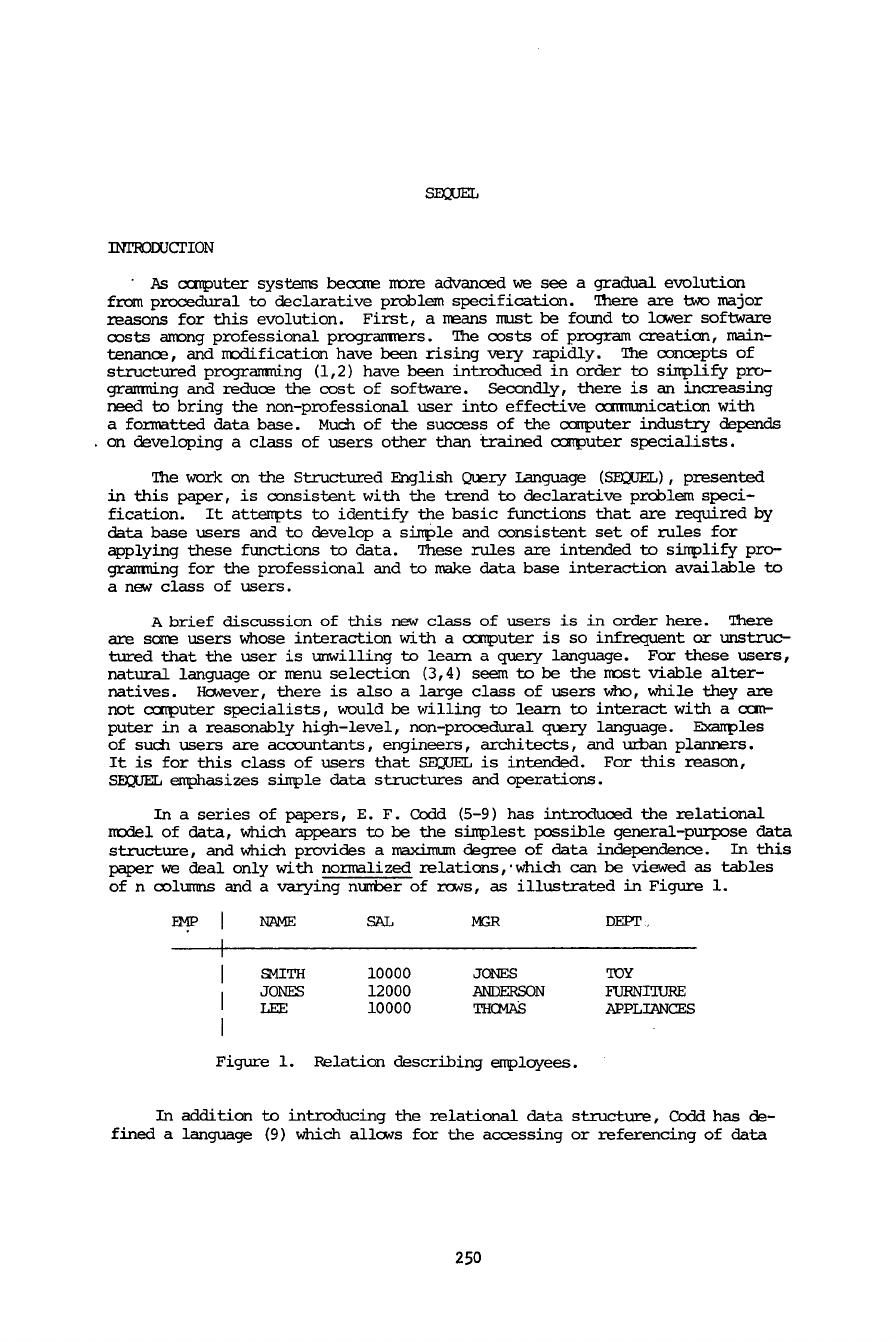
of n columns and a varying number of rows, as illustrated in Figure i.
~4P i NAME SAL MGR DEPT.
i
I ~4ITH i0000 JC~ES TOY
JONES 12000 ANDERSON FURNI~JRE
i LEE i0000 THCMAS APPLIANCES
i
Figure i.
Relation describing enployees.
In addition to introducing the relational data structure, Codd has de-
fined a language (9) which allows for the accessing or referencing of data
250
of 16
免费下载
【版权声明】本文为墨天轮用户原创内容,转载时必须标注文档的来源(墨天轮),文档链接,文档作者等基本信息,否则作者和墨天轮有权追究责任。如果您发现墨天轮中有涉嫌抄袭或者侵权的内容,欢迎发送邮件至:contact@modb.pro进行举报,并提供相关证据,一经查实,墨天轮将立刻删除相关内容。
下载排行榜

文档被以下合辑收录
评论