



PolarDB Serverless:A Cloud Native Database for Disaggregated Data Centers - Wei Cao.pdf
免费下载

PolarDB Ser verless: A Cloud Native Database for Disaggregated
Data Centers
Wei Cao
†,‡
, Yingqiang Zhang
‡
, Xinjun Yang
‡
, Feifei Li
‡
, Sheng Wang
‡
, Qingda Hu
‡
Xuntao Cheng
‡
, Zongzhi Chen
‡
, Zhenjun Liu
‡
, Jing Fang
‡
, Bo Wang
‡
, Yuhui Wang
‡
Haiqing Sun
‡
, Ze Yang
‡
, Zhushi Cheng
‡
, Sen Chen
‡
, Jian Wu
‡
, Wei Hu
‡
, Jianwei Zhao
‡
Yusong Gao
‡
, Songlu Cai
‡
, Yunyang Zhang
‡
, Jiawang Tong
‡
mingsong.cw@alibaba-inc.com
†
Zhejiang University and
‡
Alibaba Group
ABSTRACT
The trend in the DBMS market is to migrate to the cloud for elas-
ticity, high availability, and lower costs. The traditional, monolithic
database architecture is dicult to meet these requirements. With
the development of high-speed network and new memory technolo-
gies, disaggregated data center has become a reality: it decouples
various components from monolithic servers into separated re-
source pools (e.g., compute, memory, and storage) and connects
them through a high-speed network. The next generation cloud
native databases should be designed for disaggregated data centers.
In this paper, we describe the novel architecture of PolarDB
Serverless, which follows the disaggregation design paradigm: the
CPU resource on compute nodes is decoupled from remote mem-
ory pool and storage pool. Each resource pool grows or shrinks
independently, providing on-demand provisoning at multiple di-
mensions while improving reliability. We also design our system to
mitigate the inherent penalty brought by resource disaggregation,
and introduce optimizations such as optimistic locking and index
awared prefetching. Compared to the architecture that uses local
resources, PolarDB Serverless achieves better dynamic resource pro-
visioning capabilities and 5.3 times faster failure recovery speed,
while achieving comparable performance.
CCS CONCEPTS
• Information systems → Data management systems
;
• Net-
works → Cloud computing.
KEYWORDS
cloud database; disaggregated data center; shared remote memory;
shared storage
ACM Reference Format:
Wei Cao
†, ‡
, Yingqiang Zhang
‡
, Xinjun Yang
‡
, Feifei Li
‡
, Sheng Wang
‡
,
Qingda Hu
‡
, Xuntao Cheng
‡
, Zongzhi Chen
‡
, Zhenjun Liu
‡
, Jing Fang
‡
, Bo
Wang
‡
, Yuhui Wang
‡
, Haiqing Sun
‡
, Ze Yang
‡
, Zhushi Cheng
‡
, Sen Chen
‡
,
Jian Wu
‡
, Wei Hu
‡
, Jianwei Zhao
‡
, and Yusong Gao
‡
, Songlu Cai
‡
, Yunyang
Zhang
‡
, Jiawang Tong
‡
. 2021. PolarDB Serverless: A Cloud Native Database
Permission to make digital or hard copies of part or all of this work for personal or
classroom use is granted without fee provided that copies are not made or distributed
for prot or commercial advantage and that copies bear this notice and the full citation
on the rst page. Copyrights for third-party components of this work must be honored.
For all other uses, contact the owner/author(s).
SIGMOD ’21, June 20–25, 2021, Virtual Event, China
© 2021 Copyright held by the owner/author(s).
ACM ISBN 978-1-4503-8343-1/21/06.
https://doi.org/10.1145/3448016.3457560
for Disaggregated Data Centers. In Proceedings of the 2021 International
Conference on Management of Data (SIGMOD ’21), June 20–25, 2021, Virtual
Event, China. ACM, New York, NY, USA, 13 pages. https://doi.org/10.1145/
3448016.3457560
1 INTRODUCTION
As enterprises move their applications to the cloud, they are also
migrating their databases to the cloud. The driving force of this
trend is threefold. First, cloud vendors provide the “pay-as-you-go”
model that allows customers to avoid paying for over-provisioned
resources, resulting in signicant cost reduction. Second, marketing
activities such as Black Friday and Singles’ Day often demand
rapid but transient resource expansion from the database systems
during peak time, where cloud vendors can oer such elasticity
to customers. Third, cloud vendors are able to quickly upgrade
and evolve the database systems to maintain competitiveness and
repair defects in time while sustaining high availability. Customers
always expect that node failures, especially planned downtime and
software upgrades, will have less impact on their business.
Cloud vendors such as AWS [
43
], Azure [
2
], GCP and Alibaba [
9
]
provide relational database as a services (DBaaS). There are three
typical architectures for cloud databases: monolithic machine (Fig-
ure 1), virtual machine with remote disk (Figure 2(a)), and shared
storage (Figure 2(b)), and the last two can be referred as separation of
compute and storage. Though these architectures have been widely
used, they all suer from challenges caused by resource coupling.
Under the monolithic machine architecture, all resources (such
as CPU, memory and storage) are tightly coupled. The DBaaS plat-
form needs to solve bin-packing problems when assigning database
instances to machines. It is dicult to make dierent resources
allocated on a physical machine all have a high utilization rate,
which is prone to fragmentation. Moreover, it is dicult to meet
the demands of customers to adjust individual resources exibly
according to the load at runtime. Finally, a system with tightly
coupled resources has the problem of fate sharing, i.e., the failure
of one resource will cause the failure of other resources. Resources
cannot be recovered independently and transparently, which leads
to longer system recovery time.
With the separation of compute and storage architecture, DBaaS
can independently improve the resource utilization of the storage
pool. The shared storage subtype further reduces storage costs —
the primary and read replicas can attach and share the same storage.
Read replicas help to serve high volume read trac and ooad ana-
lytical queries from the primary. However, in all these architectures,
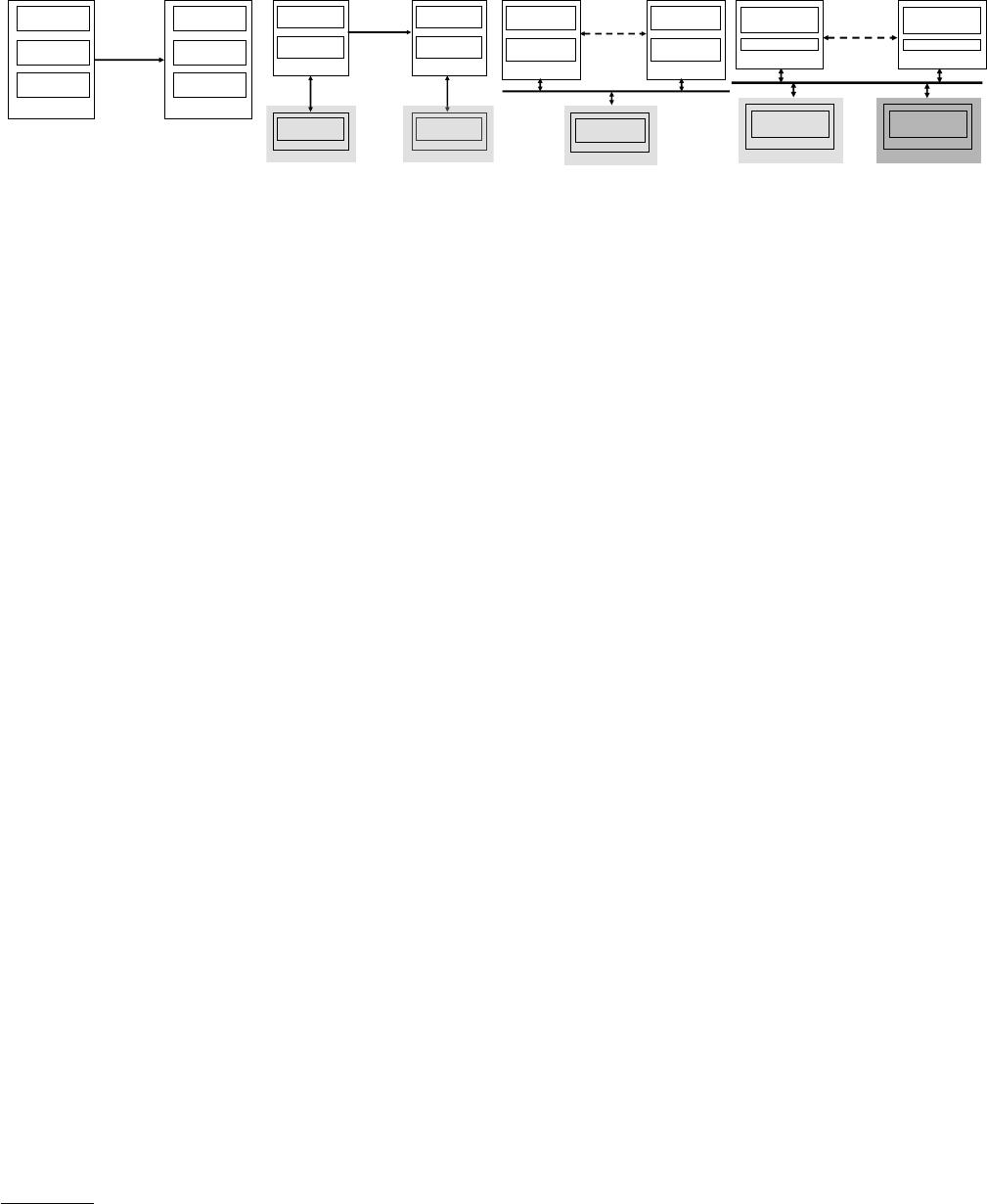
Replication
Monolithic Server
CPU
Memory
Storage
Monolithic Server
CPU
Memory
Storage
Figure 1: monolithic machine
Replication
Compute Node
CPU
Memory
Compute Node
CPU
Memory
Storage
Storage Node
Storage
Storage Node
Network
Storage Pool Storage Pool
(a) virtual machine with remote disk
Coordination
Compute Node
CPU
Memory
Compute Node
CPU
Memory
Storage
Storage Node
Storage Pool
Network
(b) shared storage
Figure 2: separation of compute and storage
Coordination
Compute Node
Local Memory
CPU
Storage
Storage Node
Storage Pool
Memory
Memory Node
Memory Pool
Compute Node
Local Memory
CPU
Network
Figure 3: disaggregation
problems like bin-packing of CPU and memory, lacking of exible
and scalable memory resources, remain unsolved. Furthermore,
each read replica keeps a redundant in-memory data copy, leading
to high memory costs.
In this paper, we propose a novel cloud database design par-
adigm of the disaggregation architecture (Figure 3). It goes one
step further than the shared storage architecture, to address the
aforementioned problems. The disaggregation architecture runs
in the disaggregated data centers (DDC), in which CPU, memory
and storage resources are no longer tightly coupled as in a mono-
lithic machine. Resources are located in dierent nodes connected
through high-speed network. As a result, each resource type im-
proves its utilization rate and expands its volume independently.
This also eliminates fate sharing, allowing each resource be re-
covered from failure and upgraded independently. Moreover, data
pages in the remote memory pool can be shared among multiple
database processes, analogous to the storage pool being shared
in shared storage architecture. Adding a read replica no longer in-
creases the cost of memory resources, except for consuming a small
piece of local memory.
A trend in recent years is that cloud-native database vendors are
launching serverless variants [
3
,
4
]. The main feature of serverless
databases is on-demand resource provisioning (such as auto-scaling
and auto-pause), which should be transparent and seamless without
interrupting customer workloads. Most cloud-native databases are
implemented based on the shared storage architecture, where CPU
and memory resources are coupled and must be scaled at the same
time. In addition, auto-pause has to release both resources, resulting
in long resumption time. We show that disaggregation architecture
can overcome these limitations.
PolarDB Serverless is a cloud-native database implementation
that follows the disaggregation architecture. Similar to major cloud-
native database products like Aurora, HyperScale, and PolarDB
1
,
it includes one primary (RW node) and multiple read replicas (RO
nodes) in the database node layer. With the disaggregation architec-
ture, it is possible to support multiple primaries (RW nodes), but
this is not within the scope of this paper.
The design of a multi-tenant scale-out memory pool is intro-
duced in PolarDB Serverless, including page allocation and life cycle
management. The rst challenge is to ensure that the system exe-
cutes transactions
correctly
after adding remote memory to the
system. For example, read after write should not miss any updates
even across nodes. We realize it using cache invalidation. When
1
PolarDB Serverless is developed on a fork of PolarDB’s codebase.
RW is splitting or merging a B+Tree index, other RO nodes should
not see an inconsistent B-tree structure in the middle. We protect
it with global page latches. When a RO node performs read-only
transactions, it must avoid reading anything written by uncommit-
ted transactions. We achieve it through the synchronization of read
views between database nodes.
The evolution of the disaggregation architecture could have a
negative impact on the database performance. It is because the
data is likely to be accessed from the remote, which introduces
signicant network latency. The second challenge is to execute
transactions
eciently
. We exploit RDMA optimization exten-
sively, especially one-sided RDMA verbs, including using RDMA
CAS [
42
] to optimize the acquisition of global latches. In order
to improve concurrency, both RW and RO use optimistic locking
techniques to avoid unnecessary global latches. On the storage side,
page materialization ooading allows dirty pages to be evicted
from remote memory without ushing them to the storage, while
index-aware prefetching improve query performance.
The disaggregation architecture complicates the system and
hence increases the variety and probability of system failures. As a
cloud database service, the third challenge is to build a
reliable
sys-
tem, we summarize our strategies to handle single-node crashes of
dierent node types which guarantee that there is no single-point
failure in the system. Because the states in memory and storage are
decoupled from the database node, crash recovery time of the RW
node becomes 5.3 times faster than that in the monolithic machine
architecture.
We summarize our main contributions as follows:
•
We propose the disaggregation architecture and present the
design of PolarDB Serverless, which is the rst cloud database
implementation following the architecture. We demonstrate
that this architecture provides new opportunities for the
design of new cloud-native and serverless databases.
•
We provide design details and optimizations that make the
system work correctly and eciently, overcoming the perfor-
mance drawbacks brought by the disaggregation architecture.
•
We describe our fault tolerance strategies, including the
handling of single-point failures and cluster failures.
The remainder of this paper is organized as follows. In Section 2,
we introduce backgrounds of PolarDB and DDC. Section 3 explains
the design of PolarDB Serverless. Section 4 presents our performance
optimizations. Section 5 discusses our fault tolerance and recov-
ery strategies. Section 6 gives the experimental results. Section 7
reviews the related work, and Section 8 concludes the paper.
of 13
免费下载
【版权声明】本文为墨天轮用户原创内容,转载时必须标注文档的来源(墨天轮),文档链接,文档作者等基本信息,否则作者和墨天轮有权追究责任。如果您发现墨天轮中有涉嫌抄袭或者侵权的内容,欢迎发送邮件至:contact@modb.pro进行举报,并提供相关证据,一经查实,墨天轮将立刻删除相关内容。
下载排行榜

文档被以下合辑收录
评论