



Serverless Foundations for Elastic Database Systems - Johann Schleier-Smith.pdf
免费下载
Ser verless Foundations for Elastic Database Systems
Johann Schleier-Smith
UC Berkeley
jssmith@berkeley.edu
In distributed databases, elasticity is a property that describes how
quickly a system responds to changes in the workload, to scaling
or shifting demand for resources [
4
]. Such resource elasticity is
one of cloud computing’s key promised benets, and a number
of transactional, big data, and information retrieval systems have
demonstrated its value, typically by scaling by multiples of 2-3x on
timescales of minutes to hours.
Recent advances in serverless computing, the implementation
of the pioneering AWS Lambda Function as a Service (FaaS) plat-
form [
1
] preeminent among them, have established expectations
of elasticity that are dicult for databases to match. For example,
PyWren scales up from zero to hundreds of processors in seconds,
and to thousands of processors minutes, drawing from multi-tenant
resource pools maintained in the public cloud [
3
]. With equal ease,
it scales down to zero resource consumption. When used in combi-
nation with a serverless FaaS system, an elastic database can easily
become a bottleneck. We suggest that the design principles behind
“stateless” FaaS platforms point the way to system abstractions
that oer transformative improvements in the elastic scalability of
state-intensive applications.
FaaS was designed to oer users elastic scalability and complete
relief from server operations. Users congure functions, bits of
application code, that run in response to events, bits of data on
queues. Functions run on compute instances provisioned by the
cloud operator, and since function state is ephemeral and function
execution is time-bounded, the operator has many opportunities to
reclaim resources, to create more of them, or to invoke one of the
most time-tested troubleshooting procedures, the instance restart.
FaaS is often described as stateless but in fact most implementa-
tions recycle compute instances over many function invocations,
with instance state persisting between them. Thus it is natural to ask
whether one can build a database system that uses FaaS functions as
compute and FaaS ephemeral state as memory, memory for keeping
the database buer pool among other things. The trouble is that
FaaS lacks a way of addressing functions; invocations can go to any
available instance. In our proposal, we extend FaaS by partitioning
the function execution instances across an invocation key space. Put
simply, invoke(func,args) becomes invoke(func,args,pkey).
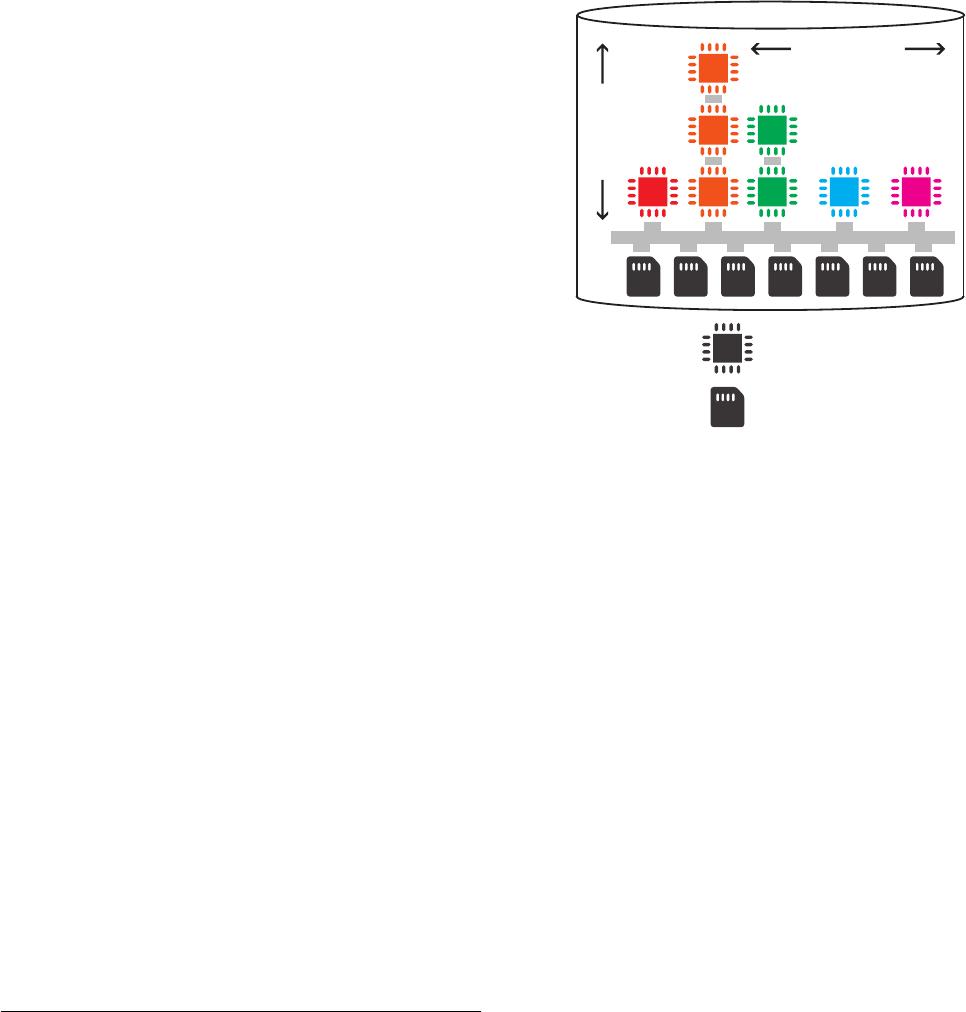
As illustrated in Figure 1, the serverless runtime establishes a
partitioning on the space of keys, then routes function invocations
for each key to the same instance consistently. Additional cong-
uration allows users to specify whether partitions may be served
by only one instance, or by many, e.g., to support replicas for read
scalability. If a partition becomes overloaded, the partitioned FaaS
(pFaaS) runtime terminates the associated function instance, splits
its key set, and creates two or more new ones in its place. Merging
This article is published under a Creative Commons Attribution License
(http://creativecommons.org/licenses/by/3.0/), which permits distribution and repro-
duction in any medium as well as allowing derivative works, provided that you attribute
the original work to the author(s) and CIDR 2019.
λ λ λ λ λ
λλ
λ
replication
Scales with compute demand
Isolated and ephemeral state
λ
Scales with storage demand
Shared and durable state
pFaaS Layer
Storage Layer
partitioning
Figure 1: An elastic database with a shared disk architecture
built from partitioned FaaS (pFaaS) serverless compute and
serverless storage (e.g., AWS S3 or EFS). FaaS need not be
truly stateless, and we make its cached state addressable and
accessible through keyed function invocations.
key sets for scale-in works similarly. Virtual actor systems [
2
] also
build working state from a backing store as needed, so pFaaS could
oer a practical route to Actors as a Service (AaaS).
Several challenges remain before we see databases and other
stateful applications built atop pFaaS. Previous scalable databases
have used a shared-nothing approach, but achieving high levels of
elasticity requires scaling compute, cache, and storage separately.
Existing clustered database techniques may also struggle with rapid
changes in node count, and with node quiescence between function
invocations. Transactional workloads will be more challenging to
implement than big data or analytics on account of their demanding
coordination and latency requirements. Still, we believe that pFaaS
promises to provide a foundation for a broad variety of stateful
applications, allowing them to achieve serverless elastic scaling
similar to that today enjoyed by stateless FaaS applications.
REFERENCES
[1] [n. d.]. AWS Lambda - Serverless Compute. https://aws.amazon.com/lambda/.
[2]
Philip A Bernstein et al
.
2014. Orleans: Distributed virtual actors for programma-
bility and scalability. MSR-TR-2014–41 (2014).
[3]
Eric Jonas et al
.
2017. Occupy the cloud: Distributed computing for the 99%. In
Proceedings of the 2017 Symposium on Cloud Computing. ACM, 445–451.
[4]
Rebecca Yale Taft. 2017. Elastic database systems. Ph.D. Dissertation. Massachusetts
Institute of Technology.
of 1
免费下载
【版权声明】本文为墨天轮用户原创内容,转载时必须标注文档的来源(墨天轮),文档链接,文档作者等基本信息,否则作者和墨天轮有权追究责任。如果您发现墨天轮中有涉嫌抄袭或者侵权的内容,欢迎发送邮件至:contact@modb.pro进行举报,并提供相关证据,一经查实,墨天轮将立刻删除相关内容。
下载排行榜

文档被以下合辑收录
评论