



Approximating Median Absolute Deviation With Bounded Error.pdf
免费下载
Approximating Median Absolute Deviation with Bounded Error
Zhiwei Chen, Shaoxu Song
∗
Tsinghua University
{czw18,sxsong}@tsinghua.edu.cn
Ziheng Wei, Jingyun Fang, Jiang Long
Data Governance Innovation Lab, HUAWEI Cloud BU
{ziheng.wei,fangjingyun,longjiang4}@huawei.com
ABSTRACT
The median absolute deviation (MAD) is a statistic measuring the
variability of a set of quantitative elements. It is known to be more
robust to outliers than the standard deviation (SD), and thereby
widely used in outlier detection. Computing the exact MAD how-
ever is costly, e.g., by calling an algorithm of nding median twice,
with space cost
𝑂 (𝑛)
over
𝑛
elements in a set. In this paper, we
propose the rst fully mergeable approximate MAD algorithm, OP-
MAD, with one-pass scan of the data. Remarkably, by calling the
proposed algorithm at most twice, namely TP-MAD, it guarantees
to return an
(𝜖,
1
)
-accurate MAD, i.e., the error relative to the ex-
act MAD is bounded by the desired
𝜖
or 1. The space complexity
is reduced to
𝑂 (𝑚)
while the time complexity is
𝑂 (𝑛 + 𝑚 log𝑚)
,
where
𝑚
is the size of the sketch used to compress data, related
to the desired error bound
𝜖
. To get a more accurate MAD, i.e.,
with smaller
𝜖
, the sketch size
𝑚
will be larger, a trade-o between
eectiveness and eciency. In practice, we often have the sketch
size
𝑚 ≪ 𝑛
, leading to constant space cost
𝑂 (
1
)
and linear time
cost
𝑂 (𝑛)
. The extensive experiments over various datasets demon-
strate the superiority of our solution, e.g., 160000
×
less memory and
18
×
faster than the aforesaid exact method in datasets pareto and
norm. Finally, we further implement and evaluate the parallelizable
TP-MAD in Apache Spark, and the fully mergeable OP-MAD in
Structured Streaming.
PVLDB Reference Format:
Zhiwei Chen, Shaoxu Song and Ziheng Wei, Jingyun Fang, Jiang Long.
Approximating Median Absolute Deviation with Bounded Error. PVLDB,
14(11): 2114-2126, 2021.
doi:10.14778/3476249.3476266
1 INTRODUCTION
Like the standard deviation (SD), the median absolute deviation
(MAD) measures the variability of a quantitative dataset. It is de-
ned as the median of the absolute deviations from the dataset’s
median. For instance, for a dataset
D = {
1
,
3
,
3
,
5
,
5
,
6
,
9
,
9
,
10
}
, we
have
MEDIAN =
5. The absolute deviations from the MEDIAN 5
are
{
4
,
2
,
2
,
0
,
0
,
1
,
4
,
4
,
5
}
. The MAD of
D
is thus 2, the MEDIAN of
the absolute deviations.
MAD is practically important for various applications, since it is
a statistic more robust to outliers and long tails than the standard
deviation (SD). For example, Cao et al. [
9
] use Cauchy distributions
[
16
] with MEDIAN and MAD of historical query latency data as
∗
Corresponding author
This work is licensed under the Creative Commons BY-NC-ND 4.0 International
License. Visit https://creativecommons.org/licenses/by-nc-nd/4.0/ to view a copy of
this license. For any use beyond those covered by this license, obtain permission by
emailing info@vldb.org. Copyright is held by the owner/author(s). Publication rights
licensed to the VLDB Endowment.
Proceedings of the VLDB Endowment, Vol. 14, No. 11 ISSN 2150-8097.
doi:10.14778/3476249.3476266
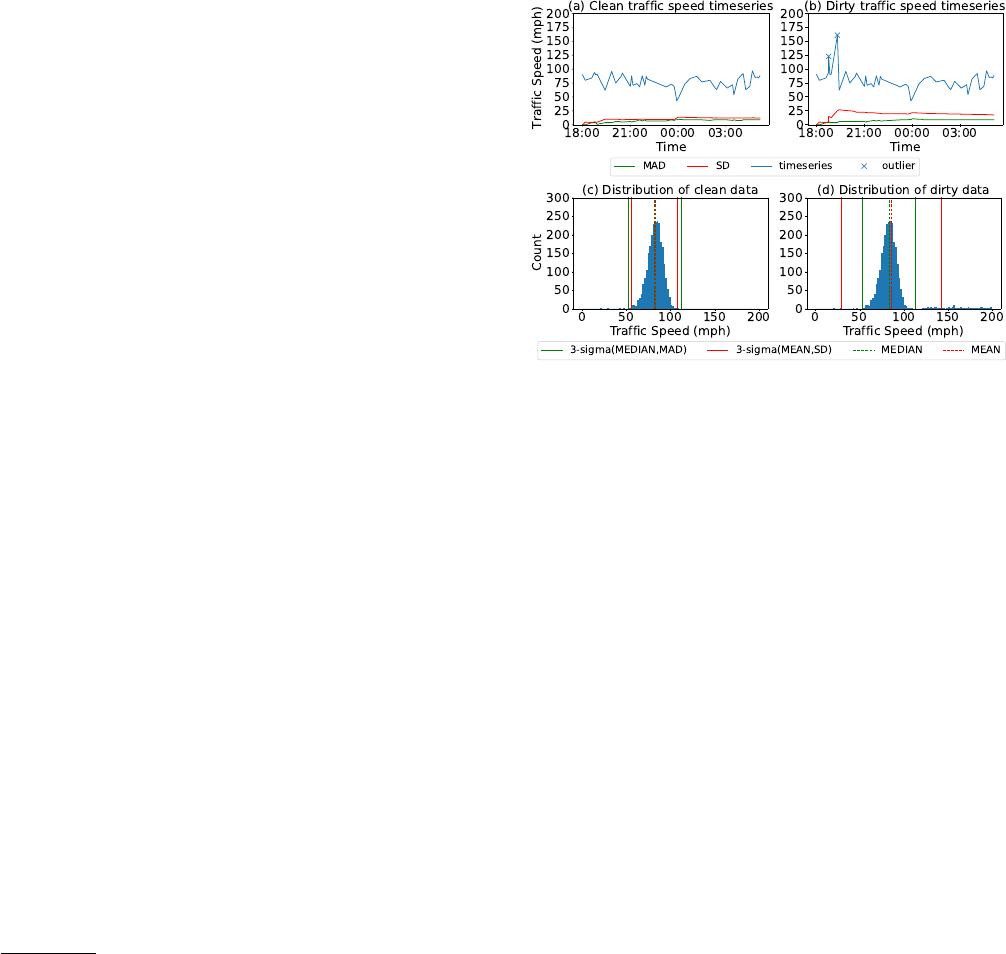
Figure 1: Robustness of median absolute deviation (MAD) to
outliers. The outliers (introduced by errors) in the time se-
ries in (b) signicantly distract the SD statistics, while the
MAD statistics are not aected by such outliers, close to
those in the clean data in (a). When using the 3-sigma rule
for outlier detection, the ranges determined by MEAN and
SD over the dirty data in (d) deviate largely from the truths
in (c), compared to the robust ones by MEDIAN and MAD.
parameters to detect rare or abnormal query events in a database.
They also apply this method to detect anomalous machines, proxy
anomaly and network anomaly. Malinowski et al. [
19
] use MAD
as a parameter to determine the number of principal factors for
a data matrix in outlier detection. Wu et al. [
25
] and Adekeye
et al. [
4
] calculate the limits of control charts with MAD as the
scale parameter for statistical process control. Shawiesh et al. [
3
]
and Athari et al. [
7
] use MAD as the estimation of variability to
determine condence intervals for locations of skewed distributions.
Moreover, MAD is applied to image preprocessing, e.g., estimating
noises [
17
] in gray-scale and colored images using MAD to select
the threshold. As a popular method to preprocess high-throughput
gene expression microarray data, the hit selection method uses
MAD as the parameter of the z score (a hit selection threshold) to
improve the overall selection rates [
10
]. Software engineers use
MAD as the threshold to classify the defective and clean classes of
datasets from monitoring systems, as an unsupervised method for
software defect prediction [20].
Example 1.1. Figure 1 illustrates the superiority of MAD in out-
lier detection compared to SD. The time series in Figure 1(a) presents
(a segment of) the trac speeds in the Twin Cities Metro area in
Minnesota in NAB [
6
]. Outliers, e.g., introduced by data errors,
2114
signicantly distract the SD statistics but not MAD, as shown in
Figure 1(b). The K-sigma rule [
18
] with
𝐾 =
3 detects elements
outside the ranges of solid lines in the distribution as outliers, in
Figure 1(d). Such ranges of solid lines can either be determined
by MEAN and SD (in red), or by MEDIAN and MAD (in green).
As shown in Figure 1(d), the ranges determined by MEDIAN and
MAD are more robust and closer to those over the clean data in
Figure 1(c). The outlier detection by MEDIAN and MAD is thus
more accurate [
6
]. For instance, the outlier at time 19:00 with value
125, outside the range of green lines, will be detected by MEDIAN
and MAD, but not by MEAN and SD in red lines. ■
Unfortunately, computing the exact MAD over a set of
𝑛
ele-
ments is costly, since it is dened on the median. Unlike SD, which
can be eciently calculated in constant space, the MAD computa-
tion needs to nd the median of the absolute deviations from the
dataset’s median, i.e., nding median twice. Such an exact MAD
algorithm has the space cost
𝑂 (𝑛)
and its time cost depends heavily
on data size, which is not aordable for large scale data. Therefore,
approximate MAD is often considered.
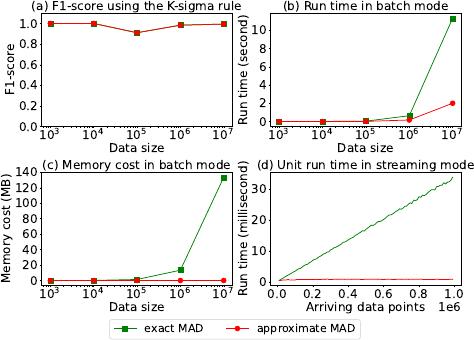
Example 1.2. To demonstrate the suciency and superiority of
approximate MAD compared with exact MAD, we run the outlier
detection application in Example 1.1 over a larger data size with up
to 10
7
elements. Figure 2 compares the results of approximate MAD
(by Algorithm 2 in Section 3.2) and exact MAD (by Algorithm 3 in
the full version technical report [1]).
(1) Comparable eectiveness. Figure 2(a) with
𝐾 =
7 shows that
the F1-score of outlier detection with approximate MAD is almost
the same as that using exact MAD. That is, it is sucient to use
approximate MAD in this application.
(2) Lower time cost. Figure 2(b) presents the corresponding time
costs of computing approximate MAD and exact MAD in a batch
mode. While their eectiveness of outlier detection is almost the
same as shown in Figure 2(a), the time cost of computing approxi-
mate MAD is only about 1/5 of exact MAD over 10
7
elements.
(3) Lower space cost. Not only is the time cost saved, as illus-
trated in Figure 2(c), the corresponding space cost of computing
approximate MAD is signicantly lower, almost constant. Given
the almost the same eectiveness but much more ecient time and
space costs, it is sucient to use approximate MAD in practice and
the costly exact MAD is not necessary.
(4) Streaming computation. As presented in Section 3.2, the algo-
rithm for computing approximate MAD can be naturally adapted to
incremental computation for streaming data. In contrast, the exact
MAD needs to scan the entire data, since the set of absolute devia-
tions needs to be reconstructed given a changed median. Therefore,
as illustrated in Figure 2(d), the time cost of computing approximate
MAD is constant in the streaming mode, while that of exact MAD
increases heavily. It demonstrates again the necessity of studying
approximate MAD.
Similarly, the superiority of approximate MAD compared to
exact MAD is also observed in another application of Shewhart
control charts in Figure 11 in Section 5.4. ■
To nd approximate MAD, a natural idea is to nd the approxi-
mate median of the absolute deviations from the dataset’s approxi-
mate median, by calling twice the existing methods of approximat-
ing median [
15
,
21
]. With two median approximations, the error
Figure 2: Superiority of approximate MAD over exact MAD.
(a) Approximate MAD and exact MAD show almost the same
F1-score of outlier detection under various data sizes. The
time costs in (b) and space costs in (c) of computing approxi-
mate MAD are signicantly lower than those of exact MAD,
in a batch mode. (d) The approximate MAD can also be in-
crementally computed in a streaming mode.
introduced by such a simple approximation relative to the exact
MAD is theoretically unknown and practically ineective (see a
detailed discussion in Section 6.1).
To the best of our knowledge, this is the rst study on approxi-
mating MAD with bounded error. Our contributions include
•
an approximate MAD algorithm with explicit error bound,
which is fully mergeable and needs only 1-pass scan of data;
•
a solution by calling the proposed algorithm twice, which is
parallelizable and guarantees to nd an (
𝜖
,1)-accurate MAD;
•
a pruning strategy to skip buckets in the sketch of the second
scan, signicantly reducing the space cost;
•
a distributed implementation in Apache Spark and a stream-
ing implementation in Structured Streaming, both outper-
forming the simple MAD approximation using the built-in
approxQuantile for the approximate median.
Following is the structure of our paper. In Section 2, we rst
give the formal denition of MAD and the measure of approxi-
mate MAD in accuracy. In Section 3, we present the approximate
MAD algorithm and analyze its error bound as well as complex-
ity. In Section 4, we illustrate the solution for approximate MAD
with desired error guarantees, and the bucket pruning strategy.
In Section 5, we compare our solution with several baselines in
experiments, showing the superiority of our proposal in accuracy
and resource occupation. Finally, in Section 6 and Section 7, we
discuss the related work and the conclusion.
Table 1 lists the frequently used notations.
2 FRAMEWORK
In this section, we review the MAD problem together with an exact
computation algorithm, and introduce approximate MAD as well
as the framework of our approximation solution.
2115
of 13
免费下载
【版权声明】本文为墨天轮用户原创内容,转载时必须标注文档的来源(墨天轮),文档链接,文档作者等基本信息,否则作者和墨天轮有权追究责任。如果您发现墨天轮中有涉嫌抄袭或者侵权的内容,欢迎发送邮件至:contact@modb.pro进行举报,并提供相关证据,一经查实,墨天轮将立刻删除相关内容。
下载排行榜

文档被以下合辑收录
评论