

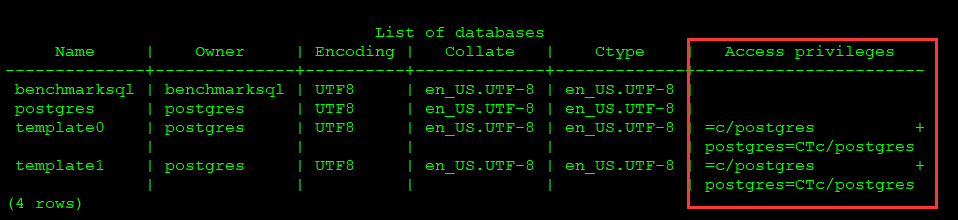

Table 5.1. ACL Privilege Abbreviations
| Privilege | Abbreviation | Applicable Object Types |
|---|---|---|
SELECT | r (“read”) | LARGE OBJECT, SEQUENCE, TABLE (and table-like objects), table column |
INSERT | a (“append”) | TABLE, table column |
UPDATE | w (“write”) | LARGE OBJECT, SEQUENCE, TABLE, table column |
DELETE | d | TABLE |
TRUNCATE | D | TABLE |
REFERENCES | x | TABLE, table column |
TRIGGER | t | TABLE |
CREATE | C | DATABASE, SCHEMA, TABLESPACE |
CONNECT | c | DATABASE |
TEMPORARY | T | DATABASE |
EXECUTE | X | FUNCTION, PROCEDURE |
USAGE | U | DOMAIN, FOREIGN DATA WRAPPER, FOREIGN SERVER, LANGUAGE, SCHEMA, SEQUENCE, TYPE |
Table 5.2 summarizes the privileges available for each type of SQL object, using the abbreviations shown above. It also shows the psql command that can be used to examine privilege settings for each object type.
Table 5.2. Summary of Access Privileges
| Object Type | All Privileges | Default PUBLIC Privileges | psql Command |
|---|---|---|---|
DATABASE | CTc | Tc | \l |
DOMAIN | U | U | \dD+ |
FUNCTION or PROCEDURE | X | X | \df+ |
FOREIGN DATA WRAPPER | U | none | \dew+ |
FOREIGN SERVER | U | none | \des+ |
LANGUAGE | U | U | \dL+ |
LARGE OBJECT | rw | none | |
SCHEMA | UC | none | \dn+ |
SEQUENCE | rwU | none | \dp |
TABLE (and table-like objects) | arwdDxt | none | \dp |
| Table column | arwx | none | \dp |
TABLESPACE | C | none | \db+ |
TYPE | U | U | \dT+ |
The privileges that have been granted for a particular object are displayed as a list of aclitem entries, where each aclitem describes the permissions of one grantee that have been granted by a particular grantor. For example, calvin=r*w/hobbes specifies that the role calvin has the privilege SELECT (r) with grant option (*) as well as the non-grantable privilege UPDATE (w), both granted by the role hobbes. If calvin also has some privileges on the same object granted by a different grantor, those would appear as a separate aclitem entry. An empty grantee field in an aclitem stands for PUBLIC.
 评论
评论 有用 0
有用 0 墨值悬赏
墨值悬赏